

A student project has discovered superconductivity in polycrystalline iron-nickel-zirconide.
Researchers from Tokyo Metropolitan University have identified a groundbreaking new superconducting material. By combining iron, nickel, and zirconium in specific ratios, they synthesized a novel transition metal zirconide, with varying proportions of iron and nickel.
While pure iron zirconide and nickel zirconide do not exhibit superconductivity, the new mixtures demonstrate superconducting properties, forming a “dome-shaped” phase diagram characteristic of unconventional superconductors. This finding represents a significant step forward in the search for high-temperature superconducting materials that could have widespread applications.
Superconductors are already integral to advanced technologies, such as superconducting magnets in medical imaging devices, maglev trains, and power transmission cables. However, current superconductors require cooling to extremely low temperatures, typically around 4 Kelvin, which limits their practicality. Researchers are focused on discovering materials that achieve zero electrical resistance at higher temperatures, especially near the critical threshold of 77 Kelvin, where liquid nitrogen can replace liquid helium as a coolant—making the technology more accessible and cost-effective.
Unveiling Unconventional Superconductors
The good news is that promising candidates have begun to appear, like iron-based superconductors discovered in 2008. It is becoming increasingly clear that high-temperature superconductivity might follow a different mechanism from those of “conventional superconductors” that follow well-established theoretical frameworks, notably the BCS (Bardeen-Cooper-Schrieffer) theory. In particular, materials with magnetic elements, or those that exhibit “magnetic ordering,” have begun to emerge as being important for the emergence of “unconventional superconductivity.”
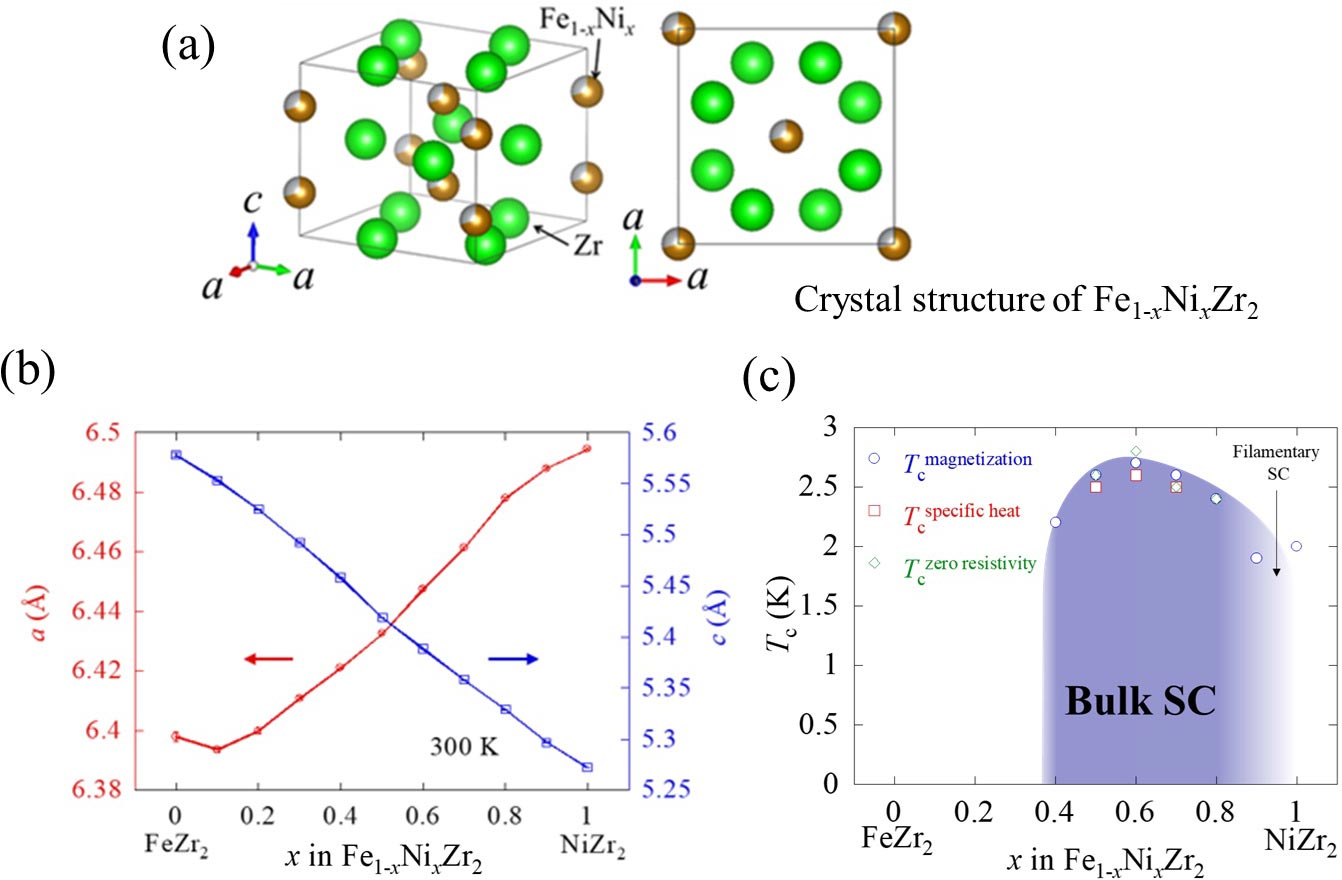
Now, a team of researchers led by Associate Professor Yoshikazu Mizuguchi from Tokyo Metropolitan University has conceived a new superconducting material containing a magnetic element. For the first time, they showed that a polycrystalline alloy of iron, nickel, and zirconium shows superconducting properties.
Curiously, both iron zirconide and nickel zirconide are not superconducting in crystalline form. In experiments that began as an undergraduate student project, the team combined iron, nickel, and zirconium in different ratios using a method known as arc melting, confirming that the resulting alloy had the same crystal structure as tetragonal transition-metal zirconides, a family of promising superconducting materials.
The lattice constants, or the lengths of repeating cells, were also found to change smoothly with the ratio of iron to nickel. Crucially, they found a region of compositions where the superconducting transition temperature rose, then fell again. This “dome-like” form is a promising hallmark of unconventional superconductivity.
Magnetic Behavior and Future Potential
Further experiments confirmed that the magnetization of nickel zirconide exhibits a magnetic-transition-like anomaly, suggesting a close relationship between their findings and the unconventional superconductivity arising from the magnetic order suggested in other materials.
They hope that their new platform for studying unconventional superconductivity might inspire new inroads into our understanding of its mechanism, as well as in the practical design of cutting-edge materials for the next generation of superconducting devices.
Reference: “Superconducting properties and electronic structure of CuAl2-type transition-metal zirconide Fe1-xNixZr2” by Ryunosuke Shimada, Yuto Watanabe, Lorenzo Tortora, Giovanni Tomassucci, Muammer Yasin Hacisalihoglu, Hiroto Arima, Aichi Yamashita, Akira Miura, Chikako Moriyoshi, Naurang L. Saini and Yoshikazu Mizuguchi, 7 November 2024, Journal of Alloys and Compounds.
DOI: 10.1016/j.jallcom.2024.177442
This work was supported by JSPS-KAKENHI Grant Number 23KK0088, a TMU Research Project for an Emergent Future Society, and a Tokyo Government-Advanced Research Grant (H31–1).
Never miss a breakthrough: Join the SciTechDaily newsletter.
Follow us on Google and Google News.
1 Comment
Rewriting the Rules: Scientists Discover New Superconductor With “Unconventional” Properties. This “dome-like” form is a promising hallmark of unconventional superconductivity.
GOOD!
Ask the scientists:
1. Are the rules you follow scientific?
2. What is the difference between science and pseudoscience?
3. What is the spacetime background of superconductivity?
4. Can space be a fluid with so many floating and moving objects in space?
5. If space is a fluid, what physical characteristics should it have?
Scientific research guided by correct theories can enable researchers to think more.
According to the Topological Vortex Theory (TVT), spins create everything, spins shape the world. There are substantial distinctions between Topological Vortex Theory (TVT) and traditional physical theories. Grounded in the inviscid and absolutely incompressible spaces, TVT introduces the concept of topological phase transitions and employs topological principles to elucidate the formation and evolution of matter in the universe, as well as the impact of interactions between topological vortices and anti-vortices on spacetime dynamics and thermodynamics.
Within TVT, low-dimensional spacetime matter serves as the foundation for high-dimensional spacetime matter, and the hierarchical structure of matter and its interaction mechanisms challenge conventional macroscopic and microscopic interpretations. The conflict between Quantum Physics and Classical Physics can be attributed to their differing focuses: Quantum Physics emphasizes low-dimensional spacetime matter, whereas Classical Physics centers on high-dimensional spacetime matter.
Subatomic particles in the quantum world often defy the familiar rules of the physical world. The fact repeatedly suggests that the familiar rules of the physical world are pseudoscience. In the familiar rules of the physical world, two sets of cobalt-60 can form the mirror image of each other by rotating in opposite directions, and can receive heavy rewards.
Please witness the grand performance of physics today. https://scitechdaily.com/microscope-spacecrafts-most-precise-test-of-key-component-of-the-theory-of-general-relativity/#comment-854286.
If the researchers are truly interested in science, please read: The Application of Inviscid and Absolutely Incompressible Spaces in Engineering Simulation (https://scitechdaily.com/microscope-spacecrafts-most-precise-test-of-key-component-of-the-theory-of-general-relativity/#comment-870077).