
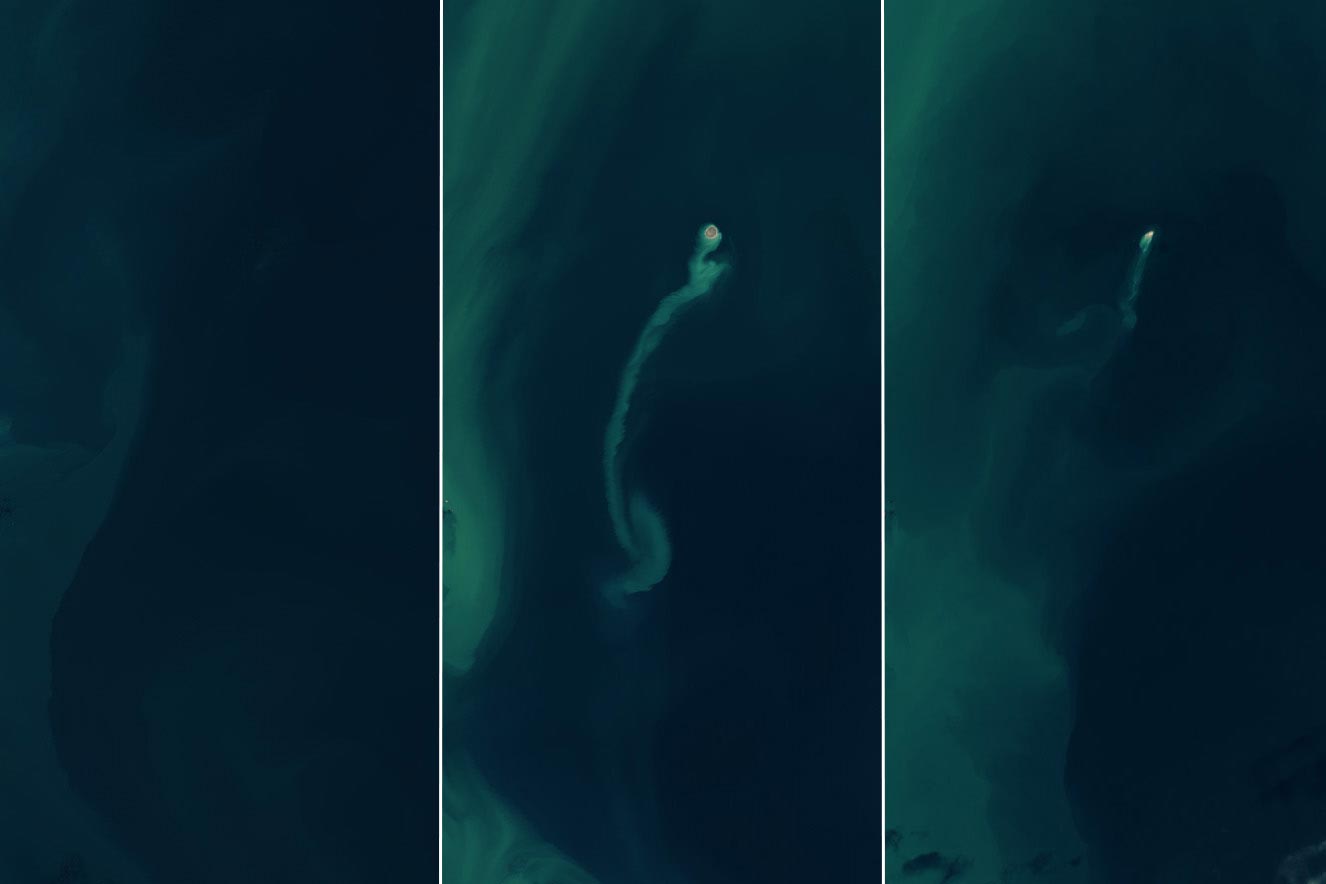
A mysterious island appeared in the Caspian Sea in 2023 due to a mud volcano eruption and vanished by the following year, fascinating scientists with its transient nature.
Satellite images tracked its fleeting existence, revealing insights into the unpredictable world of mud volcanoes, which are not only a curiosity on Earth but potentially mimic geological features on Mars.
Ephemeral Island Formation
In early 2023, a mud volcano eruption in the Caspian Sea gave rise to a temporary island. By late 2024, the island had nearly disappeared, eroding back into the sea like a fleeting mirage. This phenomenon, caused by the Kumani Bank mud volcano—also known as Chigil-Deniz—has occurred multiple times since the volcano’s first recorded eruption in 1861. Located about 25 kilometers (15 miles) off Azerbaijan’s eastern coast, Kumani Bank is known for creating these short-lived islands during its powerful eruptions.
Satellite imagery from the Operational Land Imager (OLI) on Landsat 8 and OLI-2 on Landsat 9 documented the island’s dramatic appearance and gradual shrinking. In November 2022, satellite images showed the volcano’s crest still submerged beneath the sea. By February 14, 2023, the island had emerged, with a visible sediment plume trailing away from it. Further satellite observations indicated the island appeared sometime between January 30 and February 4, measuring roughly 400 meters (1,300 feet) across, according to geologist Mark Tingay of the University of Adelaide. By the end of 2024, only a small remnant of the island remained visible above the water.
Historical Context and Volcanic Activity
Kumani Bank’s previous eight recorded eruptions occurred in bursts lasting less than two days and produced islands of different sizes and longevities. A May 1861 event resulted in an island just 87 meters (285 feet) across and 3.5 meters (11.5 feet) above the water. This one eroded away by early 1862. The strongest eruption, in 1950, produced an island 700 meters (2,300 feet) across and 6 meters (20 feet) high.
Geological Mysteries and Martian Analogs
Mud volcanoes are “weird and wonderful features that remain largely understudied and little understood,” said Tingay in a seminar for the Geological Society of Australia. Ranging in size from a couple of meters to several kilometers across, most are found in areas with active tectonics or high sedimentation rates. These are places where subsurface pressure can build and force a mix of fluids, gases, and sediments to the surface. And these features may not be unique to this planet; scientists think that some muddy mounds in the northern lowlands of Mars may have formed when gas- and liquid-rich sediments spewed out to the surface.

Hazardous Eruptions and Environmental Impact
On Earth, Azerbaijan is unusual for its high concentration of mud volcanoes. Geologists have tallied more than 300 in eastern Azerbaijan and offshore in the Caspian Sea, with most of those occurring on land. The region falls within a convergence zone where the Arabian and Eurasian tectonic plates are colliding.
Mud volcano eruptions can be hazardous, with the potential to expel large amounts of material—and even flames—over a short period of time. Azerbaijan’s mud volcanoes are linked to the South Caspian Basin’s vast hydrocarbon system and are known to emit flammable gases such as methane along with the characteristic muddy slurries. It is uncertain if the 2023 Kumani Bank eruption was fiery, but past eruptions of this and other nearby mud volcanoes have sent towers of flame hundreds of meters into the air.
NASA Earth Observatory images by Wanmei Liang, using Landsat data from the U.S. Geological Survey.
Never miss a breakthrough: Join the SciTechDaily newsletter.
Follow us on Google and Google News.
1 Comment
Wonder what ancient peoples of the region though of these phenomena. Very interesting