
Global satellite data show that afforestation boosts low-level cloud cover in most regions, cooling the climate beyond carbon capture.
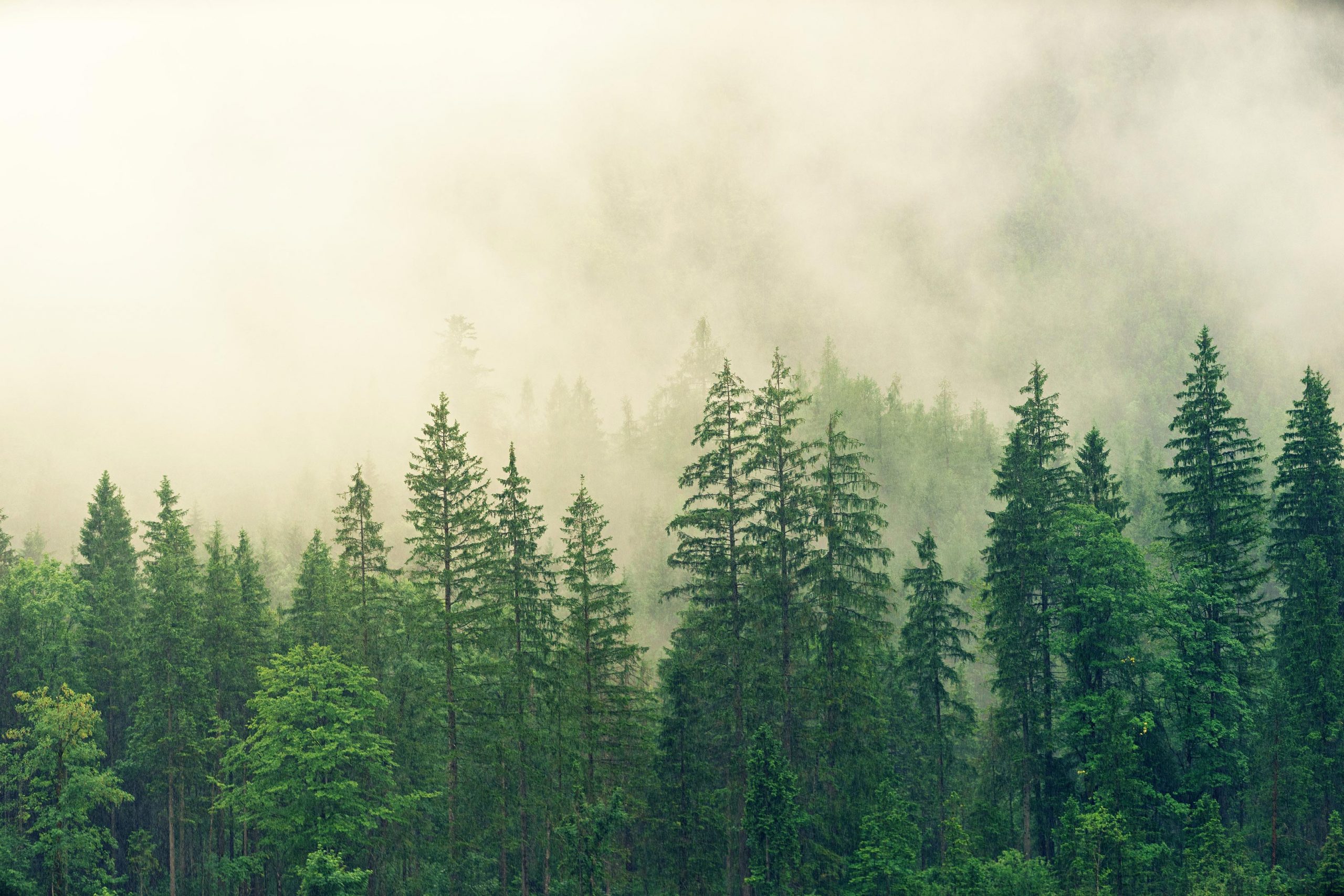
Forests are not only key to moderating our climate by sequestering atmospheric carbon, but they also create a cooling effect by increasing low-level clouds. A first global assessment using satellite observations has shown that for two-thirds of the world, afforestation increases low-level cloud cover, with the effect being strongest over evergreen needleleaf forest.
Because trees sequester carbon dioxide from the atmosphere and convert it into biomass, forests are widely championed for their role in mitigating climate change. What has been less clear, however, is how forests affect the climate in other ways such as their role in the water cycle and surface energy balance.
The paper, published recently in Nature Communications, uses global data records of cloud and land-fractional cover produced by ESA’s Climate Change Initiative to examine the effect of the transition of vegetation cover into deciduous and evergreen forest.
“Earth observations are increasingly showing that trees and forests are impacting climate by affecting biophysical surface properties,” says one of the co-authors of the study, Alessandro Cescatti.
Seasonal and Regional Patterns in Cloud Increases
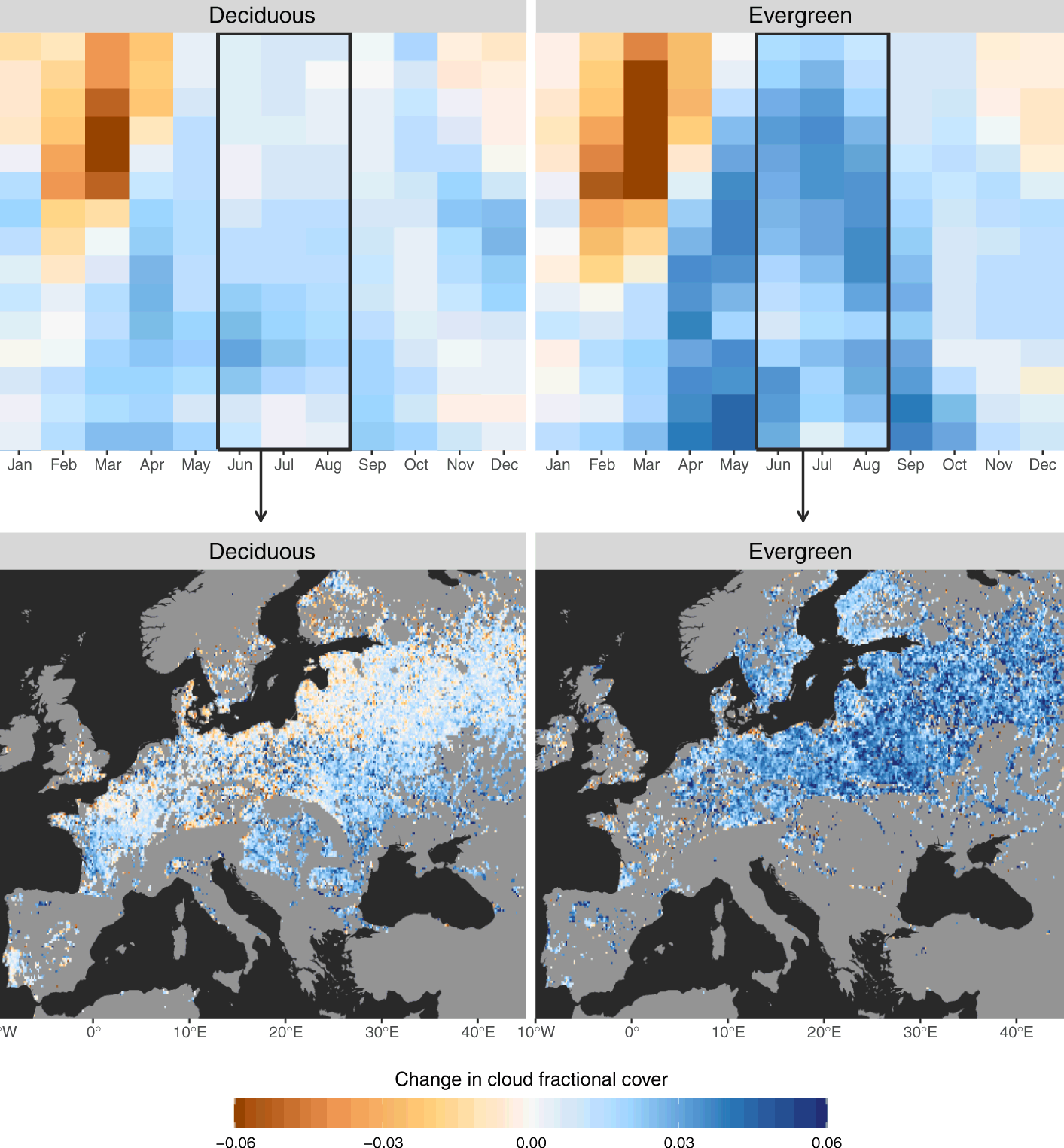
The paper describes how cloud generally increased over the whole year in afforested areas in temperate, tropical, and arid regions, sometimes by as much as 15%.
However, during the boreal winter and spring across North America, Russia, and Eastern Europe, when these regions have prolonged snow cover, the authors found a reduction in cloud cover over forests compared to open land. The boreal summer, on the other hand, has strong and consistent increases in cloud fraction by about 5%.
“Without global cloud and land-cover type observations from satellites this study would not have been possible on a global scale,” says Martin Stengel, who was not involved in the study but leads the Climate Change Initiative Cloud project. “The authors of this study appreciated the high-spatial resolution of the initiative’s products.”
Dr. Cescatti added, “Studies like this one, based on robust satellite observations, are fundamental to characterize the complexity of the climate system and provide benchmarks for climate model developments.”
The team emphasizes that land-based climate mitigation through afforestation, forest restoration, and avoided deforestation should not be reasoned purely in terms of carbon capture. Instead, policies should include the wider climate benefits that forests offer, including increasing cloud cover for localized cooling and generating rainfall, giving forests additional hydrological value.
Reference: “Revealing the widespread potential of forests to increase low level cloud cover” by Gregory Duveiller, Federico Filipponi, Andrej Ceglar, Jędrzej Bojanowski, Ramdane Alkama and Alessandro Cescatti, 15 July 2021, Nature Communications.
DOI: 10.1038/s41467-021-24551-5
Never miss a breakthrough: Join the SciTechDaily newsletter.
Follow us on Google and Google News.
1 Comment
What is responsible for the difference between deciduous and evergreen biomes? Is it the volatile hydrocarbons such as turpenes?
Characteristically, for climate research, the numbers are presented as though they are exact. That is, they are typically presented as integers, or decimal fractions with a single significant figure, e.g. 0.5! Nowhere in this summary, or the original research article, is uncertainty even mentioned, let alone presented as is the practice in science, to indicate the precision of measurements and the probability of the distribution of measurements. That is, it is common practice to display at least the standard deviation of a sample (at least one sigma, preferably two or more) of measurements or calculations.
It is also common practice in remote sensing to provide a table of classification errors (false-positives and false-negatives). In this case, the percentage of time that pixels were misidentified as being deciduous or evergreen.
The research article provided the mathematical formulas used for calculations. However, nothing was said about the accuracy and precision of the data used in the formulas. It is, therefore, impossible for peers to assess the value of their findings. There is an expression used in computing: Garbage In, Garbage Out (GIGO). They provide little information to assure readers that they are not inputting garbage!