
Scientists at the University of Southampton have developed a new method for measuring the mass of pulsars.
Until now, scientists have determined the mass of stars, planets, and moons by studying their motion in relation to others nearby, using the gravitational pull between the two as the basis for their calculations. However, in the case of young pulsars, mathematicians at Southampton have now found a new way to measure their mass, even if a star exists on its own in space.
Dr Wynn Ho, of Mathematical Sciences at the University of Southampton, who led the research says: “For pulsars, we have been able to use principles of nuclear physics, rather than gravity, to work out what their mass is – an exciting breakthrough which has the potential to revolutionize the way we make this kind of calculation.”
Collaborator Dr. Cristobal Espinoza of the Pontificia Universidad Catolica de Chile goes on to explain: “All previous precise measurements of pulsar masses have been made for stars that orbit another object, using the same techniques that were used to measure the mass of the Earth or Moon, or discover the first extrasolar planets. Our technique is very different and can be used for pulsars in isolation.”
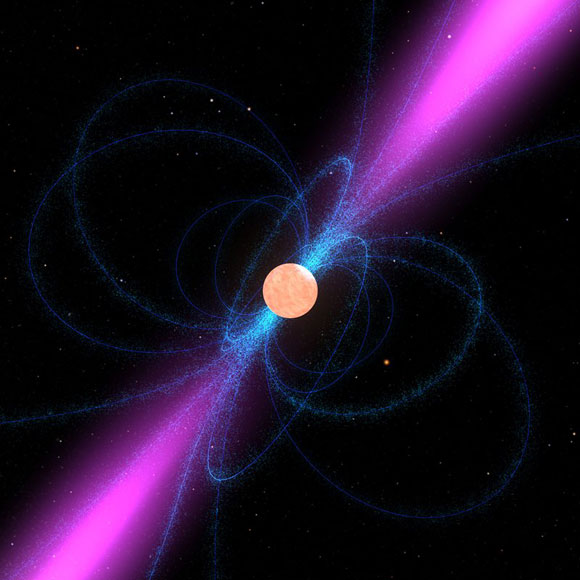
Pulsars emit a rotating beam of electromagnetic radiation, which can be detected by telescopes when the beam sweeps past the Earth, like observing the beam of a lighthouse. They are renowned for their incredibly stable rate of rotation, but young pulsars occasionally experience so-called ‘glitches’, where they are found to speed up for a very brief period of time.
The prevailing theory is that these glitches arise as a rapidly spinning superfluid within the star transfers its rotational energy to the star’s crust, the component that is tracked by observations.
Professor of Applied Mathematics at Southampton, Nils Andersson explains, “Imagine the pulsar as a bowl of soup, with the bowl spinning at one speed and the soup spinning faster. Friction between the inside of the bowl and its contents, the soup, will cause the bowl to speed up. The more soup there is, the faster the bowl will be made to rotate.”
Dr Ho has collaborated with his colleague Professor Andersson and external researchers Dr. Espinoza and Dr. Danai Antonopoulou of the University of Amsterdam, to use new radio and X-ray data to develop a novel mathematical model that can be used to measure the mass of pulsars that glitch. The idea relies on a detailed understanding of superfluidity. The magnitude and frequency of the pulsar glitches depend on the amount of superfluid in the star and the mobility of the superfluid vortices within. By combining observational information with the involved nuclear physics, one can determine the star’s mass.
The team’s results have important implications for the next generation of radio telescopes being developed by large international collaborations, like the Square Kilometer Array (SKA) and the Low Frequency Array (LOFAR), of which Southampton is a UK partner university. The discovery and monitoring of many more pulsars is one of the key scientific goals of these projects.
“Our results provide an exciting new link between the study of distant astronomical objects and laboratory work in both high-energy and low-temperature physics. It is a great example of interdisciplinary science,” says Professor Andersson.
The Southampton-led team has written a paper detailing their work, published in Science Advances.
Reference: “Pinning down the superfluid and measuring masses using pulsar glitches” by Wynn C. G. Ho, Cristóbal M. Espinoza, Danai Antonopoulou and Nils Andersson, 2 October 2015, Science Advances.
DOI: 10.1126/sciadv.1500578
Never miss a breakthrough: Join the SciTechDaily newsletter.
Follow us on Google and Google News.