
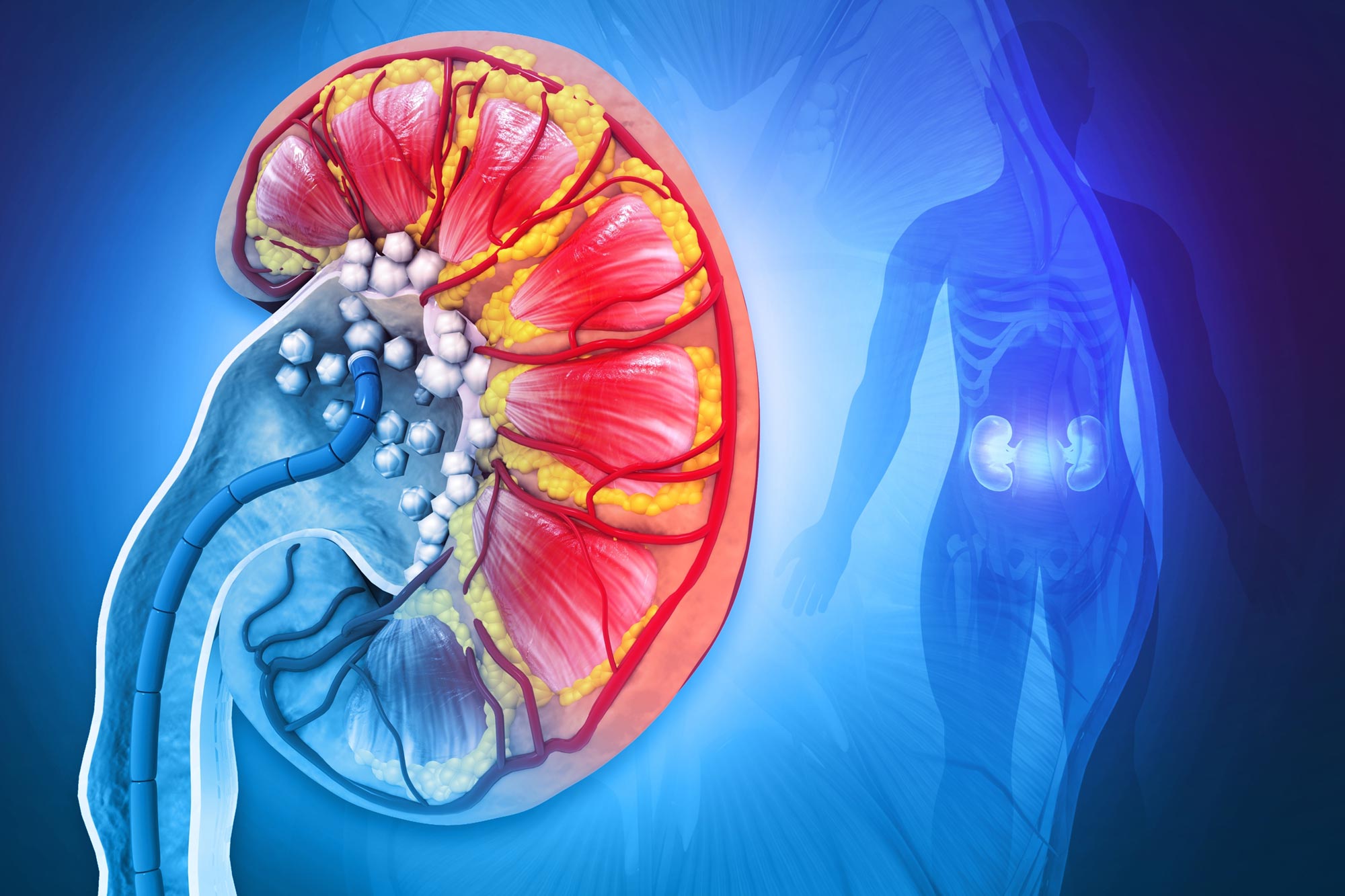
Scientists have uncovered an unexpected biological factor hidden within the most common type of kidney stone.
A team of researchers at UCLA has reported an unexpected twist in a condition long treated as a crystal chemistry problem. In samples of the most common kidney stone, they found bacteria living inside the stone itself, suggesting that biology may be part of the process that helps these stones take shape.
The study, recently published in the peer-reviewed journal PNAS, points toward a new kind of treatment target. Instead of focusing only on the minerals that make up the stone, future strategies could also aim at the microbial activity associated with it, with the goal of preventing stones or making them easier to treat.
“This breakthrough challenges the long‑held assumption that these stones develop solely through chemical and physical processes, and instead shows that bacteria can reside inside stones and may actively contribute to their formation,” said Dr. Kymora Scotland, an assistant professor of urology at the David Geffen School of Medicine at UCLA and the study’s co-senior author. “By uncovering this novel mechanism, the study opens the door to new therapeutic strategies that target the microbial environment of kidney stones.”
The work was co-authored by Gerard Wong of UCLA.
Rising Prevalence and Known Risk Factors
Kidney stones begin as tiny crystals that can accumulate and clump together in urine. Rates have increased worldwide in recent years, and about 1 in 11 people are expected to develop a stone at some point. Family history, metabolic syndrome, and low fluid intake are among the factors linked to higher risk, in part because they can allow crystals to grow large enough to resist being flushed out naturally.
Several stone subtypes exist, and bacteria have been recognized in one rare type. Calcium oxalate (CaOx) stones, which make up nearly 80% of cases, have not been considered bacterial. Using electron and florescence microscopy, the researchers identified live bacteria within these stones, along with biofilms, layered bacterial communities that were embedded within the crystal structure.
“We found a new mechanism of stone formation that may help to explain why these stones are so common,” Scotland said. “These results may also help to explain the connections between recurrent urinary tract infections and recurrent kidney stone formation, and provide insights on potential future treatment for these conditions.”
The findings suggest that bacteria could also be involved in other kidney stone types, she added.
Ongoing Questions and Future Research
The study has focused on calcium-based stones. How other, less common stones form is still in question. More studies are needed to fully understand how bacteria and calcium-based kidney stones interact, the researchers conclude.
“Our multi-institutional team is currently performing studies to determine how bacteria and calcium-based kidney stones interact. We want to understand exactly what makes some patients particularly susceptible to recurrent stone formation, and what it is about these particular species of bacteria that allows them to nucleate these stones,” Scotland said.
Reference: “Intercalated bacterial biofilms are intrinsic internal components of calcium-based kidney stones” by William C. Schmidt, Ava Mousavi, Jiahui Li, Rena Yang, Gerson Gonzalez Marin, Henry L. Schreiber, Rachael E. S. Hammann, Chloe L. P. Obernuefemann, Karla Bergeron, Aleksandra Klim, Daniel Wong, Kefu Du, Scott J. Hultgren, Qian Chen, Aaron Celestian, Gerard C. L. Wong and Kymora B. Scotland, 26 January 2026, Proceedings of the National Academy of Sciences.
DOI: 10.1073/pnas.2517066123
Grants from National Institutes of Health (1K08DK132486-01A1, KL2TR001882-06, R01AI143730, R01DK051406, and S10OD025017), the National Science Foundation (DMR2325840, CHE-0722519, and RaMP-2216721), a National Research Service Award (T32AI007323), Air Force Office of Scientific Research (FA9550-23-1-0609), Chan Zuckerberg Biohub Chicago, and a CNSI Voucher Award funded this research.
Never miss a breakthrough: Join the SciTechDaily newsletter.
Follow us on Google and Google News.