
Plastic pollution from food packaging, like tea bags, releases billions of MNPL particles, which can infiltrate human cells, highlighting serious health risks and the need for regulatory action.
Plastic waste pollution poses a significant environmental challenge with serious implications for the health and well-being of future generations. A major source of human exposure to micro and nanoplastics (MNPLs) is food packaging, with ingestion and inhalation being the primary pathways of exposure.
Researchers from the Mutagenesis Group at the UAB Department of Genetics and Microbiology conducted a study to identify and characterize MNPLs released from various types of commercially available tea bags. The study found that steeping these tea bags in hot water leads to the release of large quantities of nano-sized particles and filamentous structures, representing a notable source of MNPL exposure.
The tea bags analyzed were made from nylon-6, polypropylene, and cellulose. The findings revealed that:
- Polypropylene released approximately 1.2 billion particles per milliliter, averaging 136.7 nanometers in size.
- Cellulose emitted around 135 million particles per milliliter, with an average size of 244 nanometers.
- Nylon-6 released about 8.18 million particles per milliliter, averaging 138.4 nanometers in size.
To characterize the different types of particles present in the infusion, a set of advanced analytical techniques such as scanning electron microscopy (SEM), transmission electron microscopy (TEM), infrared spectroscopy (ATR-FTIR), dynamic light scattering (DLS), laser Doppler velocimetry (LDV), and nanoparticle tracking analysis (NTA) were used. “We have managed to innovatively characterize these pollutants with a set of cutting-edge techniques, which is a very important tool to advance research on their possible impacts on human health,” remarks UAB researcher Alba Garcia.
Interactions with human cells observed for the first time
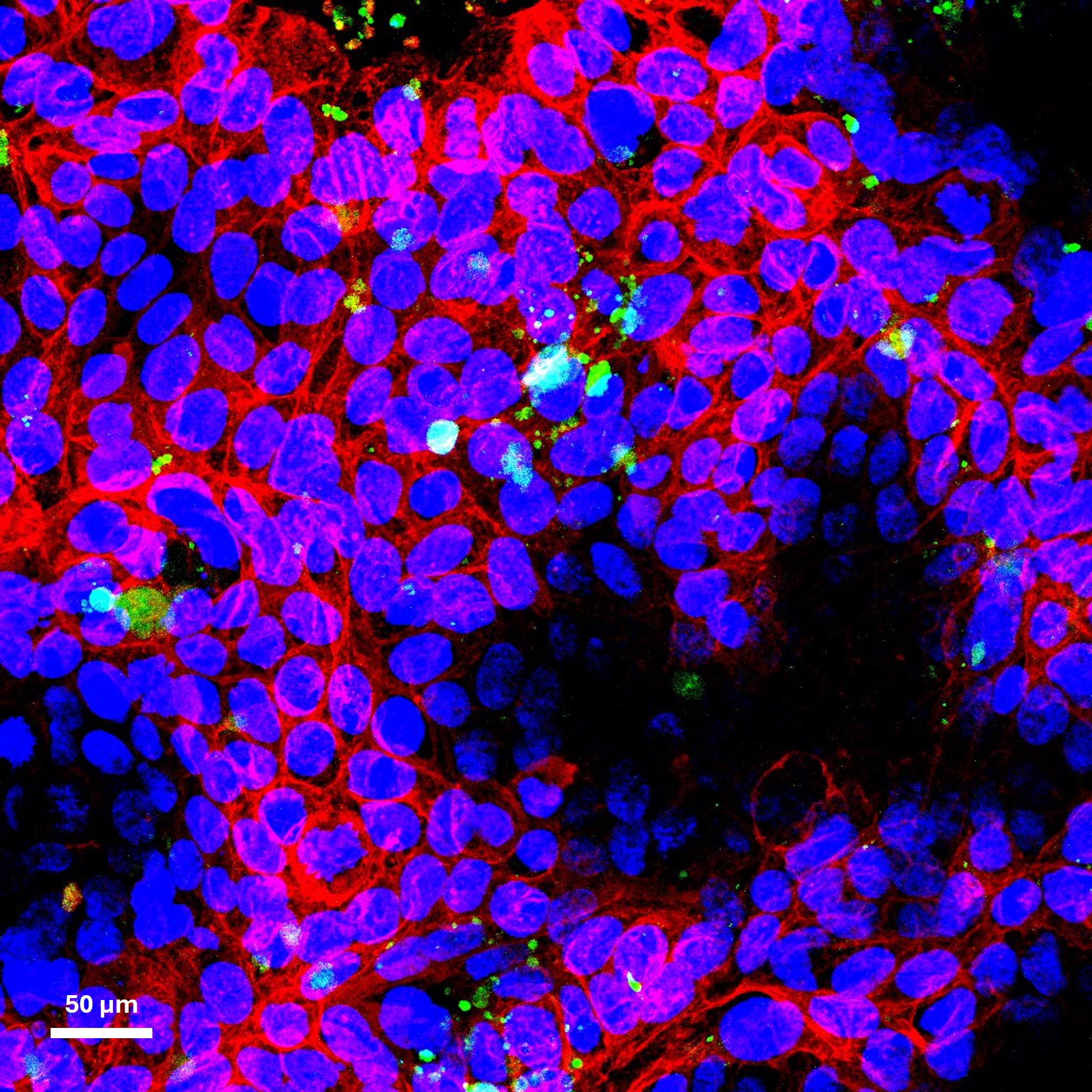
The particles were stained and exposed for the first time to different types of human intestinal cells to assess their interaction and possible cellular internalization. The biological interaction experiments showed that mucus-producing intestinal cells had the highest uptake of micro and nanoplastics, with the particles even entering the cell nucleus that houses the genetic material. The result suggests a key role for intestinal mucus in the uptake of these pollutant particles and underscores the need for further research into the effects that chronic exposure can have on human health.
“It is critical to develop standardized test methods to assess MNPLs contamination released from plastic food contact materials and to formulate regulatory policies to effectively mitigate and minimise this contamination. As the use of plastic in food packaging continues to increase, it is vital to address MNPLs contamination to ensure food safety and protect public health”, researchers add.
Reference: “Teabag-derived micro/nanoplastics (true-to-life MNPLs) as a surrogate for real-life exposure scenarios” by Gooya Banaei, Doaa Abass, Alireza Tavakolpournegari, Joan Martín-Pérez, Javier Gutiérrez, Guyu Peng, Thorsten Reemtsma, Ricard Marcos, Alba Hernández and Alba García-Rodríguez, 16 November 2024, Chemosphere.
DOI: 10.1016/j.chemosphere.2024.143736
The study was developed under the framework of the European project PlasticHeal coordinated by, Alba Hernández lecturer in the Department of Genetics and Microbiology at the UAB. Researchers from the UAB Mutagenesis Group Alba García-Rodríguez, Ricard Marcos, and Gooya Banaei, first author of the research article, were also involved in the study, with the collaboration of researchers from the Helmholtz Centre for Environmental Research in Leipzig, Germany.
Never miss a breakthrough: Join the SciTechDaily newsletter.
Follow us on Google and Google News.
6 Comments
Would have been helpful to identify which “popular” tea bags were tested.
I agree
I agree.
How does cellulose release MNPLs?
It doesn’t. Cellulose is the most common natural plant fiber, found in every cell of every plant on Earth, and MNPLs are synthetic plastics. The article has some parts that are poorly written because apparently the author does not understand this.
If cellulose actually released MNPLs when exposed to hot water, we would have some really serious problems because then eating boiled vegetables would be bad for your health and cause microplastics to bioaccumulate in your body and clog up your blood vessels with deadly blood clots and cause heart attacks and strokes. But no, that is not where microplastics that do those things come from, cellulose is not a microplastic and it does not release microplastics. And MNPLs is just another way of saying microplastics.
The worst source of MNPLs for teabags according to this research is polyproplyene, a common plastic, categorized as plastic number 5 with the abbreviation PP. Less than 1% of polyproplyene is recycled, so its environmental impacts on human and animal health are a major problem. Polyproplyene was originally thought to be extremely safe for human health because of a lack of chemical reactions with the body making it chemically inert, but now that we know about the dangers of microplastics, it turns out that polypropylene is actually the most common microplastic found in human bodies according to studies. One method for disposing of polypropylene and other plastic waste if it cannot be recycled would be incinerating it in incinerators, but that unfortunately releases greenhouse gases like carbon dioxide into the atmosphere. Clearly we need to figure out a better way to deal with plastics.
And obviously we should stop eating and drinking them. Not a good idea to use plastic cups or plates or utensils, either. But if you consider how a teabag is made of fibers woven together and the boiling hot water circulates thru the teabag rapidly, well, that is harmless with cellulose because the body can break it down, but with a plastic teabag, you had better watch out, that is hazardous and will fill your body with microplastics. We are only beginning to find out about all the negative health effects of human consumption of microplastics.
@Rich Thank you, helpful comment. You should be writing the articles. 😉
What is not clear to me, is that some teabags are obviously plastic, and I avoid these. However, I now am unsure if the apparently cellulose bags have some plastic component to make them stronger for purposes of shelve life.