
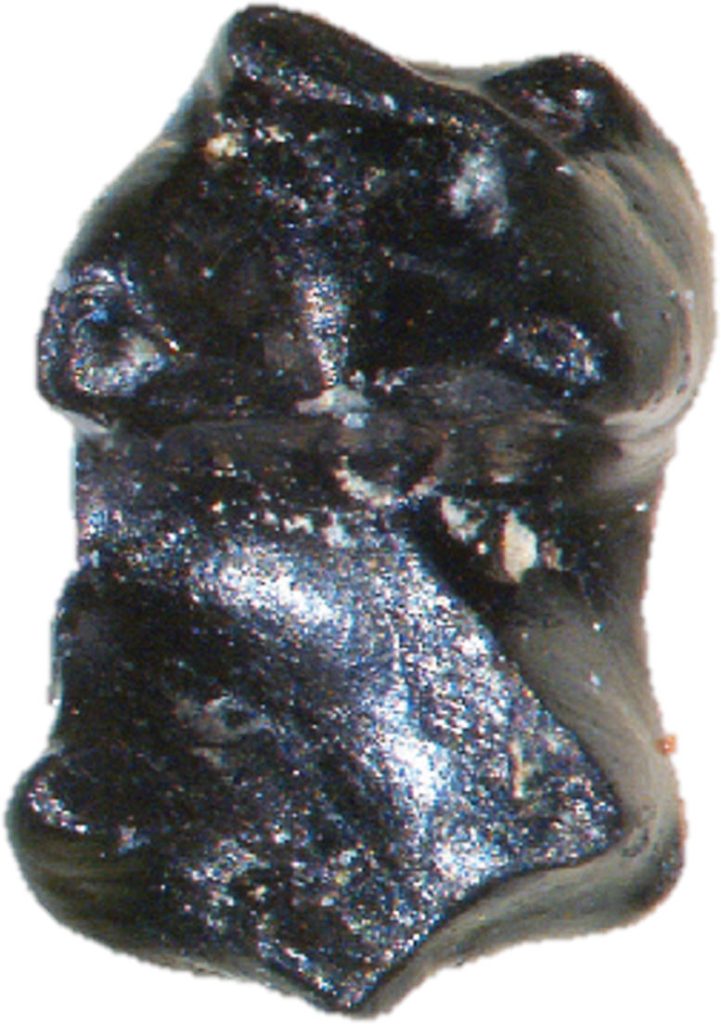
Paleontologists working in northern Alaska have discovered a tiny fossil mammal that thrived in what may have been among the coldest conditions on Earth about 73 million years ago.
The researchers, led by Jaelyn Eberle of the University of Colorado Boulder, described the Late Cretaceous animal in a study recently published in the Journal of Systematic Palaeontology.
They gave it the scientific name Sikuomys mikros—from “Siku,” an Iñupiaq word for “ice,” and “mys” and “mikros,” the Greek words for “mouse” and “little.”
It’s a fitting title. While the little ice mouse wasn’t actually a mouse, instead belonging to a now-extinct family of mammals called Gypsonictopidae, it was certainly tiny. The furry critter may have looked a bit like a modern-day shrew and weighed an estimated 11 grams or less than an empty aluminum soda can. It also lived year-round in northern Alaska, which at the time lay much farther north, above the planet’s Arctic Circle. There, the ice mouse likely weathered as much as four months of unending darkness in the winter and temperatures that fell below freezing.
“These guys probably didn’t hibernate,” said Eberle, curator of fossil vertebrates at the CU Museum of Natural History and professor in the Department of Geological Sciences. “They stayed active all year long, burrowing under leaf litter or underground and feeding on whatever they could sink their teeth into, probably insects and worms.”
She and her colleagues had to be equally tenacious to discover the fossil animals: The researchers identified the new species from only a handful of tiny teeth, each about the size of a grain of sand.
“I always like working at the ends of the Earth,” Eberle said. “You never know what you’re going to find, but you know it’s going to be new.”
Those minute fossils are giving researchers a new window into ancient Alaska, said study co-author Patrick Druckenmiller, director of the University of Alaska Museum of the North.
“Seventy-three million years ago, northern Alaska was home to an ecosystem unlike any on Earth today,” he said. “It was a polar forest teeming with dinosaurs, small mammals, and birds. These animals were adapted to exist in a highly seasonal climate that included freezing winter conditions, likely snow, and up to four months of complete winter darkness.”
Venturing North
Getting to the ends of the Earth isn’t always easy.
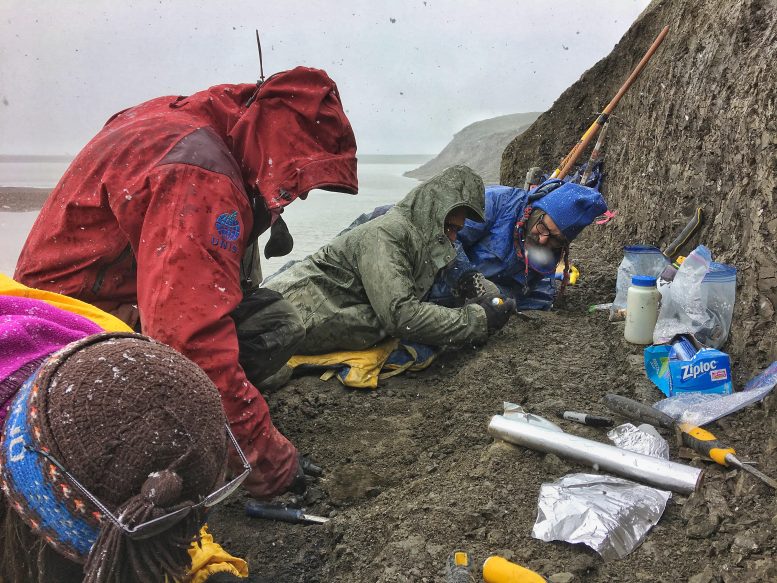
The researchers, including paleontologists from the University of Alaska Fairbanks and Florida State University, unearthed the fossils from sediments along the banks of the Colville River—not far from the Beaufort Sea on Alaska’s northern coast. The site, part of what’s called the Prince Creek Formation, is so remote the team travels the 75 or so miles from Deadhorse, Alaska, by snowmobile or bush plane.
“Our team’s research is revealing a ‘Lost world’ of Arctic-adapted animals,” said Gregory Erickson, a co-author of the study at Florida State University. “Prince Creek serves as a natural test of these animal’s physiology and behavior in the face of drastic seasonal climatic fluctuations.”
The late William Clemens of the University of California, Berkeley was also a co-author of the new research.
Unlike dinosaurs from the same time period, which left behind large bones, the only fossils remaining from the region’s mammals are a few teeth and fragments of jaws. To recover these precious specimens, the group collects buckets of dirt from the riverbanks. In the lab, the researchers wash away the mud and sort what remains under a microscope.
“You look under the microscope and see this perfect little tooth,” Eberle said. “It’s so tiny.”
Safety Underground
In the case of the ice mouse, those perfect little teeth have inspired a perfect little mystery.
For many groups of mammals on Earth, species tend to get bigger at higher latitudes and cooler climates. The ice mouse and its close cousins seem to follow the opposite pattern. Paleontologists have found related species living thousands of miles to the south that were three to five times larger than Sikuomys mikros.
Eberle suspects the ice mouse was so small because there was so little to eat during the winter in Alaska.
“We see something similar in shrews today,” she said. “The idea is that if you’re really small, you have lower food and energy needs.”
Sikuomys mikros may have spent the cold months in Alaska underground. In the end, such a subterranean lifestyle may have been a blessing for animals like the ice mouse. Burrowing mammals may have stood a better chance of surviving the harsh conditions that followed the meteorite crash that killed the dinosaurs 66 million years ago.
Reference: “A new tiny eutherian from the Late Cretaceous of Alaska” by Jaelyn J. Eberle, William A. Clemens, Gregory M. Erickson and Patrick S. Druckenmiller, 5 August 2023, Journal of Systematic Palaeontology.
DOI: 10.1080/14772019.2023.2232359
Never miss a breakthrough: Join the SciTechDaily newsletter.
Follow us on Google and Google News.