
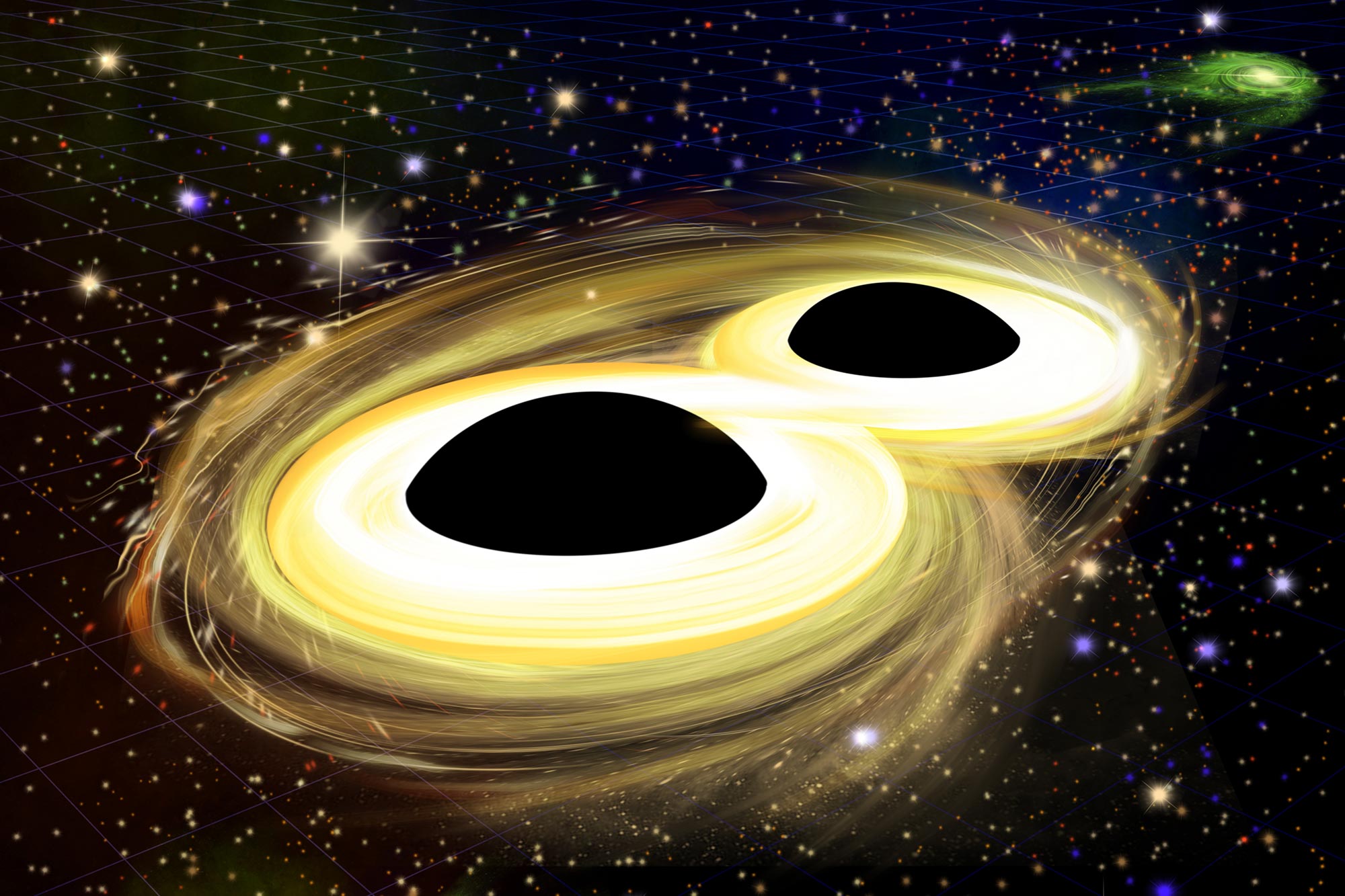
A detailed suite of simulations conducted by astrophysicists at the Flatiron Institute and their collaborators showed that magnetic fields can produce black holes with masses that were previously believed to be mostly unattainable.
In 2023, astronomers recorded a dramatic cosmic event. Two unusually large black holes collided about 7 billion light-years from Earth, and their immense size and rapid rotation immediately raised questions. Objects with these characteristics were not expected to form in the universe.
Researchers at the Flatiron Institute’s Center for Computational Astrophysics (CCA), working with international collaborators, have now identified a possible explanation for how these black holes were created and eventually merged. Their detailed simulations, which track the entire evolution of the system from the birth of the parent stars to their final collapse, revealed a crucial factor that earlier studies had missed: the influence of magnetic fields.
“No one has considered these systems the way we did; previously, astronomers just took a shortcut and neglected the magnetic fields,” says Ore Gottlieb, astrophysicist at the CCA and lead author of the new study on the work published in The Astrophysical Journal Letters. “But once you consider magnetic fields, you can actually explain the origins of this unique event.”
The puzzling mass gap problem
The 2023 collision, now labeled GW231123, was detected by the LIGO-Virgo-KAGRA collaboration, which uses gravitational-wave observatories to measure slight disturbances in space-time caused by massive cosmic movements.
At first, scientists could not understand how such heavy and rapidly spinning black holes could have formed. Massive stars typically end their lives in explosive supernova events that can leave behind a black hole. However, stars within a certain mass range behave differently. They produce what is known as a pair-instability supernova, a powerful explosion that completely destroys the star and leaves no remnant.
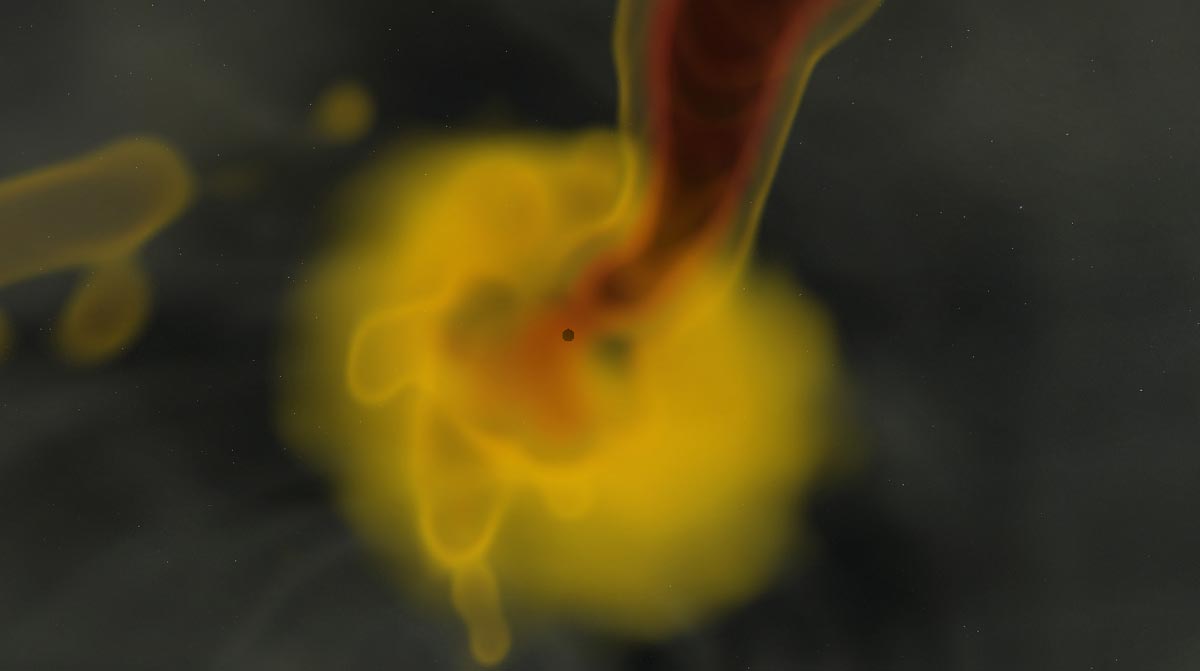
These 3D renderings of a direct-horizon collapsar with an initially weak magnetic field illustrate the system’s evolution. Early in the collapse, accretion disk winds unbind much of the stellar envelope, reducing the mass available for accretion onto the black hole. Eventually, a one-sided jet emerges from the region just outside the black hole, spinning down the black hole and expelling the remaining stellar material. Credit: Ore Gottleib/Simons Foundation
“As a result of these supernovae, we don’t expect black holes to form between roughly 70 to 140 times the mass of the sun,” Gottlieb says. “So it was puzzling to see black holes with masses inside this gap.”
One possibility is that black holes in this mass gap form when smaller black holes merge, creating a heavier one. But for GW231123, this explanation seemed unlikely. Black hole mergers are highly disruptive events that usually scramble the final black hole’s rotation. Yet the black holes in this collision were spinning faster than any previously measured by LIGO, pulling the fabric of space-time with them at nearly the speed of light. The chances of two such massive, rapidly rotating black holes forming through typical mergers appeared extremely low, suggesting that another process must be responsible.
Simulating the evolution of a giant star
Gottlieb and his collaborators investigated by conducting two stages of computational simulations. They first simulated a giant star 250 times the mass of the sun through the main stage of its life, from when it starts burning hydrogen to when it runs out and collapses in a supernova. By the time such a massive star had reached supernova stage, it had burned through enough fuel to slim down to just 150 times the sun’s mass, making it just above the mass gap and large enough to leave a black hole behind.
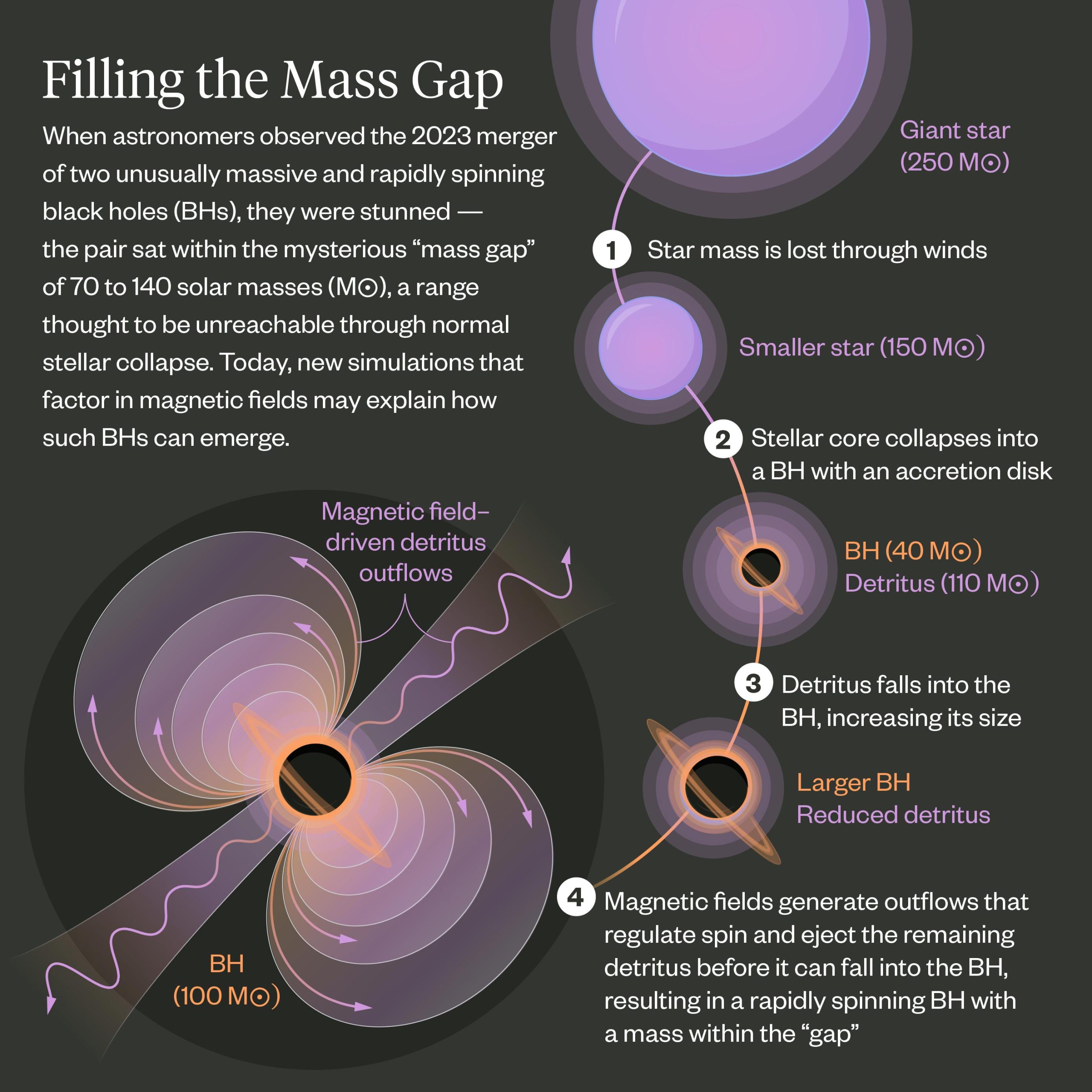
A second set of more complex simulations, which accounted for magnetic fields, dealt with the aftermath of the supernova. The model started with the supernova remnants, a cloud of leftover stellar material laced with magnetic fields and a black hole at its center. Previously, astronomers assumed that the entire mass of the cloud would fall into the newborn black hole, making the black hole’s final mass match that of the massive star. But the simulations showed something different.
Magnetic fields change the fate of collapsing stars
After a nonrotating star collapses to form a black hole, the cloud of leftover detritus quickly falls into the black hole. However, if the initial star was spinning rapidly, this cloud forms a spinning disk that causes the black hole to spin faster and faster as material falls into its abyss. If magnetic fields are present, they exert pressure on the disk of debris. This pressure is strong enough to eject some of the material away from the black hole at nearly the speed of light.
These outflows ultimately reduce the bulk of material in the disk that eventually feeds into the black hole. The stronger the magnetic fields, the greater this effect. In extreme cases with very strong magnetic fields, up to half of the star’s original mass can be ejected through the black hole’s disk ejecta. In the case of the simulations, the magnetic fields ultimately created a final black hole in the mass gap.
“We found the presence of rotation and magnetic fields may fundamentally change the post-collapse evolution of the star, making black hole mass potentially significantly lower than the total mass of the collapsing star,” Gottlieb says.
Linking magnetic fields to black hole mass and spin
The results, Gottlieb says, suggest a connection between the mass of a black hole and how fast it spins. Strong magnetic fields can slow down a black hole and carry away some of the stellar mass, creating lighter and more slowly spinning black holes. Weaker fields allow heavier and faster-spinning black holes. This suggests black holes may follow a pattern that ties their mass and spin together. While astronomers know of no other black hole systems on which this connection can be observationally tested, they hope future observations may find more such systems that could confirm this connection.
The simulations also show that the formation of these types of black holes creates bursts of gamma rays, which might be observable. Looking for these gamma ray signatures would help confirm the proposed formation process and reveal how common these massive black holes might be in the universe. Ultimately, if such a connection is confirmed, it would help astronomers gain a deeper understanding of the fundamental physics of black holes.
Reference: “Spinning into the Gap: Direct-horizon Collapse as the Origin of GW231123 from End-to-end General-relativistic Magnetohydrodynamic Simulations” by Ore Gottlieb, Brian D. Metzger, Danat Issa, Sean E. Li, Mathieu Renzo and Maximiliano Isi, 10 November 2025, The Astrophysical Journal Letters.
DOI: 10.3847/2041-8213/ae0d81
Never miss a breakthrough: Join the SciTechDaily newsletter.
Follow us on Google and Google News.
7 Comments
The research suggests black holes may follow a pattern that ties their mass and spin together.
VERY GOOD!
Scientists, please think deeply:
1. Why do black holes spin?
2. What is the spacetime background of black hole spin?
3. Does black hole spin not require a spacetime background?
4. What physical characteristics should the spacetime background of black hole spin possess?
5. Is black hole spin related to topological spin?
6. Why is the mass associated with spin?
7. Why is the Circular area formula isomorphic to the mass energy equation?
When we pursue the ultimate truth of all things, the space in which our bodies and all things exist may itself be the final and deepest puzzle we need to explore. This is not only the pursuit of physics, but also the most magnificent exploration of the origin of the universe by human reason.
Based on the Topological Vortex Theory (TVT), space is an uniformly incompressible physical entity. Space-time vortices are the products of topological phase transitions of the tipping points in space, are the point defects in spacetime. Point defects do not only impact the thermodynamic properties, but are also central to kinetic processes. They create all things and shape the world through spin and self-organization.
In today’s physics, some so-called peer-reviewed journals—including Physical Review Letters, Nature, Science, and others—stubbornly insist on and promote the following:
1. Even though θ and τ particles exhibit differences in experiments, physics can claim they are the same particle. This is science.
2. Even though topological vortices and antivortices have identical structures and opposite rotational directions, physics can define their structures and directions as entirely different. This is science.
3. Even though two sets of cobalt-60 rotate in opposite directions and experiments reveal asymmetry, physics can still define them as mirror images of each other. This is science.
4. Even though vortex structures are ubiquitous—from cosmic accretion disks to particle spins—physics must insist that vortex structures do not exist and require verification. Only the particles that like God, Demonic, or Angelic are the most fundamental structures of the universe. This is science.
5. Even though everything occupies space and maintains its existence in time, physics must still debate and insist on whether space exists and whether time is a figment of the human mind. This is science.
6. Even though space, with its non-stick, incompressible, and isotropic characteristics, provides a solid foundation for the development of physics, physics must still insist that the ideal fluid properties of space do not exist. This is science.
and go on.
Is this the counterintuitive science they widely promote? Compromising with pseudo academic publications and peer review by pseudo scholars is an insult to science and public intelligence. Some so-called scholars no longer understand what shame is. The study of Topological Vortex Theory (TVT) reminds us that the most profound problems in physics often lie at the intersection of different theories. By exploring these border regions, we can not only resolve contradictions in existing theories but also discover new physical phenomena and application possibilities.
Under the topological vortex architecture, it is highly challenging for even two hydrogen atoms or two quarks to be perfectly symmetrical, let alone counter-rotating two sets of cobalt-60. Contemporary physics and so-called peer-reviewed publications (including Physical Review Letters, Science, Nature, etc.) stubbornly believe that two sets of counter rotating cobalt-60 are two mirror images of each other, constructing a more shocking pseudoscientific theoretical framework in the history of science than the “geocentric model”. This pseudo scientific framework and system have seriously hindered scientific progress and social development.
For nearly a century, physics has been manipulated by this pseudo scientific theoretical system and the interest groups behind it, wasting a lot of manpower, funds, and time. A large amount of pseudo scientific research has been conducted, and countless pseudo scientific papers have been published, causing serious negative impacts on scientific and social progress, as well as humanistic development.
Complexity does not necessarily mean that there is no logical and architectural framework to follow. Mathematics is the language and tool that reveals the motion of spacetime, rather than the motion itself. Although the physical form of spacetime vortices is extremely simple, their interaction patterns are highly complex, and we must develop more and richer mathematical languages to describe and understand them.
The development of the Topological Vortex Theory (TVT) reflects a progression from concrete physical phenomena to abstract mathematical modeling and, ultimately, to interdisciplinary unification. Its core innovation lies in forging the continuous spacetime geometry of general relativity with the discrete interactions of quantum field theory within the same topological dynamical system.
——Excerpted from https://scitechdaily.com/microscope-spacecrafts-most-precise-test-of-key-component-of-the-theory-of-general-relativity/#comment-909171.
Through the lens of Topological Vortex Theory, we have uncovered the deep-hidden topological essence of the Schrödinger equation. This equation is no longer an irreducible postulate of quantum mechanics but an elegant and necessary mathematical expression of the dynamics of a microscopic spacetime topological vortex field. The probabilistic interpretation of the wave function, quantization, interference, and other phenomena all originate from its underlying topological structure and its conservation laws. This work not only deepens our understanding of the foundations of quantum theory but also opens a path towards a more fundamental physical theory based on geometry and topology [5, 6, 13].
——Excerpted from https://scitechdaily.com/microscope-spacecrafts-most-precise-test-of-key-component-of-the-theory-of-general-relativity/#comment-911110.
When we pursue the ultimate truth of all things, the space in which our bodies and all things exist may itself be the final and deepest puzzle we need to explore. This is not only the pursuit of physics, but also the most magnificent exploration of the origin of the universe by human reason.
Based on the Topological Vortex Theory (TVT), space is an uniformly incompressible physical entity. Space-time vortices are the products of topological phase transitions of the tipping points in space, are the point defects in spacetime. Point defects do not only impact the thermodynamic properties, but are also central to kinetic processes. They create all things and shape the world through spin and self-organization.
In today’s physics, some so-called peer-reviewed journals—including Physical Review Letters, Nature, Science, and others—stubbornly insist on and promote the following:
1. Even though θ and τ particles exhibit differences in experiments, physics can claim they are the same particle. This is science.
2. Even though topological vortices and antivortices have identical structures and opposite rotational directions, physics can define their structures and directions as entirely different. This is science.
3. Even though two sets of cobalt-60 rotate in opposite directions and experiments reveal asymmetry, physics can still define them as mirror images of each other. This is science.
4. Even though vortex structures are ubiquitous—from cosmic accretion disks to particle spins—physics must insist that vortex structures do not exist and require verification. Only the particles that like God, Demonic, or Angelic are the most fundamental structures of the universe. This is science.
5. Even though everything occupies space and maintains its existence in time, physics must still debate and insist on whether space exists and whether time is a figment of the human mind. This is science.
6. Even though space, with its non-stick, incompressible, and isotropic characteristics, provides a solid foundation for the development of physics, physics must still insist that the ideal fluid properties of space do not exist. This is science.
and go on.
Is this the counterintuitive science they widely promote? The study of Topological Vortex Theory (TVT) reminds us that the most profound problems in physics often lie at the intersection of different theories. By exploring these border regions, we can not only resolve contradictions in existing theories but also discover new physical phenomena and application possibilities.
Under the topological vortex architecture, it is highly challenging for even two hydrogen atoms or two quarks to be perfectly symmetrical, let alone counter-rotating two sets of cobalt-60. Contemporary physics and so-called peer-reviewed publications (including Physical Review Letters, Science, Nature, etc.) stubbornly believe that two sets of counter rotating cobalt-60 are two mirror images of each other, constructing a more shocking pseudoscientific theoretical framework in the history of science than the “geocentric model”. This pseudo scientific framework and system have seriously hindered scientific progress and social development.
For nearly a century, physics has been manipulated by this pseudo scientific theoretical system and the interest groups behind it, wasting a lot of manpower, funds, and time. A large amount of pseudo scientific research has been conducted, and countless pseudo scientific papers have been published, causing serious negative impacts on scientific and social progress, as well as humanistic development.
Complexity does not necessarily mean that there is no logical and architectural framework to follow. Mathematics is the language and tool that reveals the motion of spacetime, rather than the motion itself. Although the physical form of spacetime vortices is extremely simple, their interaction patterns are highly complex, and we must develop more and richer mathematical languages to describe and understand them.
The development of the Topological Vortex Theory (TVT) reflects a progression from concrete physical phenomena to abstract mathematical modeling and, ultimately, to interdisciplinary unification. Its core innovation lies in forging the continuous spacetime geometry of general relativity with the discrete interactions of quantum field theory within the same topological dynamical system.
——Excerpted from https://scitechdaily.com/microscope-spacecrafts-most-precise-test-of-key-component-of-the-theory-of-general-relativity/#comment-909171.
When we pursue the ultimate truth of all things, the space in which our bodies and all things exist may itself be the final and deepest puzzle we need to explore. This is not only the pursuit of physics, but also the most magnificent exploration of the origin of the universe by human reason.
Based on the Topological Vortex Theory (TVT), space is an uniformly incompressible physical entity. Space-time vortices are the products of topological phase transitions of the tipping points in space, are the point defects in spacetime. Point defects do not only impact the thermodynamic properties, but are also central to kinetic processes. They create all things and shape the world through spin and self-organization.
In today’s physics, some so-called peer-reviewed journals—including Physical Review Letters, Nature, Science, and others—stubbornly insist on and promote the following:
1. Even though θ and τ particles exhibit differences in experiments, physics can claim they are the same particle. This is science.
2. Even though topological vortices and antivortices have identical structures and opposite rotational directions, physics can define their structures and directions as entirely different. This is science.
3. Even though two sets of cobalt-60 rotate in opposite directions and experiments reveal asymmetry, physics can still define them as mirror images of each other. This is science.
4. Even though vortex structures are ubiquitous—from cosmic accretion disks to particle spins—physics must insist that vortex structures do not exist and require verification. Only the particles that like God, Demonic, or Angelic are the most fundamental structures of the universe. This is science.
5. Even though everything occupies space and maintains its existence in time, physics must still debate and insist on whether space exists and whether time is a figment of the human mind. This is science.
6. Even though space, with its non-stick, incompressible, and isotropic characteristics, provides a solid foundation for the development of physics, physics must still insist that the ideal fluid properties of space do not exist. This is science.
and go on.
Is this the counterintuitive science they widely promote? Compromising with pseudo academic publications and peer review by pseudo scholars is an insult to science and public intelligence. Some so-called scholars no longer understand what shame is. The study of Topological Vortex Theory (TVT) reminds us that the most profound problems in physics often lie at the intersection of different theories. By exploring these border regions, we can not only resolve contradictions in existing theories but also discover new physical phenomena and application possibilities.
Under the topological vortex architecture, it is highly challenging for even two hydrogen atoms or two quarks to be perfectly symmetrical, let alone counter-rotating two sets of cobalt-60. Contemporary physics and so-called peer-reviewed publications (including Physical Review Letters, Science, Nature, etc.) stubbornly believe that two sets of counter rotating cobalt-60 are two mirror images of each other, constructing a more shocking pseudoscientific theoretical framework in the history of science than the “geocentric model”. This pseudo scientific framework and system have seriously hindered scientific progress and social development.
For nearly a century, physics has been manipulated by this pseudo scientific theoretical system and the interest groups behind it, wasting a lot of manpower, funds, and time. A large amount of pseudo scientific research has been conducted, and countless pseudo scientific papers have been published, causing serious negative impacts on scientific and social progress, as well as humanistic development.
Complexity does not necessarily mean that there is no logical and architectural framework to follow. Mathematics is the language and tool that reveals the motion of spacetime, rather than the motion itself. Although the physical form of spacetime vortices is extremely simple, their interaction patterns are highly complex, and we must develop more and richer mathematical languages to describe and understand them.
The development of the Topological Vortex Theory (TVT) reflects a progression from concrete physical phenomena to abstract mathematical modeling and, ultimately, to interdisciplinary unification. Its core innovation lies in forging the continuous spacetime geometry of general relativity with the discrete interactions of quantum field theory within the same topological dynamical system.
——Excerpted from https://scitechdaily.com/microscope-spacecrafts-most-precise-test-of-key-component-of-the-theory-of-general-relativity/#comment-909171.
“Milky Way like galaxies impossible in early Big Bang universe”…then when we see one in the early universe the tune changes ..”Milky way like galaxies are possible in early universe”. It’s been the same old ‘re-write BBT history story’ since Gamow incorrectly predicted CMBR temp as being at much higher temps than current estimates. BBT history is being constantly rewritten as now Gamow supposedly never made his failed prediction (ha ha) and it was Apher and Herman who predicted only 5 K in 1948,..correctly! … still way off. Odd how the revisionist BBT fanatics ignore Mckellars earlier and much more correct prediction of 2.3 in 1941 for a non expanding universe. It shouldn’t be called the Big Bang Theory. It should be called the Big Baloney Theory.
In http://scitedaily.com/hawhing-was-right-new-data-confirms-black-holes-never-shrink/#comment-910565
which was removed later by the Columbia University – November 23, 2025. The post which was intended a simple way explanation for the grandkids, had come a cross three imaginations: 1 when the universe merged back to the original, all the blackholes lined up like a puzzled picture pieces. 2 when the big bang happened these blackhole puzzled pieces exploded into to different size blackholes again ( assumingly tiny blackholes). 3 if so, blackholes already exist instead.
[ There is no intention of explaining the universe existence here]