

A study identified 15 key evolutionary motives driving human behavior, grouped into five categories.
Researchers from HSE University and the London School of Hygiene and Tropical Medicine have identified 15 core motives that drive human behavior. By examining individuals’ perspectives, preferences, and actions through an evolutionary framework, they revealed how these motives interact to shape personal habits and social relationships. Their findings are published in Personality and Individual Differences.
Psychologists have long sought to understand what drives human behavior, employing various theories to analyze underlying motivations. One of the most well-known models is Abraham Maslow’s hierarchy of needs, introduced in the mid-20th century. However, while many approaches emphasize the social aspects of motivation, they often overlook its evolutionary foundations.
A group of researchers at HSE University and the London School of Hygiene and Tropical Medicine proposed analyzing human behavior motives from an evolutionary perspective. In the proposed framework, all motives are viewed as evolutionary adaptations that enhanced early humans’ ability to survive in their environment and continue to influence behavior today. The scientists proceed from the premise that if certain evolutionary mechanisms once triggered specific behaviors, the underlying motives can be identified using standard psychometric techniques.
Study Methodology and Findings
To accomplish this, the study authors conducted an online survey with over 500 participants who were asked to rate 150 statements concerning their everyday preferences, fears, desires, and social aspirations. The statements were based on previously identified motives from other studies reflecting physical, reproductive, or social needs, such as “I enjoy going on roller coasters,” “Eating is less important to me than it seems to be for most people,” and “I spend a lot of time staying in touch with my friends,” among others.
Using network analysis, the researchers identified stable clusters of motives, ultimately defining 15 key motives that drive human behavior. These motives fall into five broad categories:
- Environmental: Hoard, Create
- Physiological: Fear, Disgust, Hunger, Comfort
- Reproductive: Lust, Attract, Love, Nurture
- Psychological: Curiosity, Play
- Social: Affiliate, Status, Justice
The researchers also identified functional relationships between motives, contributing to a deeper understanding of motivational structures. For example, Justice has strong ties to Nurture and Curiosity, suggesting that it is a function of both concern for the welfare of others and a need to keep abreast of where anti-social behaviors might be occurring.
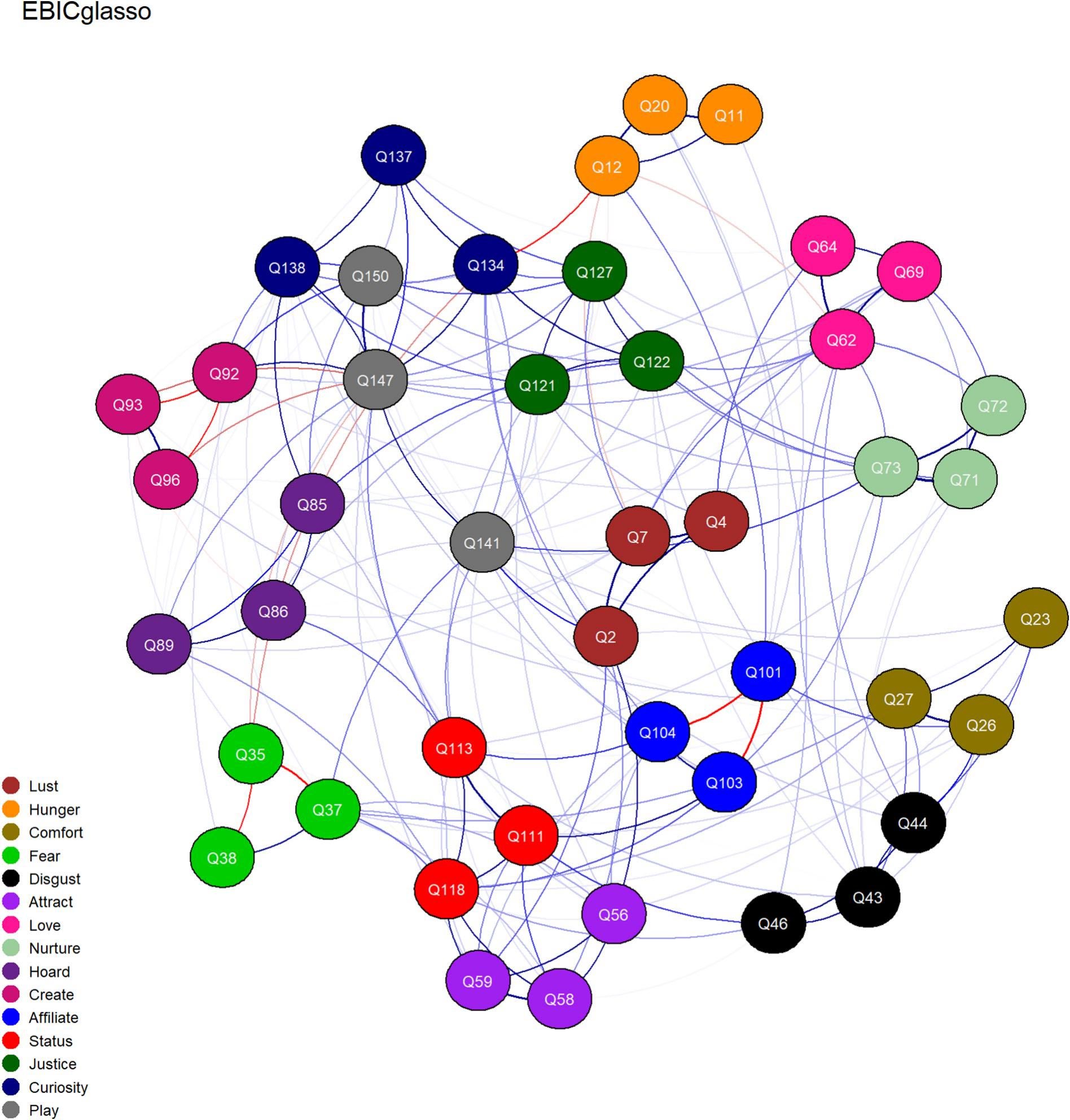
Interestingly, the motives of Play and Status emerged as pivotal points of connectivity, interacting extensively with other nodes, suggesting they influence a broad range of related motives. Status appears to be important as it facilitates the attainment of other goals by providing access to resources that enhance the chances of success in life, including attracting a partner. Maintaining status involves hoarding resources, fearing the loss of these resources, and effectively using them in various situations. The motive of play, in turn, helps develop the skills needed to maintain status and adapt to changing circumstances.
Insights from Evolutionary Psychology
“Using network-based psychometric techniques, we were able to observe how motives interrelate. For instance, the motives of Love and Nurture are positioned close to each other in the network, which makes sense from an evolutionary perspective, as caring for offspring enhances their chances of survival. Conversely, the motives of Fear and Curiosity often have opposing effects. Fear keeps us away from danger, but when excessive, it can suppress curiosity, which fosters knowledge and innovation,” explains Albina Gallyamova, Junior Research Fellow at the HSE Centre for Sociocultural Research.
The study also revealed age- and gender-related variations in the significance of different motives. Women tend to show a greater interest in the motives of Nurture and Comfort, while men are more likely to focus on the motives of Status and Attraction. The researchers note that these differences are linked to the traditional roles men and women played in our evolutionary past.
Age also contributes to shaping our priorities. Younger individuals tend to be more focused on Status and Play, while as people age, Fear and concern for Comfort become more prominent. “These changes reflect different life stages: initially, we strive to secure our place in society, and later, we focus on safety and survival,’ adds Gallyamova.
The study findings can be valuable in various fields, ranging from marketing to IT. For example, in advertising, understanding the motives of different social groups allows for more precise and effective communication. Youth focused on Status and Play are more likely to respond to incentives related to prestige and entertainment, while a more mature audience prioritizes safety, reliability, and comfort. In the field of AI, understanding evolutionary motives enables a more human-centered approach, offering gamification and social interaction for younger users, while emphasizing convenience and simplicity for the older generation. In therapy, understanding the underlying motives can help provide a more accurate response to the client’s needs. For example, addressing anxiety can take into account the evolutionary mechanism of avoiding danger and help strike a balance between safety and curiosity.
“Ultimately, understanding the evolutionary motives that drive our behavior enables us to create solutions that make people’s lives more comfortable, safer, and more interesting,” explains Gallyamova.
Reference: “Network psychometric-based identification and structural analysis of a set of evolved human motives” by Robert Aunger, Albina Gallyamova and Dmitry Grigoryev, 17 October 2024, Personality and Individual Differences.
DOI: 10.1016/j.paid.2024.112921
Never miss a breakthrough: Join the SciTechDaily newsletter.
Follow us on Google and Google News.