
Scientists at Oxford have taken a massive leap toward large-scale quantum computing by successfully linking separate quantum processors into a fully connected system.
This breakthrough overcomes a major challenge—scalability—by allowing small quantum devices to work together rather than trying to cram millions of qubits into a single machine. Using photonic links, they achieved quantum teleportation of logical gates across modules, essentially “wiring” them together. This distributed approach mirrors how supercomputers function, offering a flexible and upgradeable system.
First Distributed Quantum Computer
In a major step toward making quantum computing practical on a large scale, scientists at Oxford University Physics have successfully demonstrated distributed quantum computing for the first time. By connecting two separate quantum processors using a photonic network interface, they effectively created a single, fully integrated quantum computer. This breakthrough opens the door to solving complex problems that were previously impossible to tackle. Their findings were published today (February 5) in Nature.
One of the biggest challenges in quantum computing is scalability. To be truly revolutionary, a quantum computer would need to process millions of qubits. However, packing that many qubits into a single machine would require an enormous, impractical device. Instead, this new approach links smaller quantum processors together, allowing them to share the computational workload across a network. In theory, there is no limit to how many processors can be connected, making this a highly scalable solution.
Photonic Links: The Key to Expansion
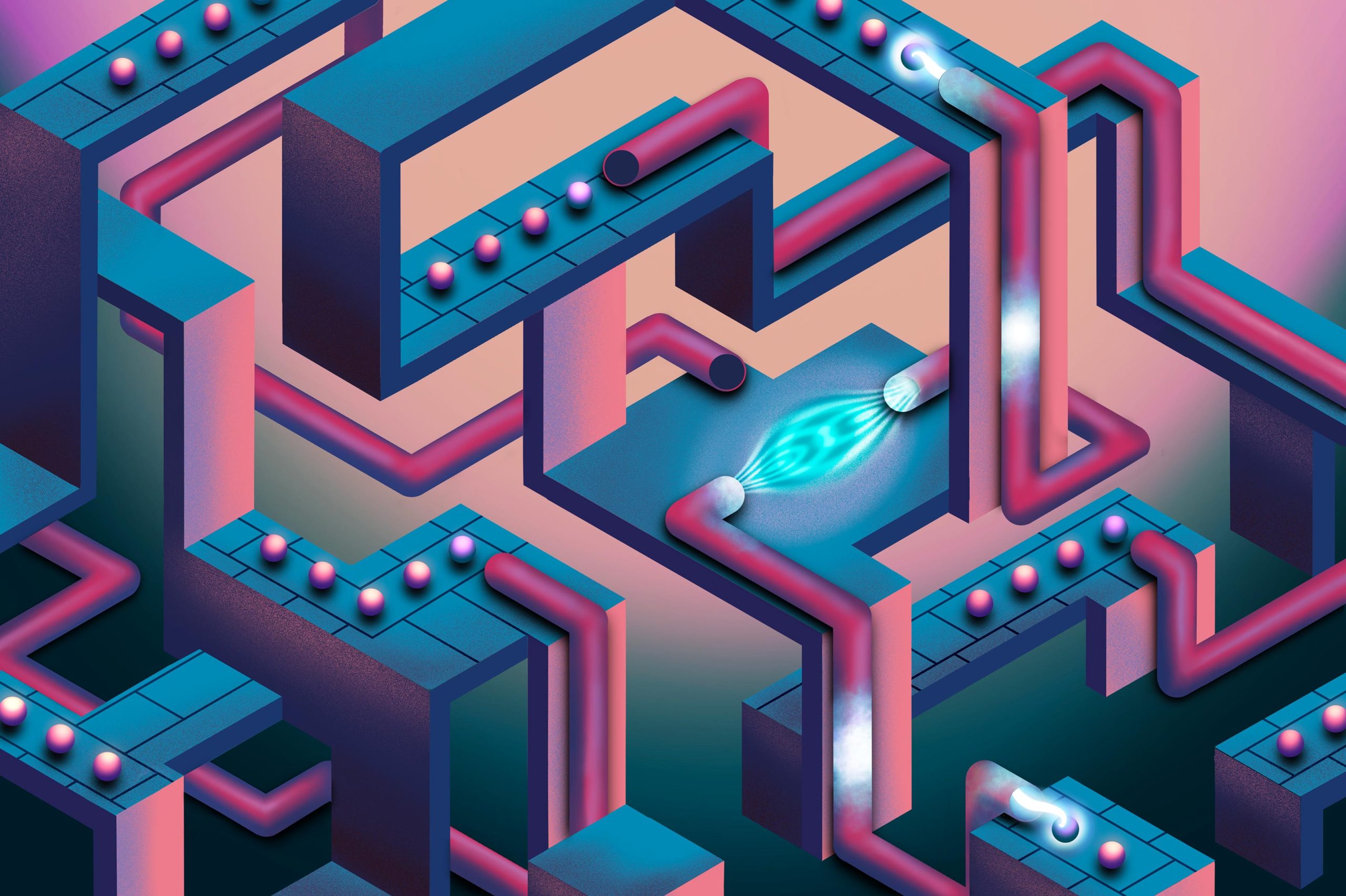
The scalable architecture is based on modules that each contain only a small number of trapped-ion qubits (atomic-scale carriers of quantum information). These are linked together using optical fibers, and use light (photons) rather than electrical signals to transmit data between them. These photonic links enable qubits in separate modules to be entangled,[1] allowing quantum logic to be performed across the modules using quantum teleportation.[2]
Although quantum teleportation of states has been achieved previously, this study is the first demonstration of quantum teleportation of logical gates (the minimum components of an algorithm) across a network link. According to the researchers, this could lay the groundwork for a future ‘quantum internet,’ where distant processors could form an ultra-secure network for communication, computation, and sensing.
Study lead Dougal Main from Oxford University Physics, said: “Previous demonstrations of quantum teleportation have focused on transferring quantum states between physically separated systems. In our study, we use quantum teleportation to create interactions between these distant systems. By carefully tailoring these interactions, we can perform logical quantum gates – the fundamental operations of quantum computing – between qubits housed in separate quantum computers. This breakthrough enables us to effectively ‘wire together’ distinct quantum processors into a single, fully-connected quantum computer.”
Linking Quantum Processors Like a Supercomputer
The concept is similar to how traditional supercomputers work. These are made up of smaller computers linked together to achieve capabilities that are greater than those of each separate unit. This strategy circumvents many of the engineering obstacles associated with packing ever larger numbers of qubits into a single device, while preserving the delicate quantum properties needed for accurate and robust computations.
Dougal Main added: “By interconnecting the modules using photonic links, the system gains valuable flexibility, allowing modules to be upgraded or swapped out without disrupting the entire architecture.”
The researchers demonstrated the effectiveness of the method by executing Grover’s search algorithm. This quantum method searches for a particular item in a large, unstructured dataset much faster than a regular computer can, using the quantum phenomena of superposition and entanglement to explore many possibilities in parallel. Its successful demonstration underscores how a distributed approach can extend quantum capabilities beyond the limits of a single device, setting the stage for scalable, high-performance quantum computers powerful enough to run calculations in hours that today’s supercomputers would take many years to solve.
Professor David Lucas, principal investigator of the research team and lead scientist for the UK Quantum Computing and Simulation Hub, led from Oxford University Physics, said: “Our experiment demonstrates that network-distributed quantum information processing is feasible with current technology. Scaling up quantum computers remains a formidable technical challenge that will likely require new physics insights as well as intensive engineering effort over the coming years.”
Notes
- Quantum entanglement: Where two particles, such as a pair of photons, remain correlated even when separated by vast distances. This allows them to share information without having to travel physically.
- Quantum teleportation: The transfer of quantum information over long distances almost instantly, using entanglement.
Reference: “Distributed quantum computing across an optical network link” by D. Main, P. Drmota, D. P. Nadlinger, E. M. Ainley, A. Agrawal, B. C. Nichol, R. Srinivas, G. Araneda and D. M. Lucas, 5 February 2025, Nature.
DOI: 10.1038/s41586-024-08404-x
Oxford University Physics is recognized worldwide for its leadership in both fundamental and applied quantum research, with teams that push the boundaries of photonic engineering, atomic-scale control, and algorithmic innovation. Principal funding for this research was provided by UKRI EPSRC, via the UK Quantum Computing and Simulation (QCS) Hub, part of the UK National Quantum Technologies Programme.
Never miss a breakthrough: Join the SciTechDaily newsletter.
Follow us on Google and Google News.
4 Comments
Holographic linkage needed.
Thinking of this in context of Large Language Models and the disruption that DeepSeek created. Would there even be a need for LLMs? So many other hardware, networking and compute disruption should this come to full fruition.
Quantum entanglement and Quantum teleportation . The enhancement of the Quantum computer to meat these goals needs something that hasn’t presented itself to the physics environment of science . Question ? Can the robustness of the two particles be enhanced to seperate them from others , solving the error correction and noise barriers that seem to be negatively affecting the processing of information . 😁
how