
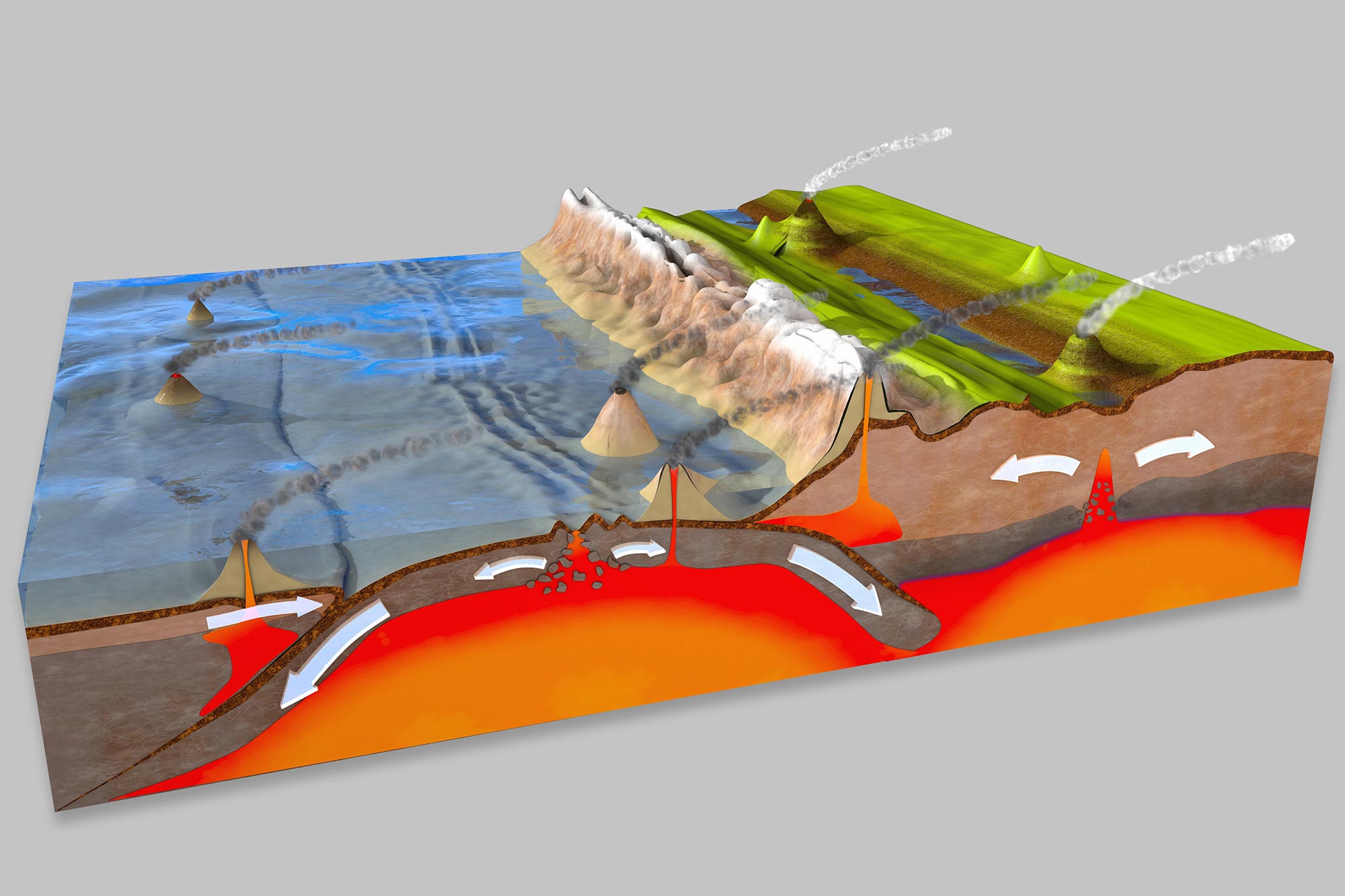
A breakthrough study has provided the most detailed 3D look yet at the inner workings of the Tonga Subduction Zone, where Earth’s fastest-moving tectonic plates are reshaping the planet’s crust.
Using innovative seismic techniques, researchers mapped deep mantle flows, revealing how molten rock interacts with sinking slabs to influence volcanic activity and plate movement.
Unveiling Mantle Dynamics in the Tonga Subduction Zone
A groundbreaking study published in Geoscience, a leading Chinese journal in earth science research, has provided new insights into mantle dynamics beneath the Tonga Subduction Zone. Researchers from Ocean University of China and Tohoku University, Japan, used advanced seismic techniques to create a detailed 3D model of mantle flow, slab-plume interactions, and back-arc basin activity. Their findings help resolve long-standing debates about how these deep-earth processes operate.
Seismic Data: Mapping the Mantle in High Resolution
The team analyzed 150,219 amplitude and phase measurements from 1,088 distant earthquakes (teleseismic events) recorded by 110 seismic stations, including both land-based and ocean-bottom sensors in the Lau Basin and surrounding areas. Using fundamental-mode Rayleigh waves (with periods of 20 to 150 seconds), they applied azimuthal anisotropy tomography—a technique that detects directional variations in seismic wave speeds due to mineral alignment in mantle rocks.
This approach allowed them to construct a high-resolution 3D velocity model extending 300 km below the surface. Rigorous validation tests confirmed the model’s accuracy, with lateral resolution of approximately 150 km and vertical resolution between 50 and 75 km above a depth of 150 km, ensuring reliable spatial detail.

Credit: Di Zhao, Xin Liu, Dapeng Zhao
Key Findings: Tracing Mantle Flow and Slab-Plume Interactions
Key findings reveal that the southward influx of Samoan mantle plume material into the Lau Basin is confined to depths shallower than 50 km, driven by asymmetric rollback of the subducting Pacific Plate. This shallow flow aligns with geochemical evidence of plume-derived signatures in the basin’s northern volcanic zones.
The study further identifies divergent mantle flow regimes: west-east oriented motion beneath the rapidly spreading northern Lau Basin contrasts with north-south flow in the slower southern region, reflecting passive adjustments to spatially variable slab retreat rates.
Within the subducting slab, near-trench-parallel fast shear-wave directions (N-S) at shallow depths (<150 km) correlate with bending-induced normal faults, while deeper regions exhibit localized trench-perpendicular anisotropy, suggesting stress reorientation. Additionally, a trench-parallel mantle flow in the outer-rise asthenosphere—likely compressed by slab rollback—challenges conventional models of subduction-driven circulation.
Tonga Subduction Zone: A Natural Laboratory for Geodynamics
The Tonga Subduction Zone, characterized by the world’s fastest plate convergence (~24 cm/year) and back-arc spreading rates, serves as a natural laboratory for studying plate-mantle interactions. By reconciling discrepancies among prior isotropic and anisotropic models, this study establishes the first cohesive 3D framework linking mantle dynamics to surface tectonics.
The integration of azimuthally varying surface-wave data with multi-scale tomography represents a methodological leap, bridging geophysical observations with geochemical evidence to clarify mechanisms of mantle flow, slab-plume interplay, and back-arc basin formation. These insights not only refine understanding of subduction zone processes but also offer a template for studying other complex systems, such as the Mariana and Izu-Bonin arcs, where mantle plumes and slab dynamics similarly interact.
Implications: Advancing Seismic Imaging and Geodynamic Models
This research underscores the transformative potential of high-resolution seismic imaging in earth sciences. The findings highlight the importance of international collaboration in addressing geodynamic challenges, providing actionable insights for hazard mitigation and advancing predictive models of planetary-scale processes. By decoding the hidden forces shaping Earth’s interior, this work exemplifies how cutting-edge seismology can illuminate the intricate dance between tectonic plates and mantle convection—a cornerstone of modern geoscience.
Reference: “Shear-wave Velocity and Azimuthal Anisotropy in the Upper Mantle of the Tonga Subduction Zone” by Di Zhao, Xin Liu and Dapeng Zhao, 10 February 2025, Geoscience.
DOI: 10.19657/j.geoscience.1000-8527.2024.101
Funding: National Natural Science Foundation of China, Japan Society for the Promotion of Science.
Never miss a breakthrough: Join the SciTechDaily newsletter.
Follow us on Google and Google News.