
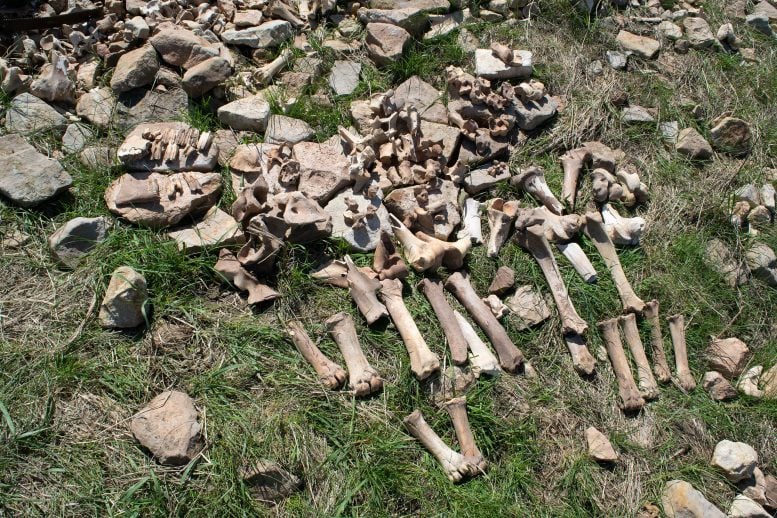
Recurring droughts and shifts to larger-scale hunting led to the abandonment of the Bergstrom bison site about 1,100 years ago, despite abundant bison.
For thousands of years, Indigenous peoples across the Great Plains hunted bison as a central part of their way of life. It was not until the late 1800s that commercial overhunting drove bison to near extinction. Long before that collapse, however, hunters relied on a range of strategies and locations, sometimes shifting between different types of sites depending on circumstances.
Scientists set out to understand why activity at the Bergstrom site ended despite the continued presence of large bison herds. The site had been used off and on for roughly 700 years before it was ultimately abandoned. Their findings were published in Frontiers in Conservation Science.
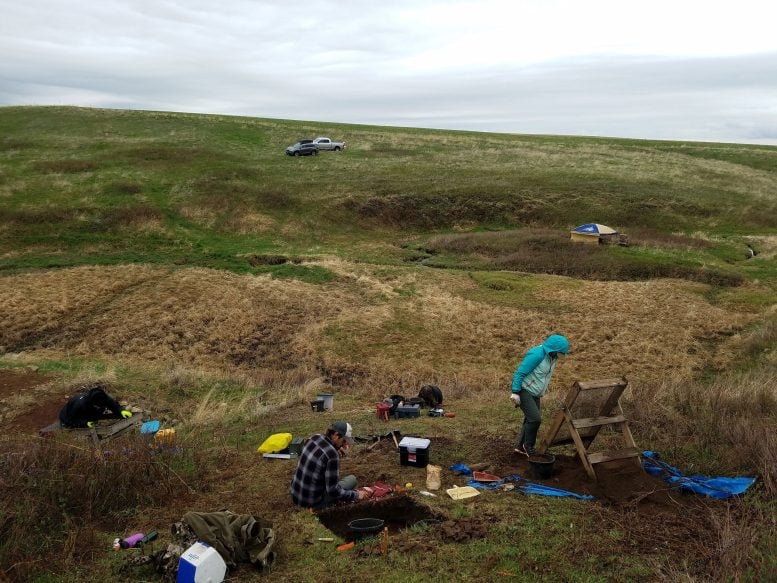
“We found that bison hunters ceased using a kill site in central Montana around 1,100 years ago,” said first author Dr. John Wendt, a paleoecologist and assistant professor of rangeland ecosystem management at New Mexico State University. “It appears that hunters stopped using it because severe, recurring droughts reduced the water available for processing animals at a small nearby creek. Site abandonment was a response to environmental stressors and changing social and economic pressures.”
Investigating the Bergstrom Site Mystery
To investigate, the researchers combined fieldwork and laboratory analysis to piece together the site’s environmental and cultural history. “The Bergstrom site presented a puzzle because it was used intermittently and abandoned when bison were common throughout the region and hunting was intense,” Wendt explained. “Why would hunters stop using a site that had worked for so long?”
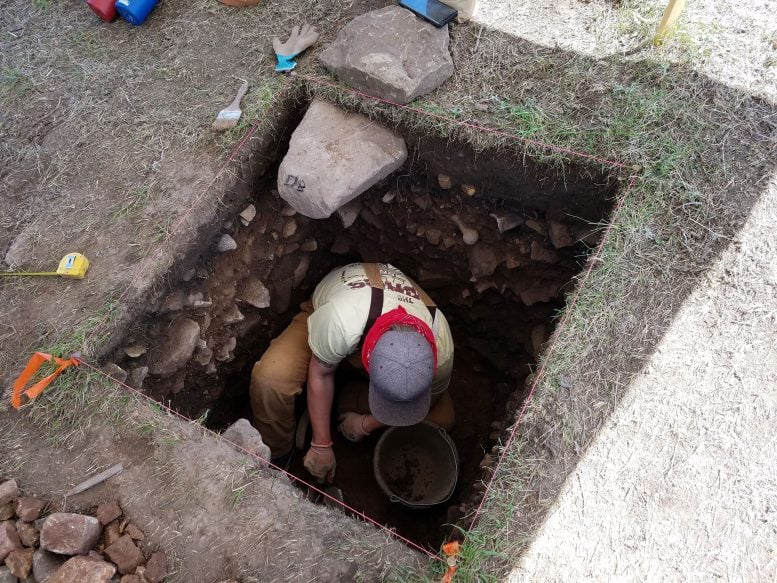
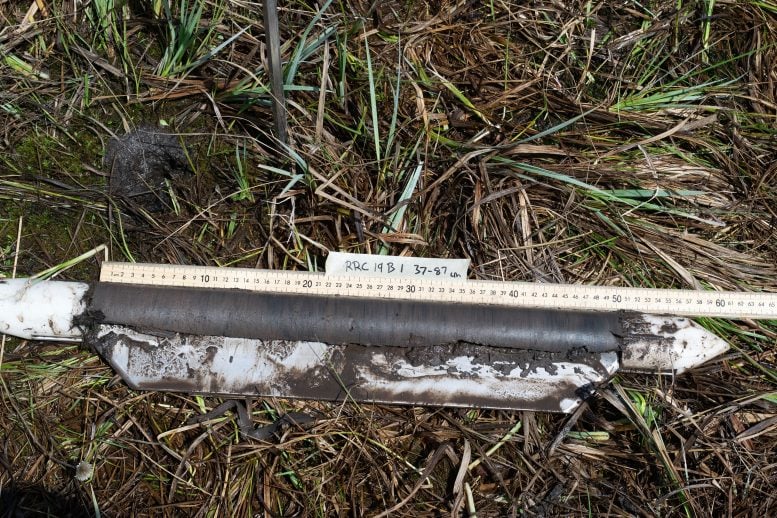
In the spring of 2019, the team excavated nine 1×1 m pits. They carefully recorded and photographed the materials they uncovered and submitted charcoal samples for radiocarbon dating. Two sediment cores were also taken near the excavation area and examined for pollen and charcoal fragments.
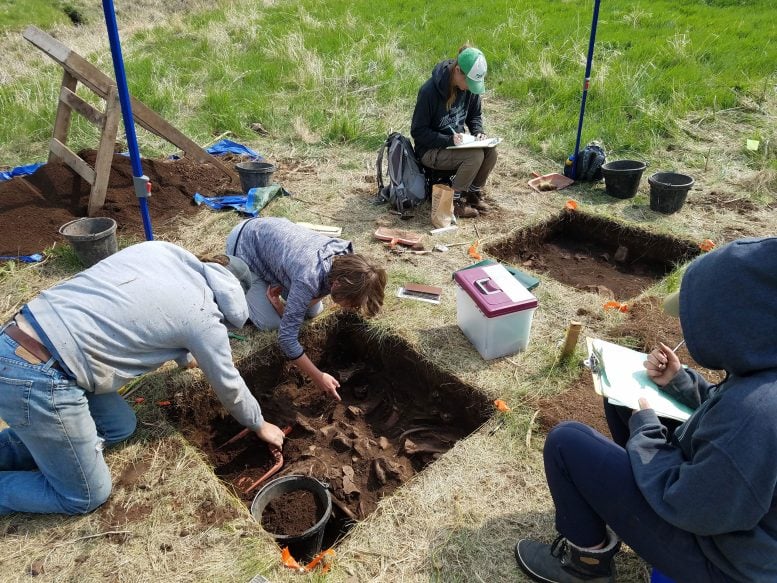
In addition, the researchers reviewed evidence for large herbivores and used climate reconstructions to understand environmental conditions at the time. This approach allowed them to test whether ecological decline explained the site’s abandonment or whether other factors were responsible.
“Abandonment wasn’t because the site became ecologically unsuitable in any absolute sense. Bison were still around, vegetation hadn’t changed, and there was no substantive shift in fire activities,” Wendt pointed out. “Bison hunting activity was not simply following prey populations.”
Drought, Water Scarcity, and Hunting Reorganization
Instead, the evidence points to extended droughts that affected the region both before and after the site was deserted. These dry periods reduced water flow in nearby creeks, making it more difficult to process animals after a hunt. Places without reliable water became less appealing.
At the same time, hunting groups were transforming how they operated. Rather than working in small, mobile bands that took advantage of opportunities as they arose, many groups began organizing larger, more coordinated hunts. These efforts involved built structures and longer stays at specific locations.
“These larger operations were based on large kills and could produce surplus for trade and winter storage, but they also meant more dependence on specific resources like water, forage for larger herds, and fuel for processing fires,” said Wendt.
Locations suitable for these large-scale hunts were limited. They required dependable water, sufficient grazing for bison, access to fuel, and landscape features that helped drive and contain herds, such as cliffs or natural barriers. When all of these conditions were met, such places were often used repeatedly for generations.
Climate Adaptation and Long-Term Flexibility
Relying on these bigger, more complex sites also increased risk. If environmental conditions shifted, they were not easy to replace. Over time, hunters adapted by reorganizing their activities while drawing on knowledge passed down through generations.
According to the researchers, this ability to adjust likely helped sustain bison hunting traditions through periods of climate instability. Similar flexibility may benefit modern bison management, allowing herds to be managed differently as environmental conditions change.
The researchers caution that not all bison hunting sites in the region would have been abandoned for the same reasons. Although evidence shows the Bergstrom site was used for about 700 years, the study could not determine how long each occupation lasted or how often people returned. It is also possible that once regular use ended, people returned only occasionally, leaving behind minimal evidence that would be difficult to detect today.
“While people have been adapting to the climate for much longer, Bergstrom’s abandonment shows that people reorganized in response to recurring droughts in the last 2,000 years,” concluded Wendt.
Reference: “American bison kill site use and abandonment amid drought and cultural shifts in late Holocene Montana” by John A. F. Wendt, Michael Neeley, Mio Alt, Stephanie A. Ewing, Georgianna S. Fischer and David B. McWethy, 27 November 2025, Frontiers in Conservation Science.
DOI: 10.3389/fcosc.2025.1688950
Never miss a breakthrough: Join the SciTechDaily newsletter.
Follow us on Google and Google News.
2 Comments
It wasn’t “commercial overhunting” that nearly drove bison to extinction. It was a planned and coordinated slaughter for the purpose of depriving natives of their primary source of meat. Few bison on the land meant few natives on the land. A peg in the wheel of a good, ol’ fashioned land grab.
It is evident that climate change has been an ongoing feature of Earth for all time, not just the last 100 or 200 years. How can one unequivocally distinguish an alleged anthropogenic imprint on temperature and precipitation from what has happened in the past, before the Industrial Revolution?
One common claim is that the recent warming rate is unprecedented. However, some have suggested that the last major glaciation ended abruptly, perhaps decades instead of thousand’s of years. The Paleocene-Eocene Thermal Maximum temperature-rise looks similar, but it is almost certainly an underestimate because time tends to act like a low-pass filter, reducing the amplitude and broadening peaks. Isotopic fractionation is one of the more compelling arguments, but we don’t really have a complete picture of how carbon and even oxygen isotope ratios change every time they are involved in a phase change or chemical reaction.
Does anyone have any suggestions?