
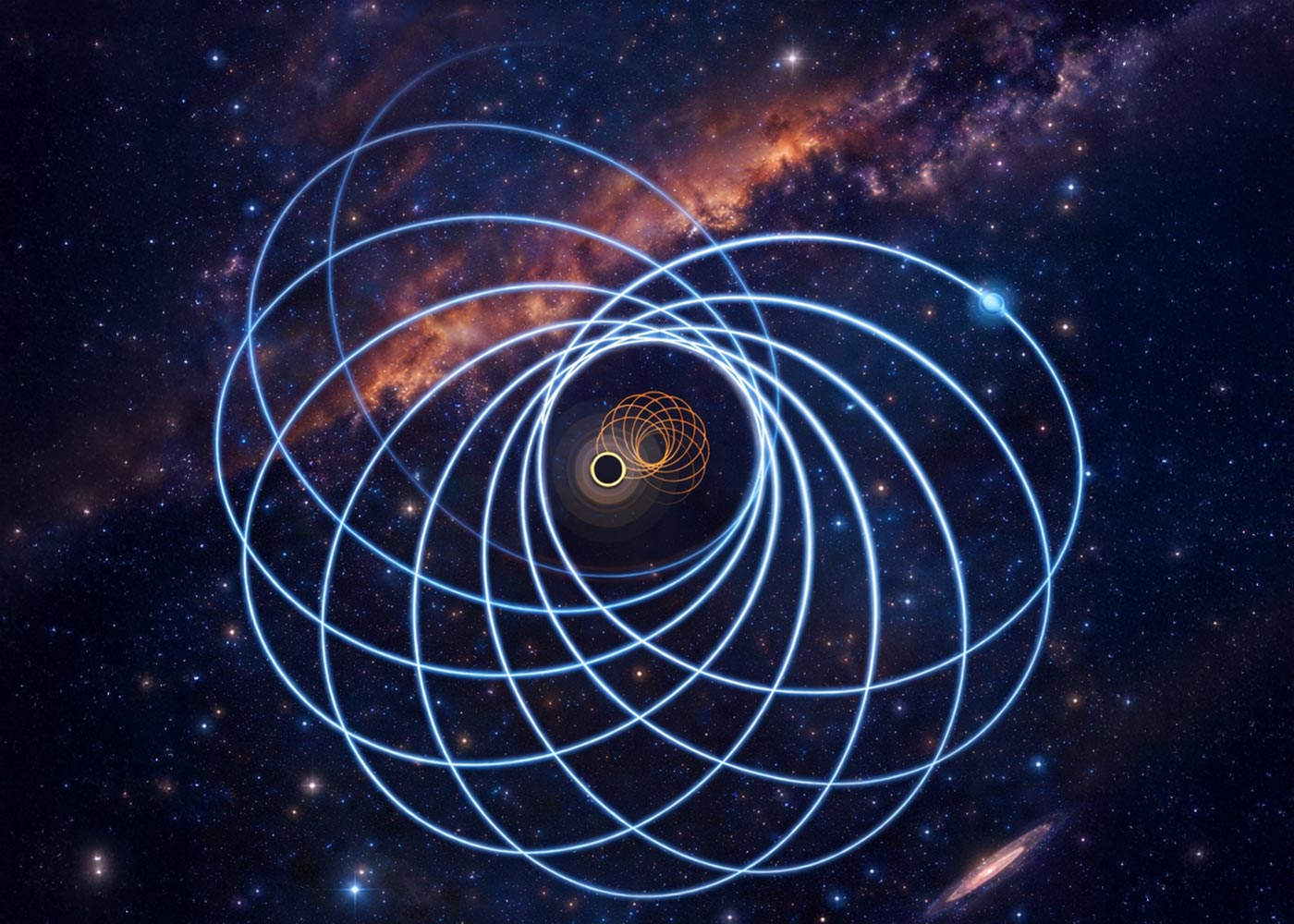
A newly analyzed gravitational-wave event has revealed something unexpected about one of the Universe’s most violent encounters.
Scientists have found the first strong evidence that a black hole and a neutron star collided while moving along an oval shaped orbit instead of the nearly perfect circle that scientists had long expected. The finding challenges existing ideas about how these extreme cosmic systems form and evolve.
Researchers from the University of Birmingham, Universidad Autónoma de Madrid, and the Max Planck Institute for Gravitational Physics reported the results in The Astrophysical Journal Letters.
Most known neutron star-black hole pairs are thought to settle into circular orbits well before they merge. However, a detailed study of the gravitational-wave event GW200105 revealed a different picture.
The data indicate that the two objects were traveling along an oval-shaped, or elliptical, orbit shortly before they merged. The collision eventually produced a black hole about 13 times the mass of the Sun. Researchers say this type of orbital pattern has never been observed before in a neutron star-black hole merger.
Dr Patricia Schmidt from the University of Birmingham said: “This discovery gives us vital new clues about how these extreme objects come together. It tells us that our theoretical models are incomplete and raises fresh questions about where in the Universe such systems are born.”
Detecting Subtle Signals in Gravitational Waves
To investigate the event, the team analyzed observations from the LIGO and Virgo detectors using a new gravitational-wave model created at the University of Birmingham’s Institute of Gravitational Wave Astronomy.
The approach allowed the scientists to measure how stretched or oval the orbit was, a property known as eccentricity. They also looked for signs of wobbling caused by spinning objects, known as precession. According to the researchers, this is the first time both of these effects have been measured together in a neutron star-black hole merger.
Geraint Pratten, a Royal Society University Research Fellow from the University of Birmingham, said: “The orbit gives the game away. Its elliptical shape just before merger shows this system did not evolve quietly in isolation but was almost certainly shaped by gravitational interactions with other stars, or perhaps a third companion.”
Reanalyzing the Event With Improved Models
The team used Bayesian statistical methods to compare thousands of theoretical predictions with the real gravitational-wave data. Their analysis shows that a circular orbit is extremely unlikely for this system, ruling it out with 99.5% confidence.
Earlier studies of GW200105 assumed the objects were moving in a circular orbit. That assumption led researchers to underestimate the mass of the black hole and overestimate the mass of the neutron star. The new analysis corrects those values.
The study also found no strong evidence for orbital wobbling caused by spin. This suggests that the elliptical orbit likely formed during the system’s early development rather than being created by the spins of the two objects.
Gonzalo Morras from the Universidad Autónoma de Madrid and the Max Planck Institute for Gravitational Physics said: “This is convincing proof that not all neutron star–black hole pairs share the same origin. The eccentric orbit suggests a birthplace in an environment where many stars interact gravitationally.”
Rethinking How These Systems Form
The discovery challenges the widely held idea that neutron star-black hole mergers mainly form through a single dominant evolutionary path. Instead, it suggests that multiple formation processes may produce these systems.
The findings also highlight the importance of developing more advanced waveform models that can better capture the complex behavior of merging compact objects.
As gravitational-wave observatories detect more events, researchers expect to uncover an even wider variety of merger scenarios. These discoveries could help reveal the diverse environments where neutron stars and black holes form and interact.
Reference: “Orbital Eccentricity in a Neutron Star–Black Hole Merger” by Gonzalo Morras, Geraint Pratten and Patricia Schmidt, 11 March 2026, The Astrophysical Journal Letters.
Never miss a breakthrough: Join the SciTechDaily newsletter.
Follow us on Google and Google News.