

Scientists are uncovering the mysteries of the Mpemba effect.
The Mpemba effect, whereby hotter systems can cool faster than cooler ones under identical conditions, was first noted by Aristotle over 2,000 years ago. It was rediscovered in 1963 by Tanzanian student Erasto Mpemba, who observed the phenomenon while making ice cream during a school cooking class. Mpemba later co-authored a scientific paper with British physicist Denis Osborne, documenting the effect in water.
Following their work, researchers have found that the Mpemba effect is not limited to water or simple liquids. It has been observed in a wide range of physical systems, including microscopic ones. However, a major challenge remains: detecting the Mpemba effect depends critically on the choice of a distance measure used to track how far a system is from equilibrium.
Because there are infinitely many possible distance measures, an effect seen using one measure may not appear within any finite time using another. Traditional approaches often evaluate relaxation speed, the rate at which a system returns to equilibrium after a temperature change, using a single, monotonic measure. But this can yield inconsistent or misleading results.
A Universal Criterion Using Thermomajorization
These pitfalls motivated a team of researchers at Kyoto University to develop a universal criterion for determining the presence of the Mpemba effect: one that does not rely on a single measure. Their approach uses thermomajorization theory, a mathematical framework that unifies different distance measures.
“Our study proves that the use of thermomajorization is equivalent to considering all monotone measures simultaneously,” says corresponding author Tan Van Vu.
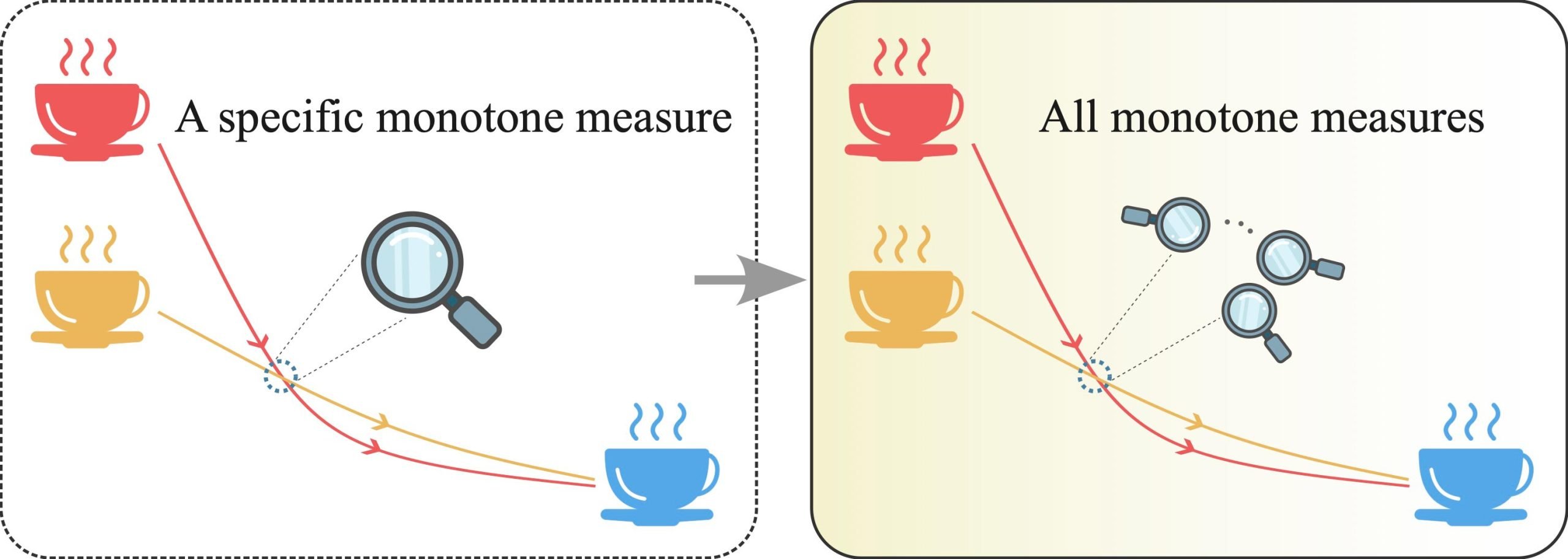
By employing this theory, Vu and his colleague Hisao Hayakawa were able to provide a rigorous criterion for evaluating thermal relaxation speed, eliminating ambiguities in previous studies and establishing an unambiguous framework for measuring the Mpemba effect.
The team’s research also led to the intriguing discovery that the effect is not restricted to a specific temperature range, but can emerge across a wide spectrum of thermal conditions.
“This surprising result suggests that the Mpemba effect reflects a more universal underlying mechanism than previously thought,” continues Vu.
In uncovering these mysteries, the group’s findings offer new insights into the fundamental principles governing thermal relaxation dynamics, as well as having potential application in enhancing the efficiency of heat engines and cooling technologies. The fields of quantum computing and biophysics stand to benefit as well.
According to Vu and Hayakawa, however, one important question remains: what is the minimum timescale at which the thermomajorization Mpemba effect can occur? Investigating this aspect through the lens of speed limits could help establish fundamental constraints on relaxation dynamics.
Reference: “Thermomajorization Mpemba Effect” by Tan Van Vu and Hisao Hayakawa, 10 March 2025, Physical Review Letters.
DOI: 10.1103/PhysRevLett.134.107101
The study was funded by the Japan Society for the Promotion of Science.
Never miss a breakthrough: Join the SciTechDaily newsletter.
Follow us on Google and Google News.
1 Comment
Which explains why my cup of tea’s heat has a half-life. Fascinating; I wonder how many other people have observed the same thing and thought nowt about it because it is normal. Thus, science advances but slowly………….