
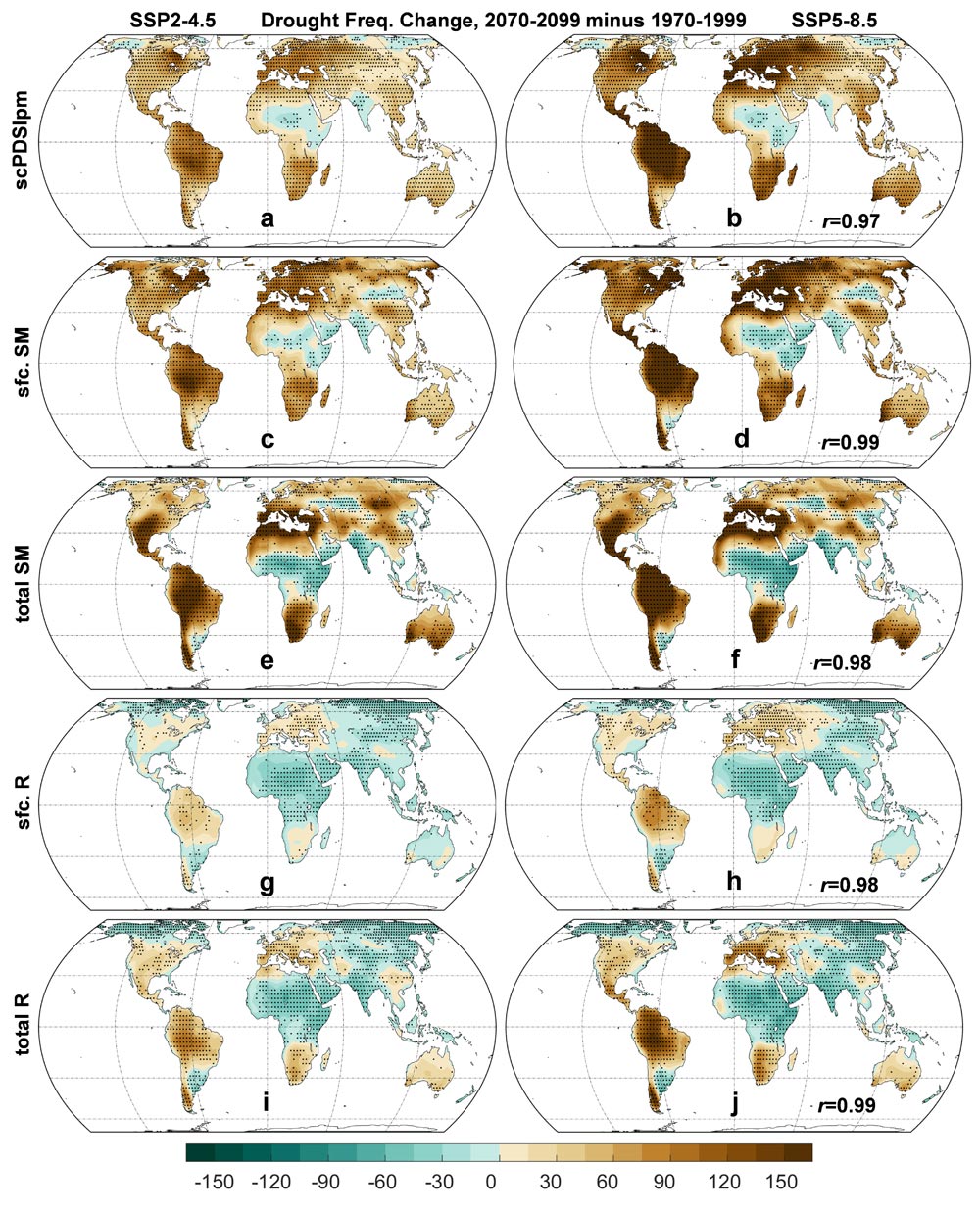
Climate models predict worsening and prolonged droughts globally, especially in Africa, Europe, and the Americas, due to climate change.
Drought is among the most damaging natural hazards in the world, often causing severe losses to agriculture, ecosystems, and human societies.
Historical records of precipitation, streamflow, and observation-derived drought indices all show increased aridity since 1950s over several hotspot regions, including Africa, southern Europe, East Asia, eastern Australia, Northwest Canada, and southern Brazil.
Insights from CMIP6 Model Projections
“Climate model projections also suggest that drought may become more severe and widespread as the greenhouse gas-induced global warming continues in the 21st century,” said Prof. ZHAO Tianbao from the Institute of Atmospheric Physics (IAP) of the Chinese Academy of Sciences.
Recently, ZHAO and Prof. DAI Aiguo from University at Albany, State University of New York, further investigated hydroclimatic and drought changes in the latest projections from 25 models of the Phase Six of the Coupled Model Intercomparison Project (CMIP6).
Their results were recently published in Journal of Climate.
The study suggests that the latest projections from CMIP6 models reaffirm the widespread drying and increases in agricultural drought by up to 200% over most of the Americas (including the Amazon), Europe and the Mediterranean region, southern Africa, Southeast Asia, and Australia under moderate-high emissions scenarios in the 21st century.
As if that wasn’t bad enough, the drought is also expected to last longer and spread wider in the late twenty-first century (2070–99), ZHAO noted.
The Drivers Behind Increasing Drought
The model results suggest a decrease in the mean and flattening of the probability distribution functions of drought metrics, despite large uncertainties in individual projections partly due to internal variability.
“With rising temperatures, everywhere there’s an increasing demand of moisture from the atmosphere, and precipitation decreases over many subtropical regions. These are the main driver of the projected widespread and increasing drought,” said ZHAO.
Reference: “CMIP6 Model-Projected Hydroclimatic and Drought Changes and Their Causes in the Twenty-First Century” by Tianbao Zhao and Aiguo Dai, 5 January 2022, Journal of Climate.
DOI: 10.1175/JCLI-D-21-0442.1
Never miss a breakthrough: Join the SciTechDaily newsletter.
Follow us on Google and Google News.
5 Comments
It is generally acknowledged that the CMIP6 models are running too hot. Furthermore, the RCP8.5 scenario, while intended as a “Business as Usual” scenario, has been shown to be improbable because of inadequate fossil fuel resources. Furthermore, models are at their least skill in predicting precipitation. So, right out of the blocks, this study is based on flawed assumptions.
While increased loss of water over land is mentioned as contributing to drought, there is no mention of concomitant increased evaporation over the oceans. Is it all going to fall back into the oceans, or will some of it make to land and help compensate the losses in fields and forests? There isn’t even speculation offered!
Only the potentially bad news is provided. It seems that all too many ‘climatologists’ have adopted the motto of the news media: “If it bleeds, it leads.” Objectivity has become a thing of the past.
“Historical records of precipitation, streamflow, and observation-derived drought indices all show increased aridity since 1950s over several hotspot regions, …”
Even more than during the infamous Dust Bowl era of the 1930s?
Some people are so freaked out about the water that they are actually picking up and moving North closer to lake superior.
I am sure these ‘predictions’ are as accurate and scientifically ‘based’ as the AGW predictions and the prediction of the coming Ice Age when I was a young kid. Really. This crap is used to scare people into giving up their rights to Mother Government. Very sad.
Maybe it is the black horse in the book of Revelation. The weight on the scale does not match the money paid. There indicates inflation and as a result famine.