
Close Menu
    Facebook X (Twitter) Instagram
    SciTechDaily
    • Biology
    • Chemistry
    • Earth
    • Health
    • Physics
    • Science
    • Space
    • Technology
    Facebook X (Twitter) Pinterest YouTube RSS
    SciTechDaily
    Home»Science»“Scintillating Starburst” Stimulus: A New Kind of Visual Illusion Uncovers How Our Brains Connect the Dots
    Science

    “Scintillating Starburst” Stimulus: A New Kind of Visual Illusion Uncovers How Our Brains Connect the Dots

    By New York UniversityJune 29, 2021No Comments3 Mins Read
    Facebook Twitter Pinterest Telegram LinkedIn WhatsApp Email Reddit
    Share
    Facebook Twitter LinkedIn Pinterest Telegram Email Reddit
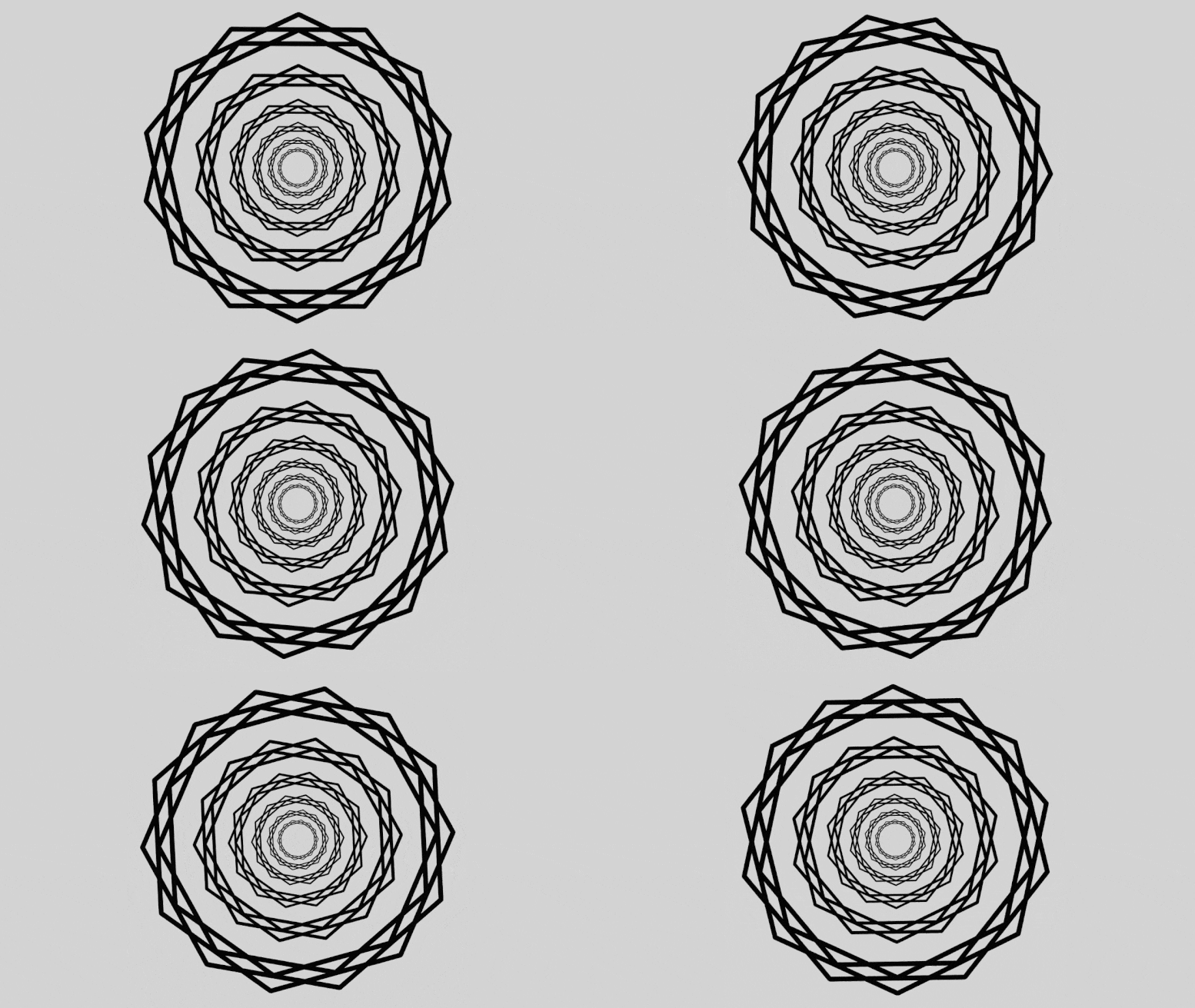
    Scintillating Starburst Stimulus
    This stimulus is made up of several concentric pairs of scaled star polygons. Most observers perceive fleeting rays, beams, or lines emanating from the center that appear to be brighter than the background. Credit: Courtesy of Michael Karlovich, Recursia LLC

    ‘Scintillating Starburst’ Offers Insights Into Visual Processing

    A new class of illusion, developed by a visual artist and a psychology researcher, underscores the highly constructive nature of visual perception.

    The illusion, which the creators label “Scintillating Starburst,” evokes illusory rays that seem to shimmer or scintillate–like a starburst. Composed of several concentric star polygons, the images prompt viewers to see bright fleeting rays emanating from the center that are not actually there.

    Perception vs. Sensation: The Psychology Behind Illusions

    “The research illustrates how the brain ‘connects the dots’ to create a subjective reality in what we see, highlighting the constructive nature of perception,” explains Pascal Wallisch, a clinical associate professor in New York University’s Department of Psychology and Center for Data Science and senior author of the paper, which appears in the journal i-Perception.

    “Studying illusions can be helpful in understanding visual processing because they allow us to distinguish the mere sensation of physical object properties from the perceptual experience,” adds first author Michael Karlovich, founder and CEO of Recursia Studios, a multidisciplinary art and fashion production company.

    The authors acknowledge that the visual effects of this illusion are superficially similar to a number of previously described effects of other, grid-based illusions. However, their Scintillating Starburst, unlike known visual illusions, evokes a number of newly discovered effects, among them that fleeting illusory lines diagonally connect the intersection points of the star polygons.

    To better understand how we process this class of illusion, the researchers ran a series of experiments with more than 100 participants, who viewed 162 different versions of the Scintillating Starburst, which varied in shape, complexity, and brightness.

    The research participants were then asked a series of questions about what they saw–for instance, “I do not see any bright lines, rays, or beams,” “I maybe see bright lines, rays, or beams, but they are barely noticeable,” and “I see bright lines, rays, or beams, but they are subtle and weak.”

    More Intersections, More Illusion

    The authors found that the confluence of several factors, including contrast, line width, and number of vertices, matters.

    “In particular, a large number of prominent intersection points leads to stronger and more vivid rays, as there are more cues to indicate the implied lines,” observes Wallisch.

    Thus, this research illustrates how the brain “connects the dots” to create one’s subjective reality, even on the perceptual level, highlighting the constructive nature of perception.

    Reference: “Scintillating Starbursts: Concentric Star Polygons Induce Illusory Ray Patterns” by Michael W. Karlovich and Pascal Wallisch, 29 June 2021, i-Perception.
    DOI: 10.1177/20416695211018720

    Never miss a breakthrough: Join the SciTechDaily newsletter.
    Follow us on Google and Google News.

    Behavioral Science Brain New York University Perception Popular
    Share. Facebook Twitter Pinterest LinkedIn Email Reddit

    Related Articles

    Universality of Human Emotional Expression: The 16 Facial Expressions Most Common Worldwide

    Brain Mechanisms Underlying Irrational Decision-Making: “Happy Endings” Can Bias Future Decisions

    Why Time Sometimes Flies or Drags: How the Brain Creates the Experience of Time

    Why Do People Believe Con Artists?

    How Touching Is Perceived in the Brain – Investigated With Two-Person MRI Scans on Couples

    Scientists Can See the Bias in Your Brain – Even Before You Make Your Decision

    Never Trust a Person’s Face? New Research on Analyzing Facial Expressions

    MIT Neuroscientists Demonstrate Controlling Attention With Brain Waves

    Dreams May Serve a Real Purpose: Preparing Us to Face Our Fears

    Leave A Reply Cancel Reply

    • Facebook
    • Twitter
    • Pinterest
    • YouTube

    Don't Miss a Discovery

    Subscribe for the Latest in Science & Tech!

    Trending News

    New “Nanozyme Hypothesis” Could Rewrite the Story of Life’s Origins

    Anatomy Isn’t Finished: The Human Body Still Holds Secrets

    “Pretty Close to Home”: The Hidden Earthquake Threat Beneath Seattle

    The Surprising Reason You Might Want To Sleep Without a Pillow

    Scientists Say This Natural Hormone Reverses Obesity by Targeting the Brain

    35-Million-Year-Old Mystery: Strange Arachnid Discovered Preserved in Amber

    Is AI Really Just a Tool? It Could Be Altering How You See Reality

    JWST Reveals a “Forbidden” Planet With a Baffling Composition

    Follow SciTechDaily
    • Facebook
    • Twitter
    • YouTube
    • Pinterest
    • Newsletter
    • RSS
    SciTech News
    • Biology News
    • Chemistry News
    • Earth News
    • Health News
    • Physics News
    • Science News
    • Space News
    • Technology News
    Recent Posts
    • Scientists Freeze a Spinning Nanoparticle to Its Quantum Limit
    • A 100x Faster Breakthrough Could Fix Quantum Computers’ Biggest Problem
    • New Memory Chip Survives 1300°F, Hotter Than Lava
    • Scientists Unveil Microscopy Breakthrough That Reveals “Invisible” Molecular States
    • Scientists Finally Crack the Mystery of Water’s Strangest Behavior After Decades of Research
    Copyright © 1998 - 2026 SciTechDaily. All Rights Reserved.
    • Science News
    • About
    • Contact
    • Editorial Board
    • Privacy Policy
    • Terms of Use

    Type above and press Enter to search. Press Esc to cancel.