
Close Menu
    Facebook X (Twitter) Instagram
    SciTechDaily
    • Biology
    • Chemistry
    • Earth
    • Health
    • Physics
    • Science
    • Space
    • Technology
    Facebook X (Twitter) Pinterest YouTube RSS
    SciTechDaily
    Home»Space»Seismic Analysis of Young Stars Reveals Their Evolution
    Space

    Seismic Analysis of Young Stars Reveals Their Evolution

    By Harvard-Smithsonian Center for AstrophysicsAugust 29, 2014No Comments3 Mins Read
    Facebook Twitter Pinterest Telegram LinkedIn WhatsApp Email Reddit
    Share
    Facebook Twitter LinkedIn Pinterest Telegram Email Reddit
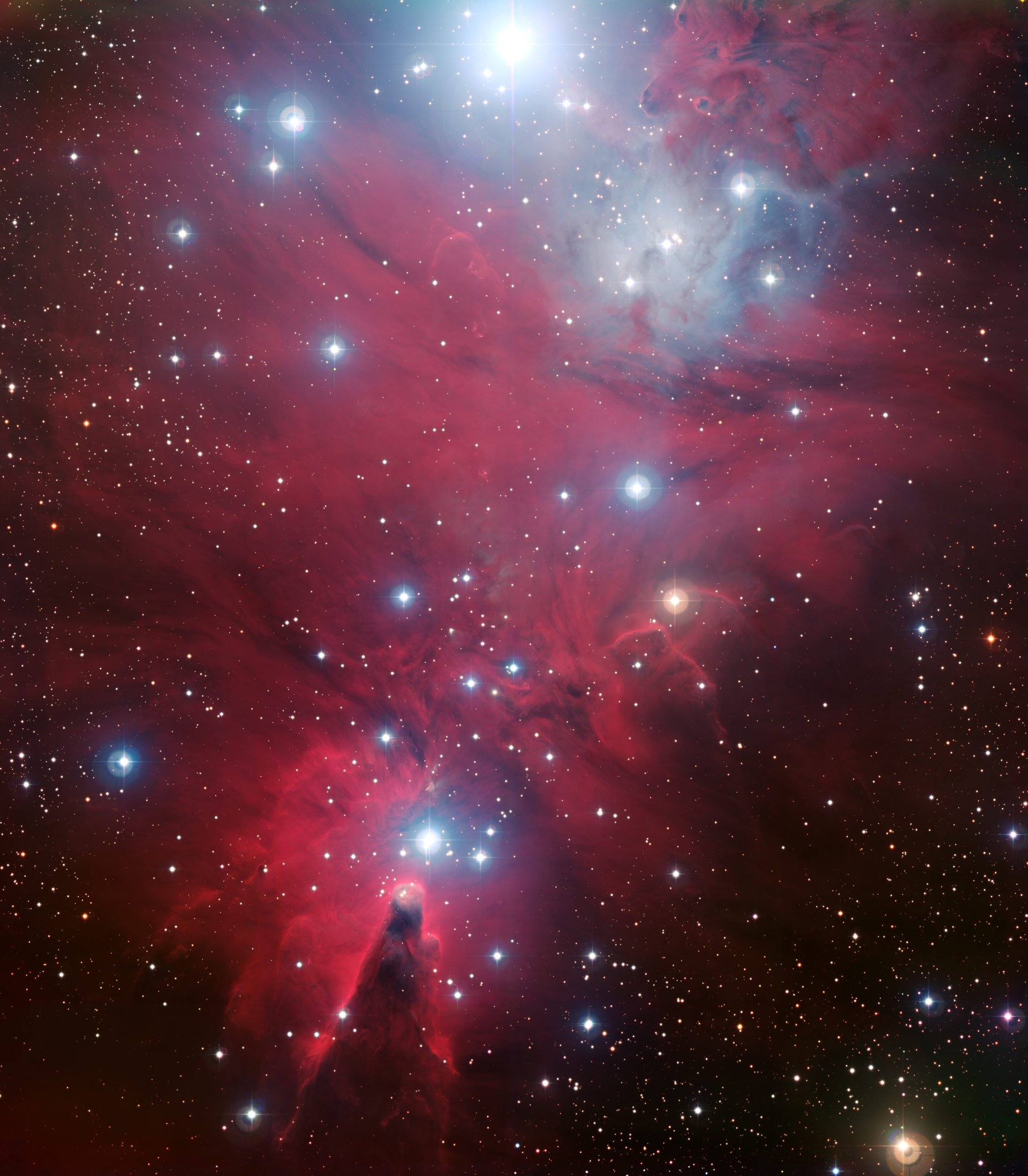
    Astronomers Measure Pulsations in the Light of Young Stars
    An optical image of the region NGC 2264 containing a cluster of young stars. Astronomers have measured pulsations in the light of some of these stars and used them to infer the physical processes underway before they mature and begin to burn hydrogen fuel. Credit: ESO

    A team of astronomers studying the surface vibrations in thirty-four young stars has found a clear relationship between seismic observables and evolutionary status, and in particular they are able to infer the internal stellar processes underway and the star’s corresponding evolutionary development.

    The evolution of a star depends crucially on its initial birth mass and composition, and developments in its early lifetime. These initial properties determine, for example, the production of the chemical elements forged later on in the star’s nuclear furnace, and its early angular momentum affects the subsequent distribution of its internal energy. Astronomers are therefore working to understand the physical processes underway in the very earliest stages of a star’s life after a dense clump of interstellar matter has contracted, warmed, and begun the stellar gestation processes.

    In the early stages of a star’s life, its central temperature and density are not yet high enough to initiate significant nuclear burning; its energy comes from the release of gravitational energy, and it circulates via gas motions. As the internal temperatures rise and the hot gas becomes more transparent, this internal energy begins to redistribute itself through radiation as well as gas motions. Then, as these and related processes compete for primacy, the star starts to vibrate slightly, an effect which can be observed as periodic variations in the star’s surface through the luminosity and temperature. In some young stars it is possible to use “asteroseismology” – the measurement of these acoustic patterns – to explore the star’s structure and evolution.

    CfA astronomer Dimitar Sasslov has joined with a team of other investigators to study the surface vibrations in thirty-four young stars. Their ages are constrained by their emission spectra or by their being members of stellar clusters whose ages are known to be less than about ten million years, either signaling likely periodic vibrations in the young stars. The team finds a clear relationship between seismic observables and evolutionary status, and in particular they are able to infer the internal stellar processes underway and the star’s corresponding evolutionary development. By analogy to a sonogram, this technique of asteroseismology is able to probe the unborn, and offers a new probe of the earliest stages of a star’s life.

    Reference: “Echography of Young Stars Reveals Their Evolution” by K. Zwintz, L. Fossati, T. Ryabchikova, D. Guenther, C. Aerts, T. G. Barnes, N. Themess, D. Lorenz, C. Cameron, R. Kuschnig, S. Pollack-Drs, E. Moravveji, A. Baglin, J. M. Matthews, A. F. J. Moffat, E. Poretti, M. Rainer, S. M. Rucinski, D. Sasselov and W. W. Weiss, 3 July 2014, Science.
    DOI: 10.1126/science.1253645
    arXiv: 1407.4928


    Never miss a breakthrough: Join the SciTechDaily newsletter.
    Follow us on Google and Google News.

    Asteroseismology Astronomy Astrophysics Harvard-Smithsonian Center for Astrophysics Stellar Evolution
    Share. Facebook Twitter Pinterest LinkedIn Email Reddit

    Related Articles

    Astronomers Explore the First Three Billion Years of Stars

    Dark Stars – Astronomers Investigate if Dark Matter Influenced the Development of Stars

    SMA Reveals New Insights Into How Cosmic Seeds Grow Into Massive Stars

    New Algorithm Allows Astronomers to Track the Process of Star Formation in the Early Universe

    Astronomers Discover “Old Young” Stars in the Eagle Nebula

    TW Hydrae Provides Insight About the Birth of Our Sun

    Herschel Discovers the Earliest Known Starburst Galaxy

    Masers as Evolutionary Indicators for Star Formation

    Two Planets Separated by Less Than 5 Earth Moon Distances

    Leave A Reply Cancel Reply

    • Facebook
    • Twitter
    • Pinterest
    • YouTube

    Don't Miss a Discovery

    Subscribe for the Latest in Science & Tech!

    Trending News

    The Universe Is Expanding Too Fast and Scientists Can’t Explain Why

    “Like Liquid Metal”: Scientists Create Strange Shape-Shifting Material

    Early Warning Signals of Esophageal Cancer May Be Hiding in Plain Sight

    Common Blood Pressure Drug Shows Surprising Power Against Deadly Antibiotic-Resistant Superbug

    Scientists Uncover Dangerous Connection Between Serotonin and Heart Valve Disease

    Scientists Discover a “Protector” Protein That Could Help Reverse Hair Loss

    Bone-Strengthening Discovery Could Reverse Osteoporosis

    Scientists Uncover Hidden Trigger Behind Stem Cell Aging

    Follow SciTechDaily
    • Facebook
    • Twitter
    • YouTube
    • Pinterest
    • Newsletter
    • RSS
    SciTech News
    • Biology News
    • Chemistry News
    • Earth News
    • Health News
    • Physics News
    • Science News
    • Space News
    • Technology News
    Recent Posts
    • Scientists Overcome Major Quantum Bottleneck, Potentially Transforming Teleportation and Computing
    • Quantum Physics’ Strangest Problem May Hold the Key to Time Itself
    • Scientists Create “Liquid Gears” That Spin Without Touching
    • The Simple Habit That Could Help Prevent Cancer
    • Forgotten Medicinal Plant Shows Promise in Fighting Dangerous Superbugs
    Copyright © 1998 - 2026 SciTechDaily. All Rights Reserved.
    • Science News
    • About
    • Contact
    • Editorial Board
    • Privacy Policy
    • Terms of Use

    Type above and press Enter to search. Press Esc to cancel.