
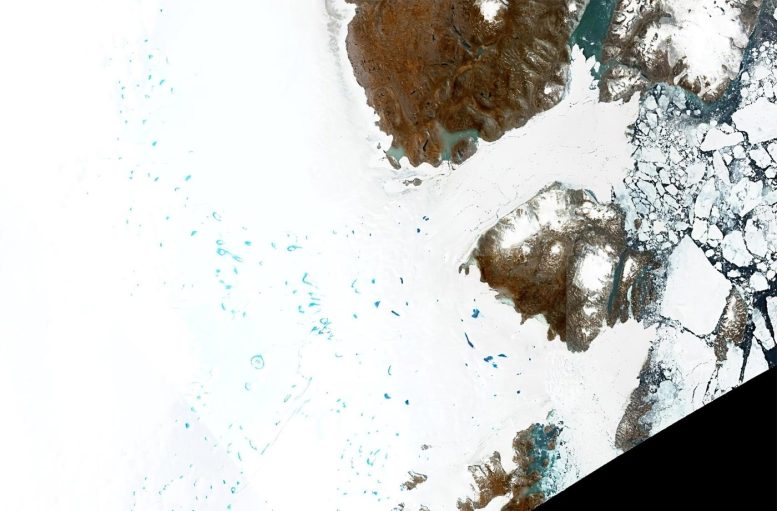
Atmospheric rivers contribute to the acceleration of glacial melting in northern Greenland, as warming conditions caused by these moisture flows result in meltwater pools and rivers that absorb more sunlight. This situation may worsen if climate change leads to increased moisture transportation within atmospheric rivers.
Atmospheric rivers — long, concentrated flows of moisture in the sky — are a key factor in the complex conditions accelerating glacial melting over northern Greenland, according to new research from the University of Wisconsin–Madison.
Led by Kyle Mattingly, a researcher at UW–Madison’s Space Science and Engineering Center, the new study of the rivers of moisture over Greenland was published recently in the journal Nature Communications.
Sometimes stretching thousands of kilometers, atmospheric rivers transport moisture away from the tropics to other parts of the globe. They are a necessary part of the global weather cycle and can bring needed rains to drought-stricken areas. But they can also contribute to dangerous flooding.
“The Greenland ice sheet has seen an acceleration in glacial melt over the last 30 years,” says Mattingly. “Our research shows the major impacts atmospheric rivers can have over the northeast part of the ice sheet.”
Greenland is covered by a 3,000-meter (9,800-foot) thick ice sheet that contains enough water to raise sea levels by 7 meters, or 23 feet. For millennia, it has played a major role in regulating Earth’s temperature and climate, but that stability is at risk due to climate change.
Foehn Winds and Amplified Warming Effects
Warming conditions begin with atmospheric rivers that form on the northwest side of Greenland and move eastward, creating what are known as Foehn winds. The winds commonly occur when moist air meets an elevation change like a mountain or the steep Greenland coastline. As that wet air climbs higher, it condenses and can precipitate in the form of rain or snow, releasing heat into the atmosphere. Now warmer and dryer, the air continues to flow over the ice sheet and back down the northeast side of Greenland.
According to Mattingly, these warming conditions are amplified over the northeast Greenland ice stream, an area of fast-moving ice that extends far into the interior and drains a huge chunk of the ice sheet into the ocean. The increase of warm air conditions from atmospheric rivers results in meltwater pools and rivers that absorb more sunlight than the nearby glacier.
“The amount of moisture transported within atmospheric rivers is projected to increase in climate warming scenarios,” says Mattingly. “This may increase melt impacts in northeast Greenland if atmospheric circulation patterns continue to favor atmospheric rivers tracking into northwest Greenland.”
Reference: “Increasing extreme melt in northeast Greenland linked to foehn winds and atmospheric rivers” by Kyle S. Mattingly, Jenny V. Turton, Jonathan D. Wille, Brice Noël, Xavier Fettweis, Åsa K. Rennermalm and Thomas L. Mote, 29 March 2023, Nature Communications.
DOI: 10.1038/s41467-023-37434-8
This research was supported by grants from the NASA Polar Radiant Energy in the Far InfraRed Experiment mission (80NSSC18K1485) and the French National Research Agency (ANR-20-CE01-0013).
Never miss a breakthrough: Join the SciTechDaily newsletter.
Follow us on Google and Google News.
1 Comment
“… as warming conditions caused by these moisture flows result in meltwater pools and rivers that absorb more sunlight.”
Has anyone bothered to used Fresnel’s equation to calculate the reflectivity of the meltwater at these high latitudes?
https://wattsupwiththat.com/2016/09/12/why-albedo-is-the-wrong-measure-of-reflectivity-for-modeling-climate/