
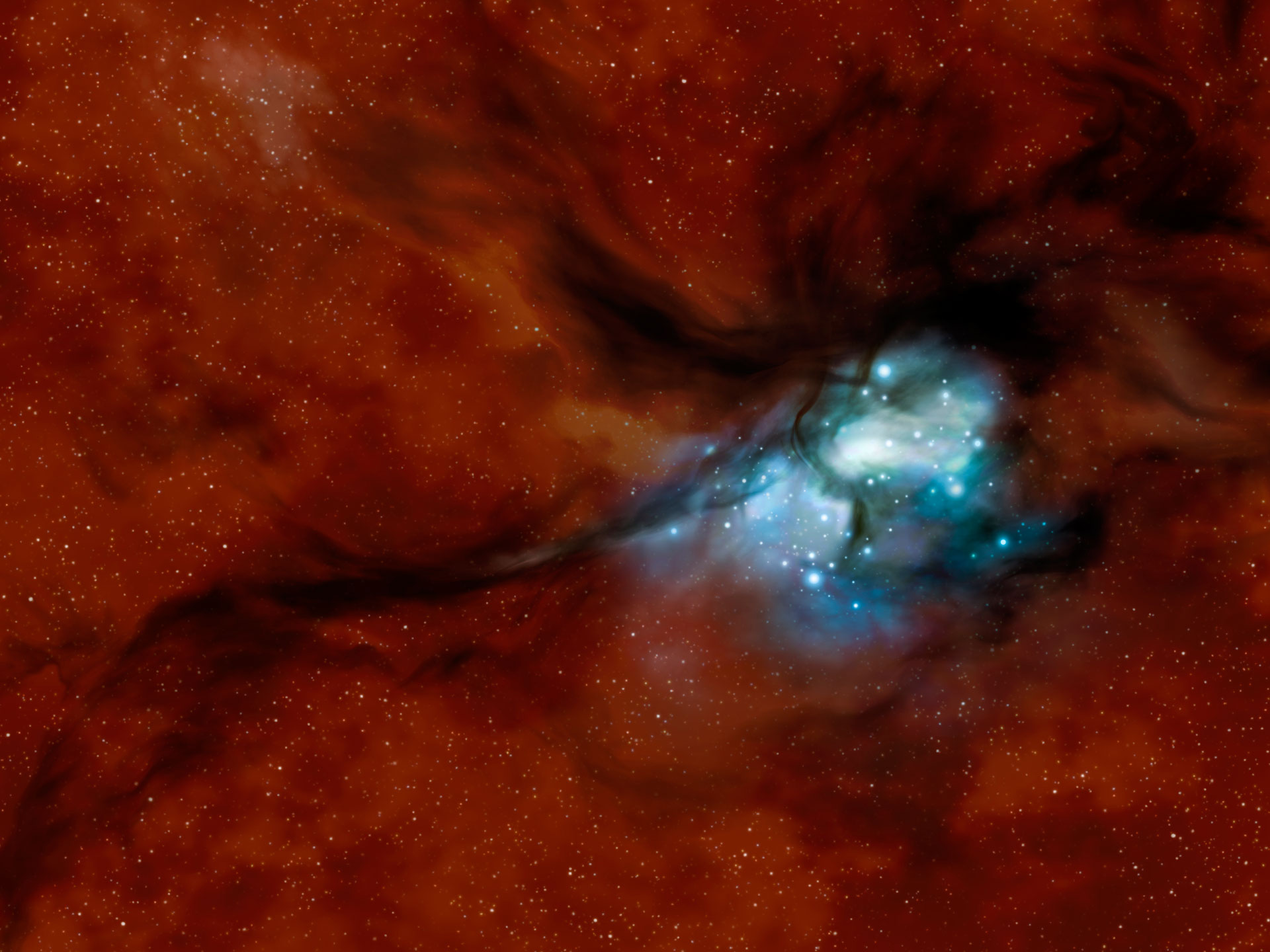
The sun, like all stars, was born in a giant cold cloud of molecular gas and dust. It may have had dozens or even hundreds of stellar siblings – a star cluster – but these early companions are now scattered throughout our Milky Way galaxy. Although the remnants of this particular creation event have long since dispersed, the process of star birth continues today within our galaxy and beyond. Star clusters are conceived in the hearts of optically dark clouds where the early phases of formation have historically been hidden from view. But these cold, dusty clouds shine brightly in the infrared, so telescopes like the Stratospheric Observatory for Infrared Astronomy, SOFIA, can begin to reveal these long-held secrets.
Traditional models claim that the force of gravity may be solely responsible for the formation of stars and star clusters. More recent observations suggest that magnetic fields, turbulence, or both are also involved and may even dominate the creation process. But just what triggers the events that lead to the formation of star clusters?
Astronomers using SOFIA’s instrument, the German Receiver for Astronomy at Terahertz Frequencies, known as GREAT, have found new evidence that star clusters form through collisions between giant molecular clouds.
The results were published in the Monthly Notices of the Royal Astronomical Society.
“Stars are powered by nuclear reactions that create new chemical elements,” said Thomas Bisbas, a postdoctoral researcher at the University of Virginia, Charlottesville, Virginia, and the lead author on the paper describing these new results. “The very existence of life on earth is the product of a star that exploded billions of years ago, but we still don’t know how these stars — including our own sun — form.”
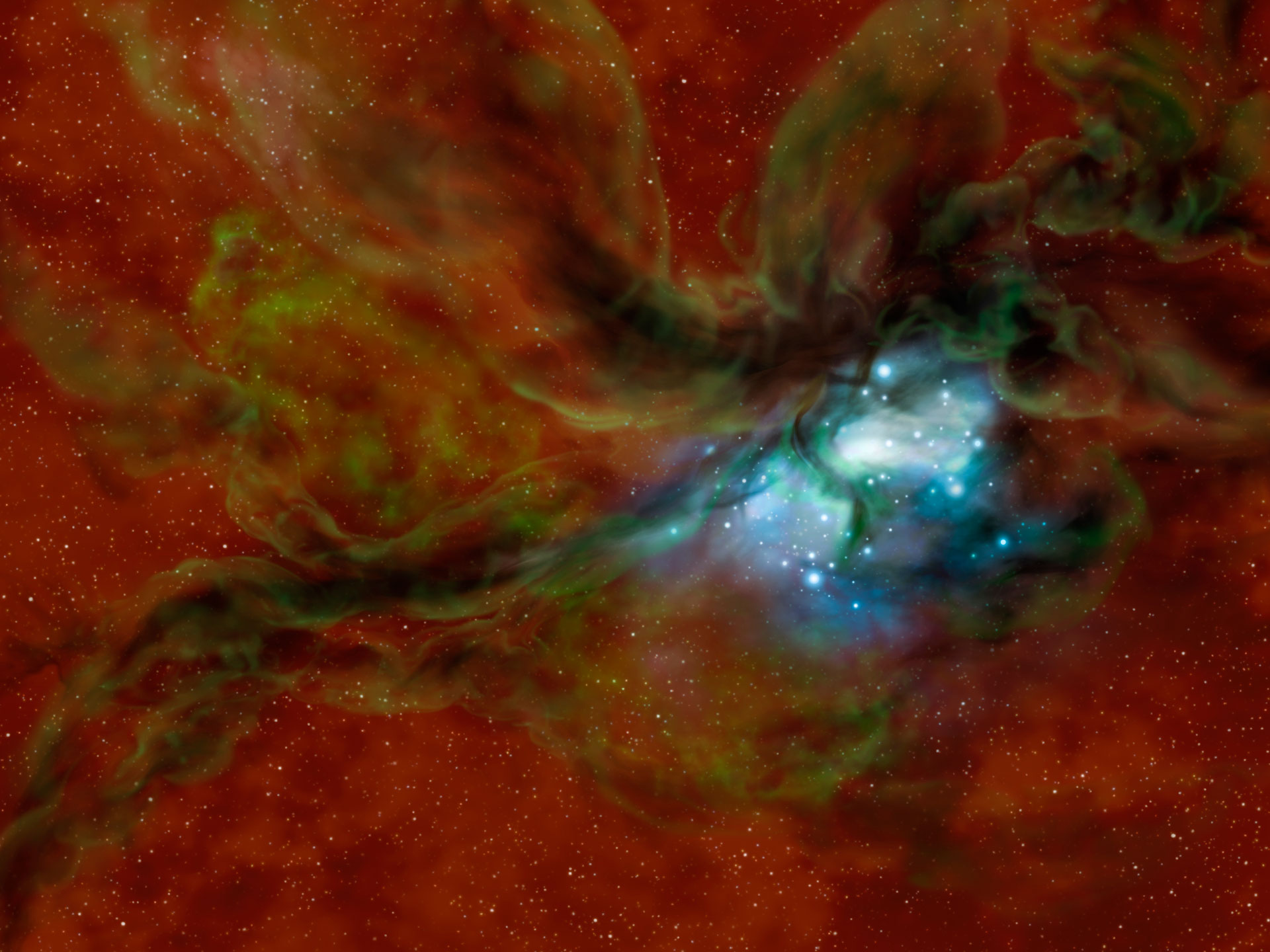
Researchers studied the distribution and motion of ionized carbon around a molecular cloud where stars can form. There appear to be two distinct components of molecular gas colliding with each other at speeds of more than 20,000 miles (32,000 kilometers) per hour. The distribution and velocity of the molecular and ionized gases are consistent with simulations of cloud collisions, which indicate that star clusters form as the gas is compressed in the shock wave created as the clouds collide.
“These star formation models are difficult to assess observationally,” said Jonathan Tan, a professor at Chalmers University of Technology in Gothenburg, Sweden, and the University of Virginia, and a lead researcher on the paper. “We’re at a fascinating point in the project, where the data we are getting with SOFIA can really test the simulations.”
While there is not yet scientific consensus on the mechanism responsible for driving the creation of star clusters, these SOFIA observations have helped scientists take an important step toward unraveling the mystery. This field of research remains an active one, and these data provide crucial evidence in favor of the collision model. The authors expect future observations will test this scenario to determine if the process of cloud collisions is unique to this region, more widespread, or even a universal mechanism for the formation of star clusters.
“Our next step is to use SOFIA to observe a larger number of molecular clouds that are forming star clusters,” added Tan. “Only then can we understand how common cloud collisions are for triggering star birth in our galaxy.”
SOFIA is a Boeing 747SP jetliner modified to carry a 106-inch diameter telescope. It is a joint project of NASA and the German Aerospace Center, DLR. NASA’s Ames Research Center in California’s Silicon Valley manages the SOFIA program, science, and mission operations in cooperation with the Universities Space Research Association headquartered in Columbia, Maryland, and the German SOFIA Institute (DSI) at the University of Stuttgart. The aircraft is maintained and operated from NASA’s Armstrong Flight Research Center Hangar 703, in Palmdale, California.
Reference: “The inception of star cluster formation revealed by [C II] emission around an Infrared Dark Cloud” by Thomas G Bisbas, Jonathan C Tan, Timea Csengeri, Benjamin Wu, Wanggi Lim, Paola Caselli, Rolf Güsten, Oliver Ricken and Denise Riquelme, 13 March 2018, MNRAS.
DOI: 10.1093/mnrasl/sly039
Never miss a breakthrough: Join the SciTechDaily newsletter.
Follow us on Google and Google News.