
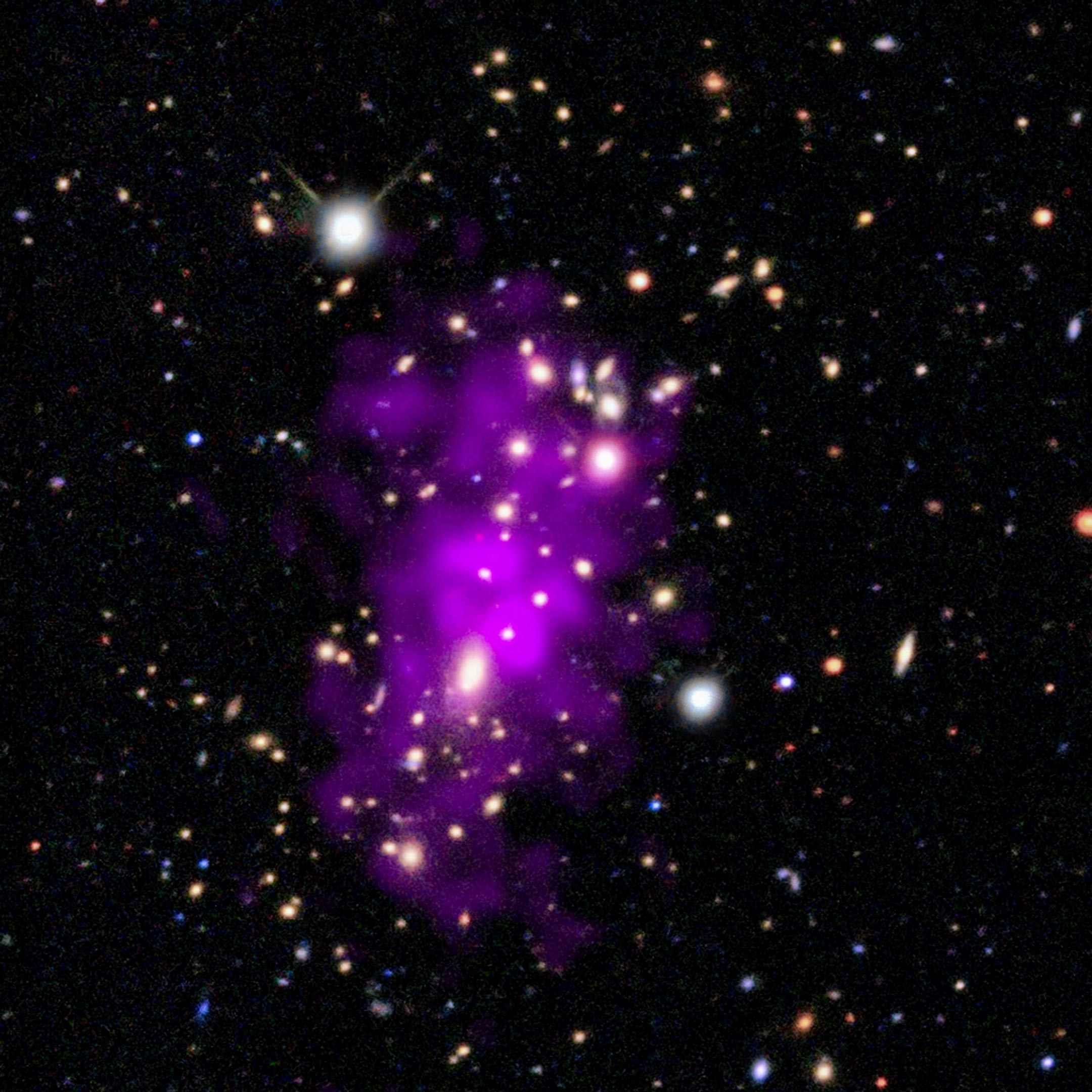
A bubbly-looking galaxy smashup called the Champagne Cluster offers a rare glimpse into cosmic collisions—and the hidden behavior of dark matter.
- The Champagne Cluster is a dramatic cosmic system where two massive galaxy clusters are colliding and slowly merging into a single, even larger structure.
- Astronomers gave it its festive nickname because it was discovered on December 31, 2020, and its galaxies and superheated gas form a bubbly pattern that resembles rising champagne.
- A newly released composite image combines X-ray data from NASA’s Chandra Observatory (shown in purple) with optical observations from the Legacy Surveys (red, green, and blue).
- By continuing to study the Champagne Cluster, scientists hope to better understand how dark matter within galaxy clusters behaves during extremely fast and powerful collisions.
A New Year’s View of the “Champagne Cluster”
Ring in the New Year with a striking space scene known as the “Champagne Cluster,” revealed in a new image that blends data from NASA’s Chandra X-ray Observatory with optical telescopes.
Astronomers first identified this galaxy cluster on December 31, 2020. The timing, along with the bubbly look created by its galaxies and the intensely heated gas detected by Chandra (represented in purple), led researchers to give it the memorable nickname Champagne Cluster. Its formal catalog name is RM J130558.9+263048.4.
Two Galaxy Clusters Colliding and Merging
The composite view shows the Champagne Cluster is not a single structure. It is actually two galaxy clusters in the process of merging into a larger one.
In many clusters, gas heated to millions of degrees appears roughly round or slightly oval in images. In this case, the hot gas is stretched more from top to bottom, which signals that two clusters are involved and are crashing into each other. You can also spot two concentrations of galaxies, one above and one below the center, marking the two groups in the collision. (The image has been rotated clockwise by 90 degrees so that North points to the right.)
Hot Gas and Hidden Dark Matter
In the newly forming system, the superheated gas carries more mass than all of the more than 100 galaxies put together. Even beyond that, the two clusters contain much larger quantities of dark matter, the invisible material thought to be spread throughout the universe.
Alongside Chandra’s X-ray observations, the image includes optical measurements from the Legacy Surveys (red, green, and blue). The Legacy Surveys combine three complementary projects using multiple telescopes located in Arizona and Chile.
A Rare Merger Like the Bullet Cluster
The Champagne Cluster belongs to an uncommon type of merging galaxy cluster. A famous example is the Bullet Cluster, where the hot gas from each cluster has slammed together and slowed, creating a noticeable offset between the hot gas and the most massive galaxy in each cluster.
Two Possible Collision Histories
By matching the observations to computer simulations, astronomers outlined two possible timelines for what happened in the Champagne Cluster.
In one scenario, the two clusters collided more than two billion years ago. After that impact, they moved apart, then gravity pulled them back toward each other, and they are now approaching a second collision. In the other scenario, there was a single collision about 400 million years ago, and the two clusters are currently moving away from each other. Scientists say that continued observations of the Champagne Cluster could help reveal how dark matter responds during a high-speed collision.
Research Paper and Chandra Program Management
Reference: “Discovery and Multiwavelength Analysis of a New Dissociative Galaxy Cluster Merger: The Champagne Cluster” by Faik Bouhrik, Rodrigo Stancioli and David Wittman, 22 July 2025, The Astrophysical Journal.
DOI: 10.3847/1538-4357/ade67c
A paper presenting these results recently appeared in The Astrophysical Journal. The authors are Faik Bouhrik, Rodrigo Stancioli, and David Wittman, all from the University of California, Davis.
NASA’s Marshall Space Flight Center in Huntsville, Alabama, manages the Chandra program. The Smithsonian Astrophysical Observatory’s Chandra X-ray Center oversees science operations from Cambridge, Massachusetts, and flight operations from Burlington, Massachusetts.
Never miss a breakthrough: Join the SciTechDaily newsletter.
Follow us on Google and Google News.