
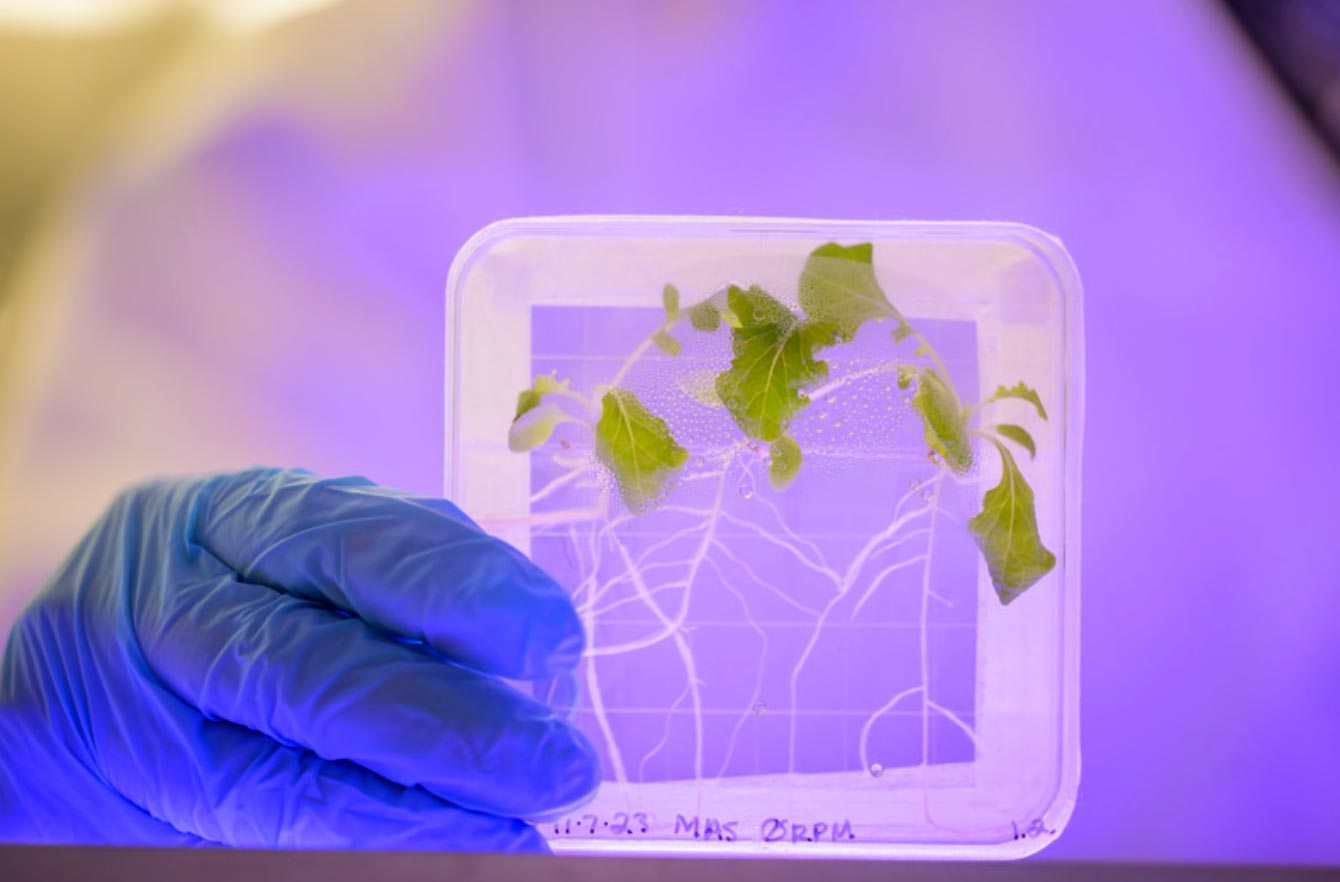
Research team finds lettuce and other plants are more susceptible to bacterial infections in space than on Earth.
Lettuce and other leafy green vegetables are part of a healthy, balanced diet — even for astronauts on a mission.
It’s been more than three years since the National Aeronautics and Space Administration (NASA) made space-grown lettuce an item on the menu for astronauts aboard the International Space Station. Alongside their space diet staples of flour tortillas and powdered coffee, astronauts can munch on a salad, grown from control chambers aboard the ISS that account for the ideal temperature, amount of water, and light that plants need to mature.
The Challenge of Pathogens in Space
But there is a problem. The International Space Station has a lot of pathogenic bacteria and fungi. Many of these disease-causing microbes at the ISS are very aggressive and can easily colonize the tissue of lettuce and other plants. Once people eat lettuce that’s been overrun by E. coli or Salmonella, they can get sick.
With billions of dollars poured into space exploration each year by NASA and private companies like SpaceX, some researchers are concerned that a foodborne illness outbreak aboard the International Space Station could derail a mission.
In new research published in Scientific Reports and in npj Microgravity, University of Delaware researchers grew lettuce under conditions that imitated the weightless environment aboard the International Space Station. Plants are masters of sensing gravity, and they use roots to find it. The plants grown at UD were exposed to simulated microgravity by rotation. The researchers found those plants under the manufactured microgravity were actually more prone to infections from a human pathogen, Salmonella.
Stomata, the tiny pores in leaves and stems that plants use to breathe, normally close to defend a plant when it senses a stressor, like bacteria, nearby, said Noah Totsline, an alumnus of UD’s Department of Plant and Soil Sciences who finished his graduate program in December. When the researchers added bacteria to lettuce under their microgravity simulation, they found the leafy greens opened their stomata wide instead of closing them.
“The fact that they were remaining open when we were presenting them with what would appear to be a stress was really unexpected,” Totsline said.
Totsline, the lead author of both papers, worked with plant biology professor Harsh Bais as well as microbial food safety professor Kali Kniel and Chandran Sabanayagam of the Delaware Biotechnology Institute. The research team used a device called a clinostat to rotate plants at the speed of a rotisserie chicken on a spinner.
“In effect, the plant would not know which way was up or down,” Totsline said. “We were kind of confusing their response to gravity.”
It wasn’t true microgravity, Totsline said, but it did the job to help plants lose their sense of directionality. Ultimately, the researchers discovered that it appears Salmonella can invade leaf tissue more easily under simulated microgravity conditions than it can under typical conditions on Earth.
Additionally, Bais and other UD researchers have shown the usage of a helper bacteria called B. subtilis UD1022 in promoting plant growth and fitness against pathogens or other stressors such as drought.
They added the UD1022 to the microgravity simulation that on Earth can protect plants against Salmonella, thinking it might help the plants fend off Salmonella in microgravity.
Instead, they found the bacterium actually failed to protect plants in space-like conditions, which could stem from the bacteria’s inability to trigger a biochemical response that would force a plant to close its stomata.
“The failure of UD1022 to close stomata under simulated microgravity is both surprising and interesting and opens another can of worms,” Bais said. “I suspect the ability of UD1022 to negate the stomata closure under microgravity simulation may overwhelm the plant and make the plant and UD1022 unable to communicate with each other, helping Salmonella invade a plant.”
Foodborne Pathogens Aboard the International Space Station
Microbes are everywhere. These germs are on us, on animals, on the food we eat and in the environment.
So naturally, UD microbial food safety professor Kali Kniel said that wherever humans are, there is a potential for bacterial pathogens to coexist.
According to NASA, around seven people at a time live and work on the International Space Station.
It’s not the tightest environment — about as big as a six-bedroom house — but it’s still the kind of place where germs can wreak havoc.
“We need to be prepared for and reduce risks in space for those living now on the International Space Station and for those who might live there in the future,” Kniel said. “It is important to better understand how bacterial pathogens react to microgravity in order to develop appropriate mitigation strategies.”
Kniel and Bais have a long history of bringing their subject areas of microbial food safety and plant biology together to study human pathogens on plants.
“To best develop ways to reduce risks associated with the contamination of leafy greens and other produce commodities we need to better understand the interactions between human pathogens on plants grown in space,” Kniel said. “And the best way to do this is with a multidisciplinary approach.”
A Growing Population on Earth, a Greater Need for Safe Food in Space
It may be a while before humans can live on the moon or Mars, but the UD research has some big potential impacts for cohabiting outer space.
According to a United Nations report, the Earth could be home to 9.7 billion people in 2050 and 10.4 billion people in 2100.
On top of that, Bais, the UD plant biology professor, said food safety and food security measures are already at their peak across the world. With the loss of agricultural land over time to grow food, “people are going to soon think seriously about alternate habitation spaces,” he said. “These are not fiction anymore.”
And seemingly more often, the Centers for Disease Control and Prevention or the U.S. Food and Drug Administration will issue a recall on certain lettuce on Earth, telling people not to eat it because of a risk of E. coli or Salmonella.
With leafy greens being the food of choice for many astronauts and easy to grow in indoor environments such as a hydroponic environment in the International Space Station, Bais said it’s important to make sure those greens are always safe to eat.
“You don’t want the whole mission to fail just because of a food safety outbreak,” Bais said.
Solutions: sterilized seeds and improved genetics
So, if plants are opening their stomata wider in a microgravity environment and allowing bacteria to easily get in, what can be done?
It turns out, the answer isn’t that simple.
“Starting with sterilized seeds is a way to reduce risks of having microbes on plants,” Kniel said. “But then microbes may be in the space environment and can get onto plants that way.”
Bais said scientists may need to tweak plants’ genetics to prevent them from opening their stomata wider in space. His lab is already taking different lettuce varieties that have different genetics and evaluating them under simulated microgravity.
“If, for example, we find one that closes their stomata compared to another we have already tested that opens their stomata, then we can try to compare the genetics of these two different cultivars,” Bais said. “That will give us a lot of questions in terms of what is changing.”
Any answers they find could help prevent future problems with rocket salad.
References:
“Simulated microgravity facilitates stomatal ingression by Salmonella in lettuce and suppresses a biocontrol agent” by Noah Totsline, Kalmia E. Kniel, Chandran Sabagyanam and Harsh P. Bais, 9 January 2024, Scientific Reports.
DOI: 10.1038/s41598-024-51573-y
“Microgravity and evasion of plant innate immunity by human bacterial pathogens” by Noah Totsline, Kalmia E. Kniel and Harsh P. Bais, 7 September 2023, npj Microgravity.
DOI: 10.1038/s41526-023-00323-x
The research was funded by NASA-EPSCoR.
Never miss a breakthrough: Join the SciTechDaily newsletter.
Follow us on Google and Google News.
1 Comment
Use ionizing-radiation food irradiation to “nuke” any such foods grown in space, before eating them. Problem solved! (Astronauts are highly competent, and can be trusted with such somewhat-dangerous food-irratiadion gear.)