
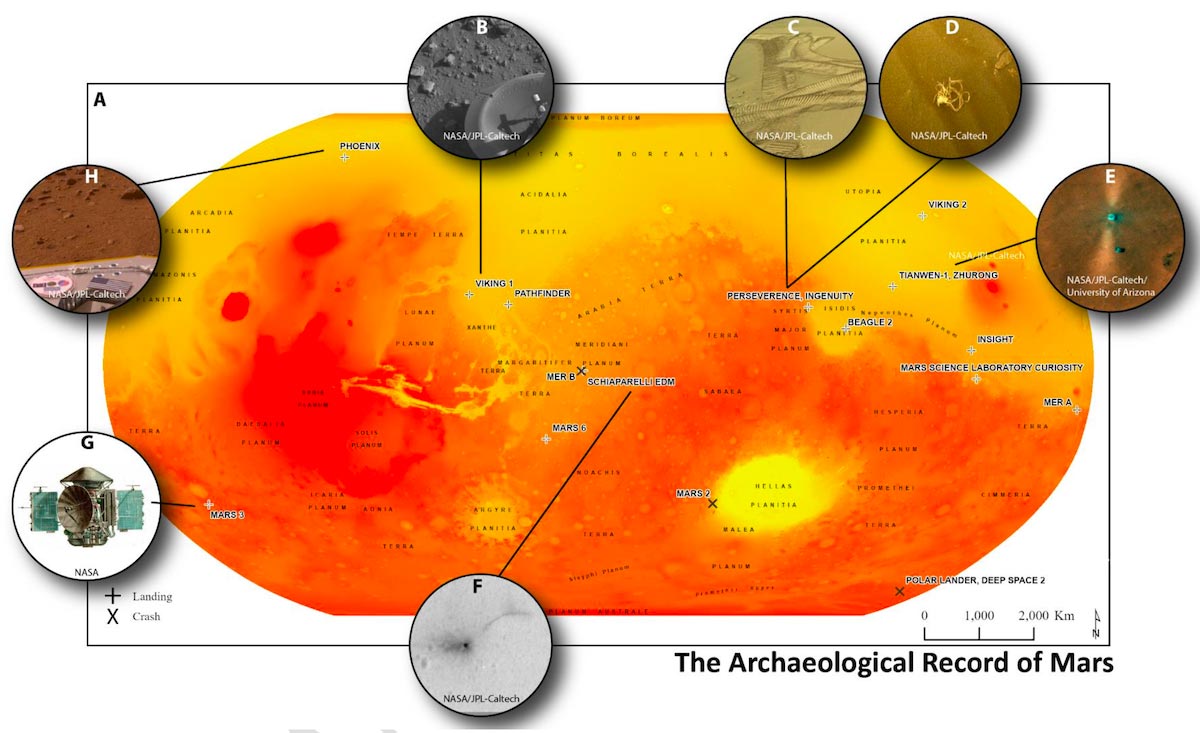
lander with DVD in foreground. Credit: Justin Holcomb
Human-made objects on Mars, including spacecraft, landers, and rovers, may hold significant archaeological value rather than being dismissed as space debris.
Scholars propose cataloging and preserving these artifacts to document humanity’s early interplanetary exploration and ensure future missions respect these historical markers.
Mars as a New Frontier: Understanding the Value of Space Debris
Are spacecraft, landers, rovers, and other debris from space exploration just litter on the surface of Mars, or are they historical artifacts akin to Clovis points — symbols of humanity’s drive to explore new frontiers?
University of Kansas anthropologist Justin Holcomb argues that these physical remnants of human activity on Mars should be cataloged, preserved, and studied as valuable records of humanity’s first steps into interplanetary exploration.
His research, published today (December 16) in the peer-reviewed journal Nature Astronomy, highlights the emerging archaeological significance of human-made objects left behind on Mars.
Tracing Human Dispersal Through Space Artifacts
“Our main argument is that Homo sapiens are currently undergoing a dispersal, which first started out of Africa, reached other continents, and has now begun in off-world environments,” Holcomb, its lead author, said. “We’ve started peopling the solar system. And just like we use artifacts and features to track our movement, evolution, and history on Earth, we can do that in outer space by following probes, satellites, landers, and various materials left behind. There’s a material footprint to this dispersal.”
Much as archaeologists use “middens” (or, ancient garbage dumps) to reveal secrets of past societies here on Earth, Holcomb argues that much of the material deemed “space trash” actually has great archaeological and environmental value.
Reconceptualizing Space Debris as Heritage
“These are the first material records of our presence, and that’s important to us,” he said. “I’ve seen a lot of scientists referring to this material as space trash, galactic litter. Our argument is that it’s not trash; it’s actually really important. It’s critical to shift that narrative towards heritage because the solution to trash is removal, but the solution to heritage is preservation. There’s a big difference.”
The KU researcher argues future missions to Mars and other planets must consider potential archaeological damage at landing locations and other sites where human exploration is planned.
NASA Mars Curiosity’s view of Martian soil and boulders after crossing the “Dingo Gap” sand dune. Photo courtesy NASA.
“Missions to other planets must consider this in their planning,” Holcomb said. “They won’t land in areas that could disturb these sites. They’ll think about them differently than just trash lying around. That’s probably the main thing. From an academic perspective — which is what these papers aim to address — what are the implications? We need to track our species’ movements through space and time, and we do that through stratigraphy.”
Holcomb’s co-authors were Beth L. O’Leary of New Mexico State University; Alberto Fairén of Centro de Astrobiología in Madrid, Spain, and Cornell University; KU’s Rolfe Mandel; and Karl Wegmann of North Carolina State University.
Holcomb’s argument for safekeeping traces of human exploration on other planets builds on earlier work, where he argued for declaration of a “lunar anthropocene” — or age of human dominion over the moon’s landscape.
“On the moon, we argued we could create an anthropocene — a human age,” he said. “On Mars, we don’t think there’s an anthropocene, but there is an archaeological record that needs to be a stratigraphic horizon, allowing us to place this material into a framework. And of course, we could do this across the solar system.”
The KU researcher traces the origin of human alteration of the Martian landscape to the crash landing of the Soviet Union’s Mars 2 rover in 1971.
Postage stamp from Soviet Union commemorating its 1971 Mars 2 mission, the first time humans launched an object to reach the Martian surface.
“The Mars 2 crash represents one of the first times our species touched another planet — not a celestial body, because that was the moon,” Holcomb said. “But the Mars 2 crash is the first time our species left a preserved imprint on the surface of another planet.”
Impact of Martian Environments on Artifacts
While anthropologists have some grasp of how climate and geology contribute to the degradation of artifacts on Earth, the otherworldly environments of planets like Mars are sure to affect how quickly and severely artifacts experience damage by cosmic energies, winds, water, and soil. These Martian processes are little understood presently.
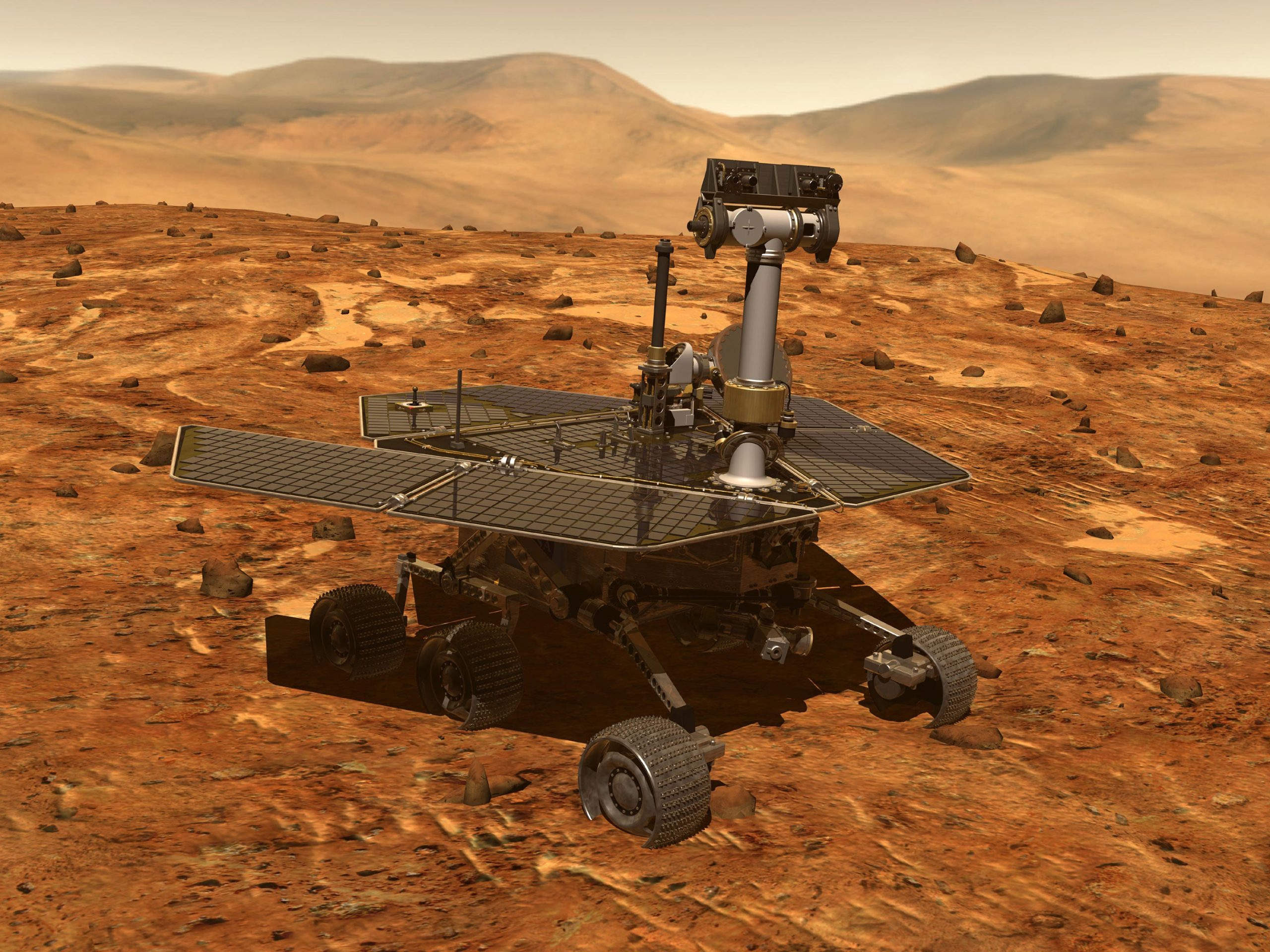
“That field is called geoarchaeology — specifically, the field that studies geological effects on archaeological materials,” Holcomb said. “Planetary geoarchaeology is a future field for sure, and we need to consider the materials not only on Mars in general but also in various places on Mars, which have different processes. For example, Mars has a cryosphere in the northern and southern latitudes, so ice action there will increase the alteration of materials much more rapidly. With Mars’ iron-rich sands — what happens when materials get buried? The most obvious issue is burial by large dune sands. Mars has global dust storms, which are unique. A single storm can literally travel across the entire globe. On top of that, there are local dust storms. The Spirit Rover, for example, is right next to an encroaching dune field that will eventually bury it. Once it’s buried, it becomes very difficult to relocate.”
Holcomb advocates establishing methodology for tracking and cataloging human material on Mars and subsequent planets humans might visit, perhaps via an already existing database like the U.N. Register of Objects Launched into Outer Space.
“If this material is heritage, we can create databases that track where it’s preserved, all the way down to a broken wheel on a rover or a helicopter blade, which represents the first helicopter on another planet,” Holcomb said. “These artifacts are very much like hand axes in East Africa or Clovis points in America. They represent the first presence, and from an archaeological perspective, they are key points in our historical timeline of migration.”
Reference: “The emerging archaeological record of Mars” by Justin A. Holcomb, Beth L. O’Leary, Alberto G. Fairén, Rolfe D. Mandel and Karl W. Wegmann, 16 December 2024, Nature Astronomy.
DOI: 10.1038/s41550-024-02439-w
Never miss a breakthrough: Join the SciTechDaily newsletter.
Follow us on Google and Google News.
1 Comment
Nice though, but one should still speak of it with its real name ”rubbish” or ”pollution”. Colonialization of the nearby planets will lead to unprecedentet amount of ”heritage”. Already now the amount of waste in near Earth orbits is complicating space explorations.
An example closer to earth: A few years ago Chinese vessels started transporting goods on nearby sea and today shores are full of plastic bags and other rubbish with Chinese prints. Chinese vessels and sailors do not care a s*** about the nature.
The same will happen in the colonialization of space in the mass popularion phase.