

Researchers at the University of Pennsylvania have developed a groundbreaking photonic switch that drastically improves the efficiency and speed of data transmission across fiber-optic networks.
By incorporating non-Hermitian physics and using a silicon-based design, this switch not only enhances control over light’s behavior but also offers compatibility with current technology infrastructures, promising faster internet services and more efficient data centers.
Breakthrough in Photonic Switch Technology
Every second, terabytes of data — enough to download thousands of movies simultaneously — travel around the world as pulses of light in fiber-optic cables. These cables function like super-fast highways, but when the data reaches its destination at data centers, it requires a system to direct it efficiently, much like traffic lights help cars exit highways in an orderly way.
Photonic switches, which route these optical signals, have long faced a tradeoff between size and speed. Larger switches can process more data at higher speeds but consume more energy, take up more space, and increase costs.
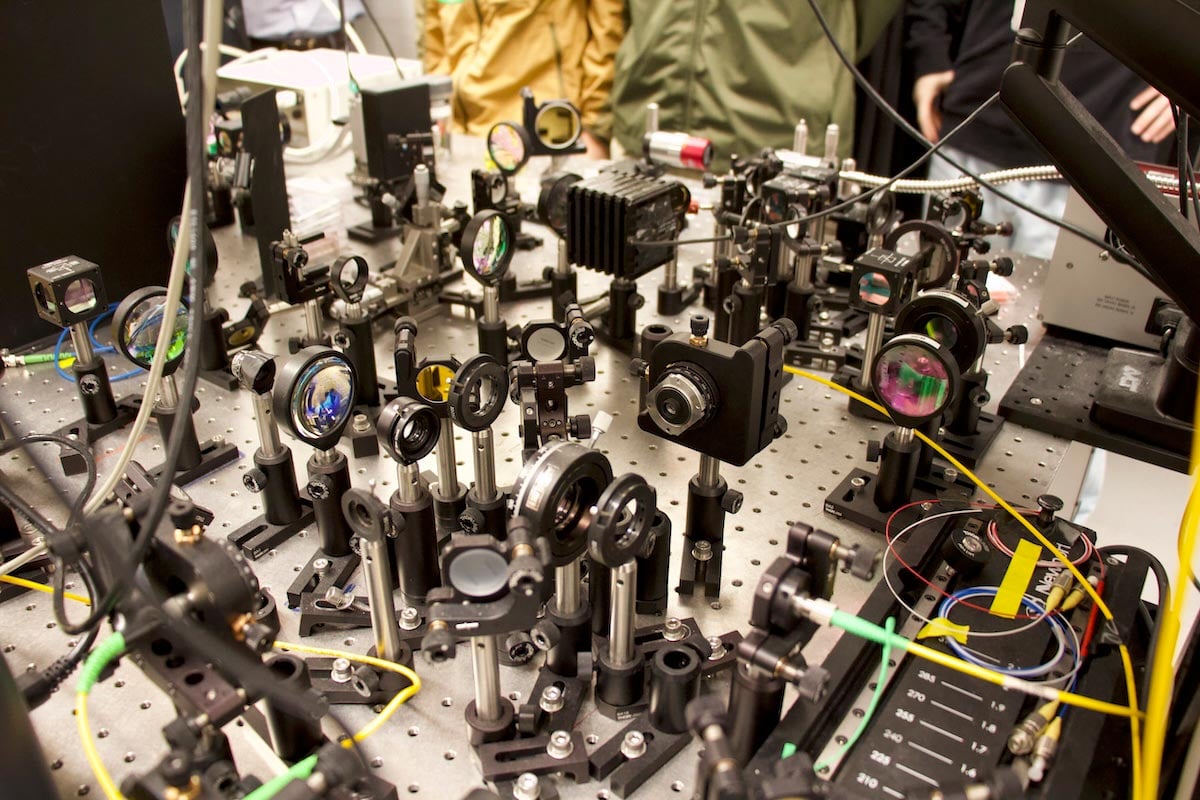
Speeding Up the Information Superhighway
In a breakthrough described in Nature Photonics, researchers at the University of Pennsylvania’s School of Engineering and Applied Science have developed a novel photonic switch that overcomes this challenge. Measuring just 85 by 85 micrometers per unit — smaller than a grain of salt — this new switch is poised to revolutionize how data moves across global networks.
By manipulating light at the nanoscale with unprecedented efficiency, the new switch speeds up the process of getting data on and off the literal information superhighway of fiber-optic cables that encircles the globe. “This has the potential to accelerate everything from streaming movies to training AI,” says Liang Feng, Professor in Materials Science and Engineering (MSE) and in Electrical and Systems Engineering (ESE) and the paper’s senior author.
Harnessing Non-Hermitian Physics
The new switch relies on non-Hermitian physics, a branch of quantum mechanics that explores how certain systems behave in unusual ways, giving researchers more control over light’s behavior. “We can tune the gain and loss of the material to guide the optical signal towards the right information highway exit,” says Xilin Feng, a doctoral student in ESE and the paper’s first author. In other words, the unique physics at play allows the researchers to tame the flow of light on the tiny chip, enabling precise control over any light-based network’s connectivity.
The upshot is that the new switch can redirect signals in trillionths of a second with minimal power consumption. “This is about a billion times faster than the blink of an eye,” says Shuang Wu, a doctoral student in MSE and co-author of the paper. “Previous switches were either small or fast, but it’s very, very difficult to achieve these two properties simultaneously.”
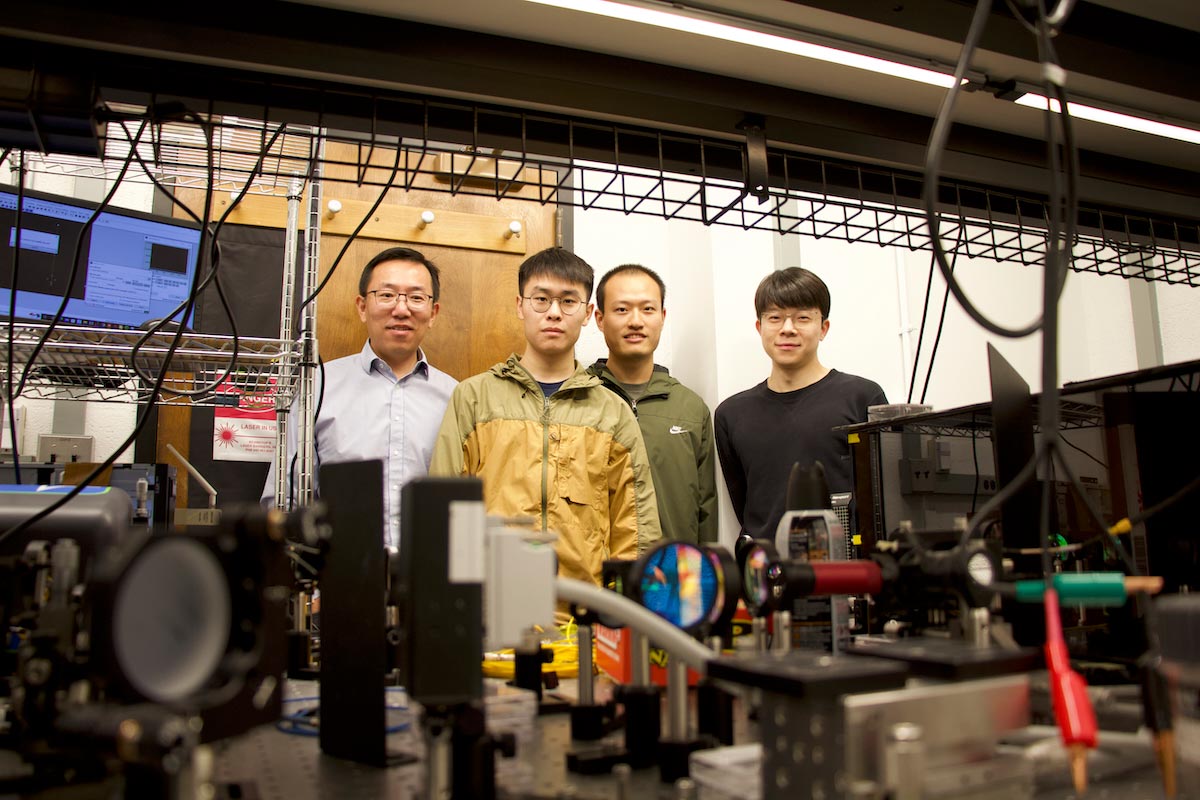
Advantages of Silicon Integration
The new switch is also notable for being made partly of silicon, the inexpensive and widely available industry-standard material. “Non-Hermitian switching has never been demonstrated in a silicon photonics platform before,” says Wu.
In theory, the incorporation of silicon into the switch will facilitate scaling the device for mass production and wide adoption in industry. Silicon is a key component in most technologies, from computers to smartphones; building the device using silicon makes it fully compatible with existing silicon photonic foundries, which make advanced chips for devices like graphics processing units (GPUs).
Challenges in Device Fabrication
On top of the silicon layer, the switch consists of a particular type of semiconductor, made of Indium Gallium Arsenide Phosphide (InGaAsP), a material that is particularly effective at manipulating infrared wavelengths of light, such as those typically transmitted in undersea optical cables.
Joining the two layers proved challenging, and required numerous attempts to build a working prototype. “It’s similar to making a sandwich,” says Xilin Feng, referring to adding the layers to one another. Only, in this case, if any of those layers were misaligned by even a tiny degree, the sandwich would be entirely inedible. “The alignment requires nanometer accuracy,” Wu notes.
Transforming Data Centers
Ultimately, the researchers say, the new switch will benefit not just academic physicists, who can now further explore the non-Hermitian physics upon which the switch depends, but companies that maintain and build data centers, and the billions of users who rely on them. “Data can only go as fast as we can control it,” says Liang Feng. “And in our experiments, we showed that the speed limit of our system is just 100 picoseconds.”
Reference: “Non-Hermitian hybrid silicon photonic switching” by Xilin Feng, Tianwei Wu, Zihe Gao, Haoqi Zhao, Shuang Wu, Yichi Zhang, Li Ge and Liang Feng, 2 January 2025, Nature Photonics.
DOI: 10.1038/s41566-024-01579-9
This study was conducted at the University of Pennsylvania School of Engineering and Applied Science and supported by the Army Research Office (ARO) (W911NF-21-1-0148 and W911NF-22-1-0140), the Office of Naval Research (ONR) (N00014-23-1-2882) and the National Science Foundation (NSF) (ECCS-2023780, DMR-2326698, DMR-2326699 and DMR-2117775).
Additional co-authors include Tianwei Wu, Zihe Gao, Haoqi Zhao, and Yichi Zhang of Penn Engineering and Li Ge of the City University of New York.
Never miss a breakthrough: Join the SciTechDaily newsletter.
Follow us on Google and Google News.