
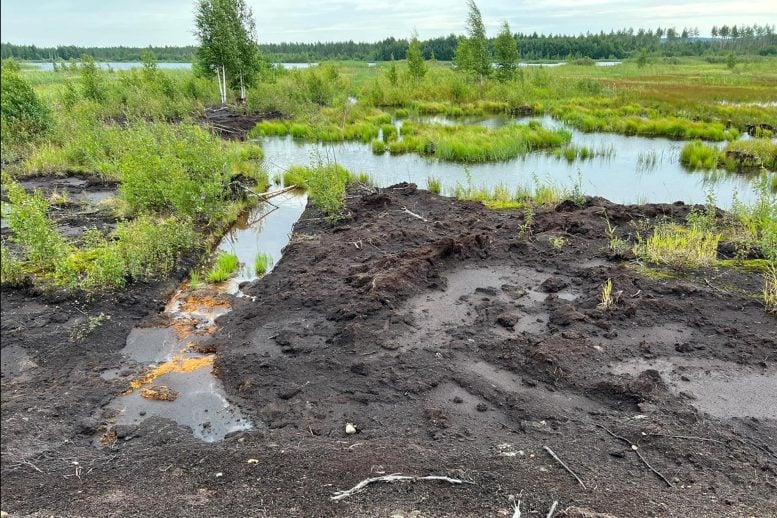
A Stanford-led study finds global wetlands losses are overestimated, despite high losses in many regions.
Sometime this spring or summer, the Supreme Court is expected to issue a case ruling that will legally define whether federal protections should be extended to wetlands outside of navigable waters. The justices might consider reading a new Stanford-led study that finds, although wetlands remain threatened in many parts of the world – including the U.S., which accounts for more losses than any other country – global losses of wetlands have likely been overestimated. Published Feb. 8 in Nature, the study’s findings could help better explain the causes and impacts of wetland loss, enabling more informed plans to protect or restore ecosystems crucial for human health and livelihoods.
“Despite the good news that our results might imply, it remains urgent to halt and reverse the conversion and degradation of wetlands,” said study lead author Etienne Fluet-Chouinard, a postdoctoral associate in Stanford’s Department of Earth System Science at the time of the research. “The geographic disparities in losses are critical to consider because the forgone local benefits from drained wetlands cannot be replaced by wetlands elsewhere.”
Rethinking Wetlands
Now understood to be vital sources of water purification, groundwater recharge, and carbon storage, wetlands were long seen as unproductive areas teeming with disease-bearing insects and good only for draining to grow crops or harvest peat for fuel and fertilizer. Unrelenting drainage for conversion to human land uses, such as farmland and urban areas, in addition to alteration by fires and groundwater extraction, has made wetlands among the world’s most threatened ecosystems in the world.
Accurately estimating the extent, distribution, and timing of wetland loss is key to understanding their role in natural processes and the impact of wetland drainage on the water and carbon cycles. A lack of historical data has hindered the effort, forcing scientists to make estimates based on incomplete collections of regional data on wetland loss.
“Wetlands purify our water, prevent flooding, and are biodiversity superheroes,” said study co-author Rob Jackson, the Michelle and Kevin Douglas Provostial Professor of Energy and Environment in the Stanford Doerr School of Sustainability. “We need the best data possible to save what we have and know what we’ve lost.”
A Second Chance
In a first-of-its-kind historical reconstruction, the researchers combed through thousands of records of wetland drainage and land-use changes in 154 countries, mapping the distribution of drained and converted wetlands onto maps of present-day wetlands to get a picture of what the original wetland area might have looked like in 1700.
They found that the area of wetland ecosystems has declined 21-35% since 1700 due to human intervention. That’s far less than the 50-87% losses estimated by previous studies. Still, the authors estimate that at least 1.3 million square miles of wetlands have been lost globally – an area about the size of Alaska, Texas, California, Montana, New Mexico, and Arizona combined.
“These new results allow us to better quantify changes in wetlands’ sequestration of carbon from the atmosphere and emission of methane, another powerful greenhouse gas,” said study co-author Avni Malhotra, a Stanford postdoctoral researcher at the time of the research.
The low estimate is likely the result of the study’s focus beyond regions with historically high wetland losses, and its avoidance of large extrapolations – characteristics of many previous estimates. The researchers note their estimate of losses is likely conservative because they constrained their analysis to available data, which is scarce for the years before 1850.
Despite what may seem to be good news, the researchers emphasize that wetland losses have been dramatically high in some regions, such as the U.S., which is estimated to have lost 40% of its wetlands since 1700 and accounts for more than 15% of all global losses during the study’s time period. Although wetland conversion and degradation have slowed globally, it continues apace in some regions, such as Indonesia, where farmers and corporations continue to clear large swaths of land for oil palm plantations and other agricultural uses.
“Discovering that fewer wetlands have been lost than we previously thought gives us a second chance to take action against further declines,” said study co-author Peter McIntyre, an aquatic conservation ecologist at Cornell University. “These results provide a guide for prioritizing conservation and restoration.”
Reference: “Extensive global wetland loss over the past three centuries” by Etienne Fluet-Chouinard, Benjamin D. Stocker, Zhen Zhang, Avni Malhotra, Joe R. Melton, Benjamin Poulter, Jed O. Kaplan, Kees Klein Goldewijk, Stefan Siebert, Tatiana Minayeva, Gustaf Hugelius, Hans Joosten, Alexandra Barthelmes, Catherine Prigent, Filipe Aires, Alison M. Hoyt, Nick Davidson, C. Max Finlayson, Bernhard Lehner, Robert B. Jackson and Peter B. McIntyre, 8 February 2023, Nature.
DOI: 10.1038/s41586-022-05572-6
Jackson is also a senior fellow at the Stanford Woods Institute for the Environment and the Precourt Institute for Energy.
Study co-authors include researchers at the University of Maryland, Canada’s Ministry of the Environment and Climate Change, NASA Goddard Space Flight Center, the University of Hong Kong, Utrecht University, the University of Göttingen, Russia’s Institute of Forest Science, Stockholm University, the University of Greifswald, Germany’s Greifswald Mire Centre, the Observatoire de Paris, Massachusetts Institute of Technology, Nick Davidson Environmental, Charles Sturt University, and McGill University.
The study was funded by the Natural Sciences and Engineering Research Council of Canada, the David and Lucile Packard Foundation, the U.S. National Science Foundation, the Gordon and Betty Moore Foundation, and the Swiss National Science Foundation
Never miss a breakthrough: Join the SciTechDaily newsletter.
Follow us on Google and Google News.
1 Comment
Somehow, it was neglected to mention that wetlands are a, if not the, major source of natural methane, a greenhouse gas that is currently receiving a lot of attention.