
Close Menu
    Facebook X (Twitter) Instagram
    SciTechDaily
    • Biology
    • Chemistry
    • Earth
    • Health
    • Physics
    • Science
    • Space
    • Technology
    Facebook X (Twitter) Pinterest YouTube RSS
    SciTechDaily
    Home»Space»Stellar Snowflake Cluster Spotted by Spitzer Space Telescope
    Space

    Stellar Snowflake Cluster Spotted by Spitzer Space Telescope

    By NASAJanuary 2, 2021No Comments2 Mins Read
    Facebook Twitter Pinterest Telegram LinkedIn WhatsApp Email Reddit
    Share
    Facebook Twitter LinkedIn Pinterest Telegram Email Reddit
    Stellar Snowflake Cluster Crop
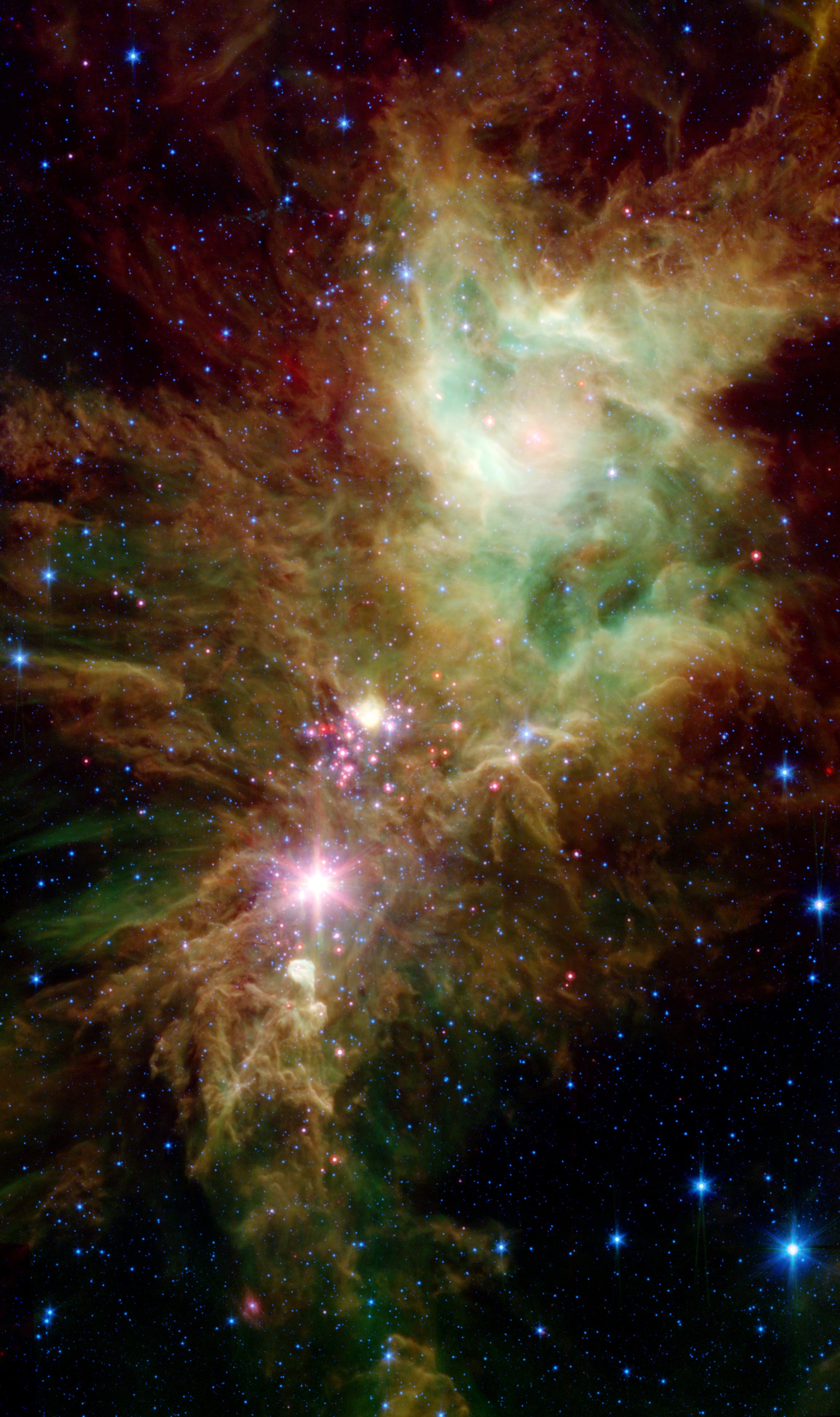
    A section of the so-called Christmas Tree Cluster captured by NASA’s Spitzer Space Telescope. Credit: NASA/JPL-Caltech/P.S. Teixeira (Center for Astrophysics)

    Spitzer’s infrared image unveils the Snowflake Cluster, where newborn stars align in a spoke-like pattern. These protostars are still clustered in their birthplace, within the dusty Christmas Tree Cluster.

    Newborn stars, hidden behind thick dust, are revealed in this image of a section of the so-called Christmas Tree Cluster from NASA’s Spitzer Space Telescope. The newly revealed infant stars appear as pink and red specks toward the center and appear to have formed in regularly spaced intervals along linear structures in a configuration that resembles the spokes of a wheel or the pattern of a snowflake. Hence, astronomers have nicknamed this the “Snowflake Cluster.”

    Star-forming clouds like this one are dynamic and evolving structures. Since the stars trace the straight line pattern of spokes of a wheel, scientists believe that these are newborn stars, or “protostars.” At a mere 100,000 years old, these infant structures have yet to “crawl” away from their location of birth. Over time, the natural drifting motions of each star will break this order, and the snowflake design will be no more.

    While most of the visible-light stars that give the Christmas Tree Cluster its name and triangular shape do not shine brightly in Spitzer’s infrared eyes, all of the stars forming from this dusty cloud are considered part of the cluster.

    Like a dusty cosmic finger pointing up to the newborn clusters, Spitzer also illuminates the optically dark and dense Cone Nebula, the tip of which can be seen towards the bottom left corner of the image.

    Never miss a breakthrough: Join the SciTechDaily newsletter.
    Follow us on Google and Google News.

    Astronomy NASA Spitzer Space Telescope
    Share. Facebook Twitter Pinterest LinkedIn Email Reddit

    Related Articles

    Incredibly Sharp Webb Space Telescope Test Images Hint at New Possibilities for Science

    “Space Butterfly” Is Actually a Nursery for Hundreds of Baby Stars

    Scores of Baby Stars Revealed in the Orion Constellation

    NASA’s Spitzer Space Telescope Illuminates Exoplanets

    Godzilla Nebula: A “Monster” Star-Forming Region Spied by NASA’s Spitzer Space Telescope

    Hidden Supernova: Stars Are Exploding in Dusty Galaxies – We Just Can’t Always See Them

    New Worlds in a River of Young Stars Discovered by NASA’s Transiting Exoplanet Survey Satellite

    3D Map of Cosmic Neighborhood Created With Help From Worldwide Network of Citizen Scientists

    Chaos Swirls at the Heart of the Orion Nebula

    Leave A Reply Cancel Reply

    • Facebook
    • Twitter
    • Pinterest
    • YouTube

    Don't Miss a Discovery

    Subscribe for the Latest in Science & Tech!

    Trending News

    Scientists Discover 132-Million-Year-Old Dinosaur Tracks on South Africa’s Coast

    Scientists Uncover the Secret Ingredient Behind the Spark That May Have Started Life on Earth

    Physicists Observe Matter in Two Places at Once in Mind-Bending Quantum Experiment

    Stanford Scientists Discover Hidden Brain Circuit That Fuels Chronic Pain

    New Study Reveals Why Ozempic Works Better for Some People Than Others

    Climate Change Is Altering a Key Greenhouse Gas in a Way Scientists Didn’t Expect

    New Study Suggests Gravitational Waves May Have Created Dark Matter

    Scientists Discover Why the Brain Gets Stuck in Schizophrenia

    Follow SciTechDaily
    • Facebook
    • Twitter
    • YouTube
    • Pinterest
    • Newsletter
    • RSS
    SciTech News
    • Biology News
    • Chemistry News
    • Earth News
    • Health News
    • Physics News
    • Science News
    • Space News
    • Technology News
    Recent Posts
    • The Crown Jewel of Dentistry? Breakthrough Tech Could Transform Tooth Repair
    • The Surprising Non-Medical Factor That Determines Cancer Survival
    • Python Blood Could Hold the Secret to Weight Loss Without Side Effects
    • Naturally Occurring Bacteria Completely Eradicate Tumors in Mice With a Single Dose
    • The Ideal Temperature for Storing Mangoes Isn’t What You Think
    Copyright © 1998 - 2026 SciTechDaily. All Rights Reserved.
    • Science News
    • About
    • Contact
    • Editorial Board
    • Privacy Policy
    • Terms of Use

    Type above and press Enter to search. Press Esc to cancel.