
JWST unexpectedly reveals nickel and oxygen, which are typically difficult to observe.
Similar to human teenagers, teenage galaxies are awkward, experience growth spurts and enjoy heavy metal — nickel, that is.
A Northwestern University-led team of astrophysicists has just analyzed the first results from the CECILIA (Chemical Evolution Constrained using Ionized Lines in Interstellar Aurorae) Survey, a program that uses NASA’s James Webb Space Telescope (JWST) to study the chemistry of distant galaxies.
Unexpected Elements in “Teenage Galaxies”
According to the early results, so-called “teenage galaxies” — which formed two-to-three billion years after the Big Bang — are unusually hot and contain unexpected elements, like nickel, which are notoriously difficult to observe.
The research was published on November 20 in The Astrophysical Journal Letters. It marks the first in a series of forthcoming studies from the CECILIA Survey.
Insights Into Galactic Evolution
“We’re trying to understand how galaxies grew and changed over the 14 billion years of cosmic history,” said Northwestern’s Allison Strom, who led the study. “Using the JWST, our program targets teenage galaxies when they were going through a messy time of growth spurts and change. Teenagers often have experiences that determine their trajectories into adulthood. For galaxies, it’s the same.”
One of the principal investigators of the CECILIA Survey, Strom is an assistant professor of physics and astronomy at Northwestern’s Weinberg College of Arts and Sciences and a member of Northwestern’s Center for Interdisciplinary Exploration and Research in Astrophysics (CIERA). Strom co-leads the CECILIA Survey with Gwen Rudie, a staff scientist at Carnegie Observatories.
‘Chemical DNA’ Insight Into Galaxy Formation
Named after Cecilia Payne-Gaposchkin, one of the first women to earn a Ph.D. in astronomy, the CECILIA Survey observes spectra (or the amount of light across different wavelengths) from distant galaxies. Strom likens a galaxy’s spectra to its “chemical DNA.” By examining this DNA during a galaxy’s “teenage” years, researchers can better understand how it grew and how it will evolve into a more mature galaxy.
For example, astrophysicists still don’t understand why some galaxies appear “red and dead” while others, like our Milky Way, are still forming stars. A galaxy’s spectrum can reveal its key elements, such as oxygen and sulfur, which provide a window into what a galaxy was previously doing and what it might do in the future.
“These teenage years are really important because that’s when the most growth happens,” Strom said. “By studying this, we can begin exploring the physics that caused the Milky Way to look like the Milky Way — and why it might look different from its neighboring galaxies.”
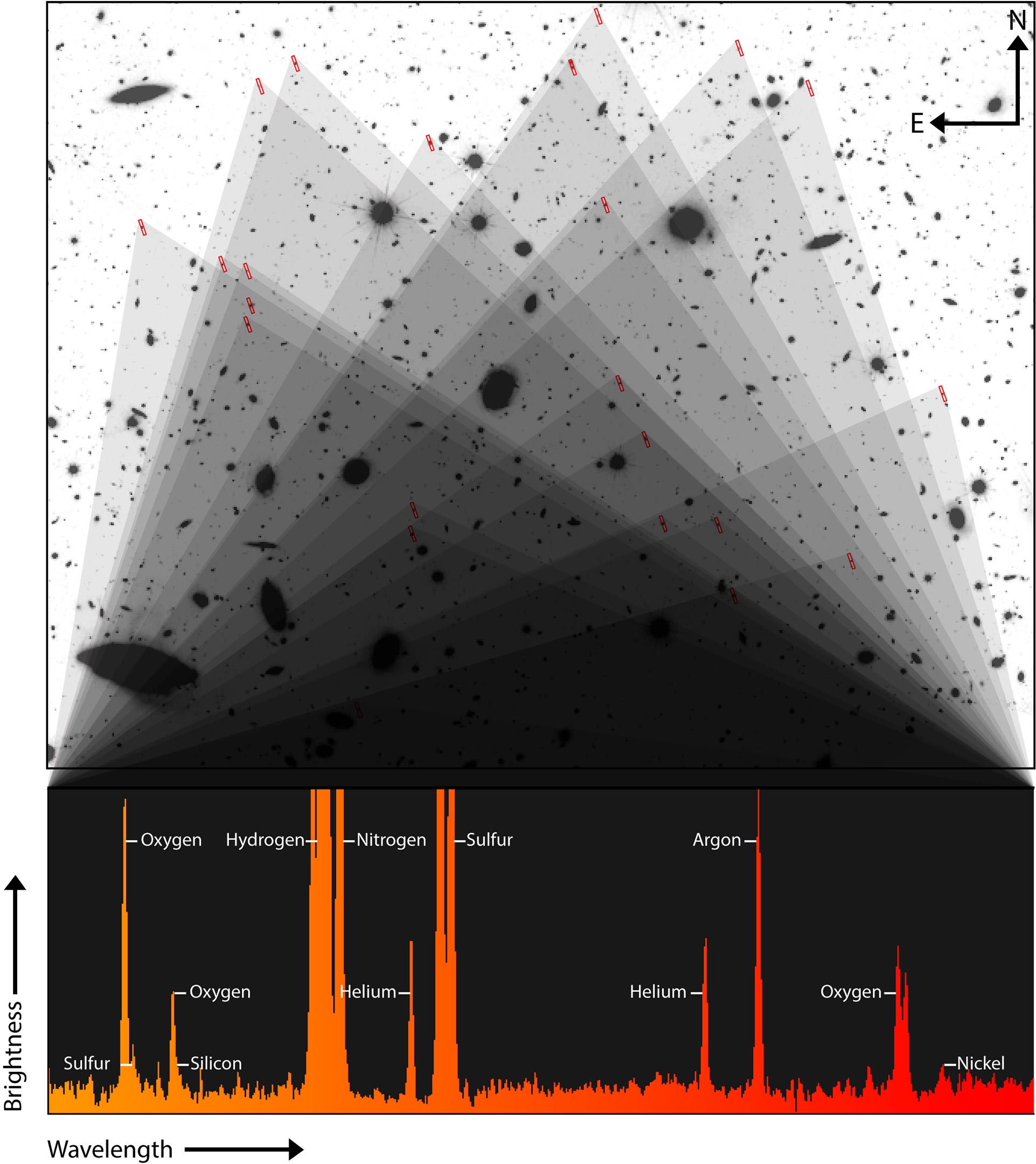
In the new study, Strom and her collaborators used the JWST to observe 33 distant teenage galaxies for a continuous 30 hours this past summer. Then, they combined spectra from 23 of those galaxies to construct a composite picture.
“This washes out the details of individual galaxies but gives us a better sense of an average galaxy. It also allows us to see fainter features,” Strom said. “It’s significantly deeper and more detailed than any spectrum we could collect with ground-based telescopes of galaxies from this time period in the universe’s history.”
Spectra Surprises
The ultra-deep spectrum revealed eight distinct elements: Hydrogen, helium, nitrogen, oxygen, silicon, sulfur, argon, and nickel. All elements that are heavier than hydrogen and helium form inside stars. So, the presence of certain elements provides information about star formation throughout a galaxy’s evolution.
While Strom expected to see lighter elements, she was particularly surprised by the presence of nickel. Heavier than iron, nickel is rare and incredibly difficult to observe.
“Never in my wildest dreams did I imagine we would see nickel,” Strom said. “Even in nearby galaxies, people don’t observe this. There has to be enough of an element present in a galaxy and the right conditions to observe it. No one ever talks about observing nickel. Elements have to be glowing in gas in order for us to see them. So, in order for us to see nickel, there may be something unique about the stars within the galaxies.”
Another surprise: The teenage galaxies were extremely hot. By examining the spectra, physicists can calculate a galaxy’s temperature. While the hottest pockets with galaxies can reach over 9,700 degrees Celsius (17,492 degrees Fahrenheit), the teenage galaxies clock in at higher than 13,350 degrees Celsius (24,062 degrees Fahrenheit).
“This is just additional evidence of how different galaxies likely were when they were younger,” Strom said. “Ultimately, the fact that we see a higher characteristic temperature is just another manifestation of their different chemical DNA because the temperature and chemistry of gas in galaxies are intrinsically linked.”
Reference: “CECILIA: The Faint Emission Line Spectrum of z ∼ 2–3 Star-forming Galaxies” by Allison L. Strom, Gwen C. Rudie, Ryan F. Trainor, Gabriel B. Brammer, Michael V. Maseda, Menelaos Raptis, Noah S. J. Rogers, Charles C. Steidel, Yuguang Chen, 昱光 陈 and David R. Law, 20 November 2023, The Astrophysical Journal Letters.
DOI: 10.3847/2041-8213/ad07dc
The study was supported by NASA, the Pittsburgh Foundation, and the Research Corporation for Scientific Advancement. The data were obtained from the Mikulski Archive for Space Telescopes at the Space Telescope Science Institute and from the W.M. Keck Observatory.
Never miss a breakthrough: Join the SciTechDaily newsletter.
Follow us on Google and Google News.