

A study with IPHES CERCA redefines the role of scavenging in human evolution and shows that it was an efficient strategy that complemented hunting and gathering.
A research group from IPHES-CERCA took part in a project led by the National Research Center on Human Evolution (CENIEH) that revisits how consuming carrion shaped human history. The study, published in the Journal of Human Evolution, examines scavenging from the earliest hominins to modern times and concludes that feeding on carcasses was a consistent and essential survival strategy throughout our evolution.
Carrion refers to the decaying flesh of dead animals, typically in progressive stages of decomposition.
The work included contributions from Dr. Jordi Rosell, a professor at the Universitat Rovira i Virgili and researcher at IPHES-CERCA, and Dr. Maite Arilla, also from IPHES-CERCA, along with collaborators from CENIEH, IREC-CSIC, IPE-CSIC, Universidad Miguel Hernández, and the universities of Alicante, Granada, and Málaga.
Ecological benefits and evolutionary advantages
The authors explain that scavenging provided early humans with important benefits. It allowed them to gather food with much less effort than hunting and became especially useful during times when other resources were limited. New ecological findings also suggest that carrion is more reliable and widespread than once believed, and that animals that feed on it exhibit behaviors that help minimize disease risks.
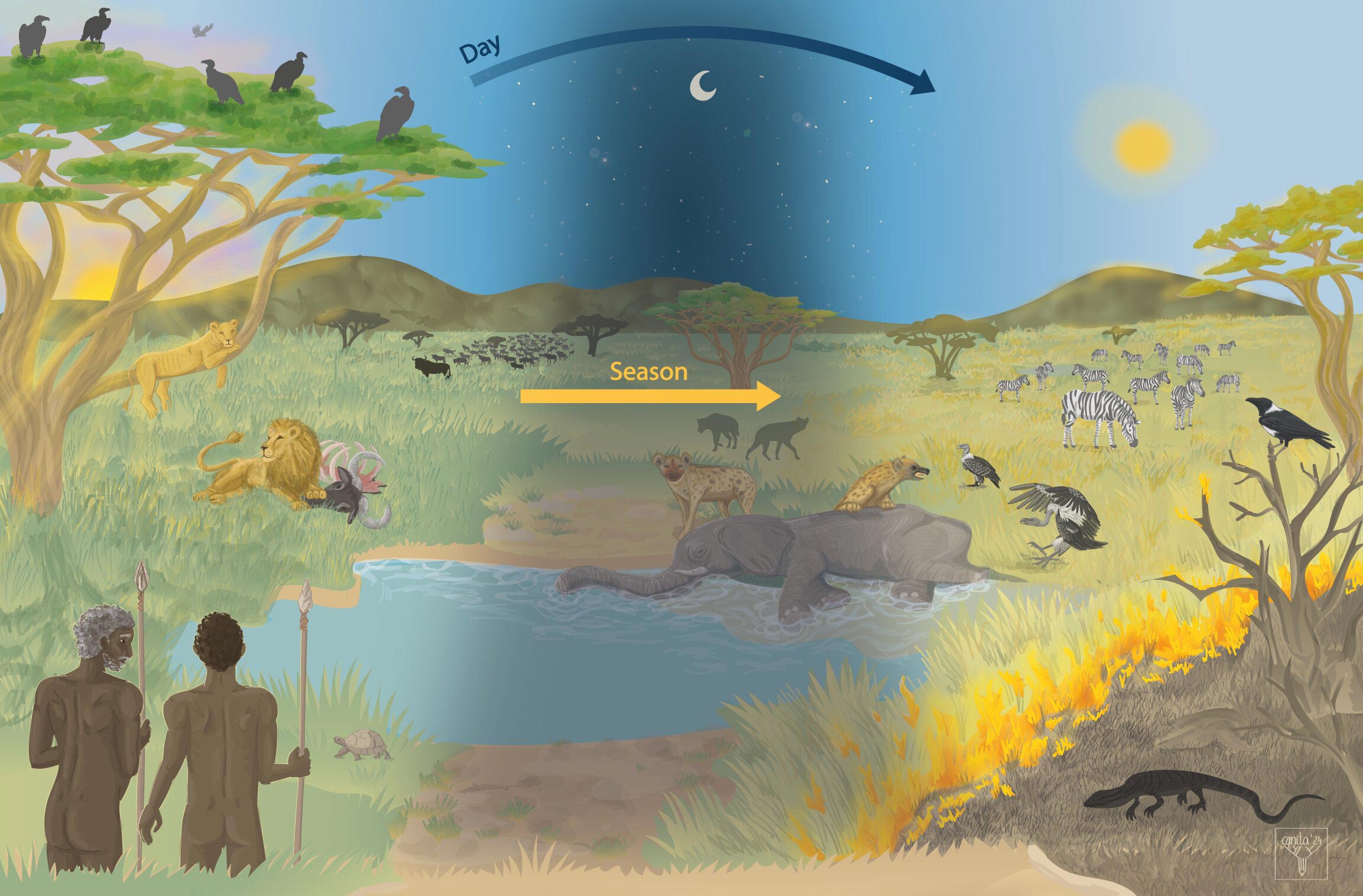
The team also points out that humans possess several features that make scavenging effective. “The acidic pH of the human stomach may act as a defense against pathogens and toxins, and the risk of infection decreased considerably when we began to use fire for cooking. Moreover, our ability to travel long distances with low energy expenditure was key to finding food opportunities,” they explain.
Tools, cooperation, and behavioral adaptations
Language and stone tools —even the simplest ones— facilitated collective organization to locate carcasses and gain access to meat, fat, and bone marrow. This combination of factors made scavenging a highly efficient activity, complementary to hunting and plant gathering.
In the 1960s, the discovery in Africa of the earliest evidence that ancient hominins ate meat sparked an intense debate: did they hunt these animals, or did they simply exploit the carcasses they found? For decades, scavenging was considered a “primitive” stage that humans had left behind once they learned to hunt. However, current studies have completely overturned this view: all carnivorous species consume carrion to some extent, and many modern hunter-gatherer groups continue to practice scavenging as part of their subsistence behavior.
The authors conclude that scavenging was not merely a transitional stage but a fundamental and recurrent strategy throughout human evolution, complementary to hunting and plant gathering. Ultimately, eating carrion (far from being a marginal behavior) was key to making us human.
Reference: “Revisiting hominin scavenging through the lens of optimal foraging theory” by Ana Mateos, Marcos Moleón, Paul Palmqvist, Jordi Rosell, Esther Sebastián-González, Antoni Margalida, José Antonio Sánchez-Zapata, Maite Arilla and Jesús Rodríguez, 17 October 2025, Journal of Human Evolution.
DOI: 10.1016/j.jhevol.2025.103762
This research was supported by TROPHIc Project (Grant I + D + I PID2019-105101GB-I00 funded by MCIN/AEI/10.13039/501100011033) (A.M. and J.R.); Spanish Ministry of Science and Innovation
Never miss a breakthrough: Join the SciTechDaily newsletter.
Follow us on Google and Google News.
1 Comment
A lot of meat is still “hung” for days or weeks to improve taste and texture. Surely this simulates carrion.