

A newly discovered Neanderthal site on Portugal’s Algarve coast has revealed the first fossilized footprints of these ancient humans in the region.
A new international study published in Scientific Reports has identified a previously unknown Neanderthal site in southern Portugal, along the Algarve coast. This discovery marks the first evidence of Neanderthal hominids in Portugal and provides a major step forward in understanding early human activity along the Atlantic coast of the Iberian Peninsula during the Pleistocene epoch.
The research was led by Carlos Neto de Carvalho, a geologist and paleontologist at IDL–University of Lisbon and scientific coordinator of the Naturtejo UNESCO Global Geopark, together with Fernando Muñiz Guinea, a professor in the Department of Crystallography, Mineralogy and Agricultural Chemistry at the University of Seville. The project also involved experts from institutions across Portugal, Spain, Gibraltar, Italy, Denmark, and China.
According to Neto de Carvalho and Muñiz, it represents an “interdisciplinary study on the ecological and behavioral analysis of the fossilized footprint record in southern Portugal.”
A unique window into everyday behavior
Researchers identified the first Neanderthal footprints in Portugal at two sites along the Algarve: Praia do Monte Clérigo, where the rocks date back around 78,000 years, and Praia do Telheiro, which dates to about 82,000 years ago. At Monte Clérigo, scientists documented five trackways and 26 individual footprints left by both adults and young children, some just over a year old, on a steep slope that once formed part of a coastal dune. At Praia do Telheiro, they uncovered a single footprint likely made by a teenager or adult female, alongside fossilised bird tracks typical of ancient coastal and rocky environments.
The study of Neanderthal footprints offers several unique and complementary advantages over other types of archaeological remains, such as bones or tools. These footprints, preserved in sediments or sedimentary rocks, constitute a direct record of the behavior at a specific moment in time of the Neanderthals who produced them. The footprints show the physical presence of a Neanderthal in a specific place, unlike artifacts, which may have been transported or abandoned.
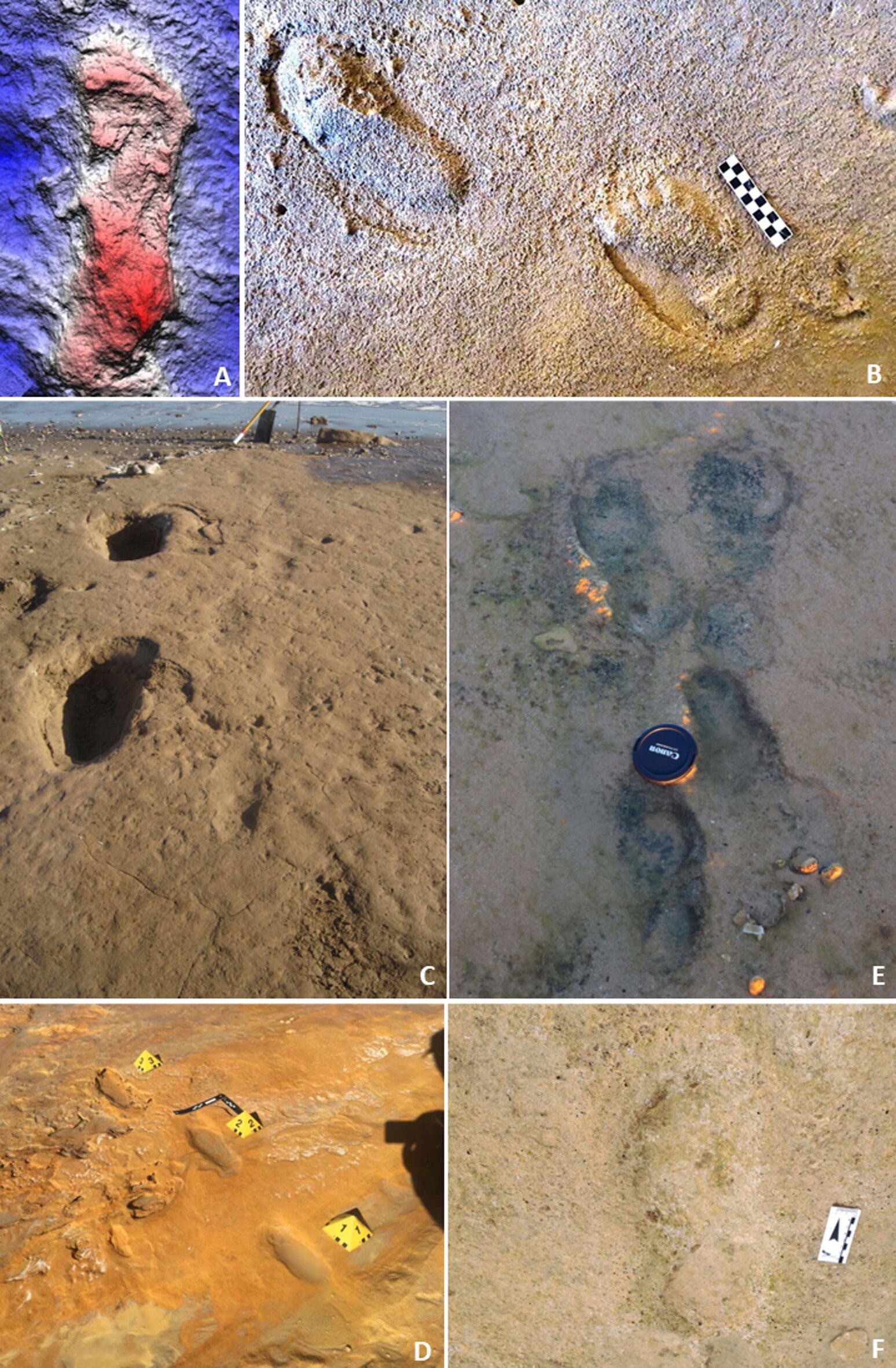
“Footprints record a specific moment, almost instantaneously, allowing us to reconstruct what was happening; for example, a group walk, a chase, a flight, or presence in a particular landscape. The footprints show how Neanderthals used space, how they explored coastal environments, forests, dunes, or riverbanks, something that is difficult to infer solely from artifacts,” argue Neto de Carvalho and Muñiz.
Through the number, size and arrangement of the footprints, it is possible to infer the minimum number of individuals present, their age range (children, adolescents, adults), or the possible division of tasks (e.g. a hunting party). Children and babies, who rarely leave archaeological traces, can be identified by their footprints (which are smaller), revealing more about the social structure: “footprints offer a unique and dynamic window into everyday behavior: a snapshot of life tens of thousands of years ago,” explain the authors.
The footprints studied by the research team indicate locomotion strategies adapted to the terrain, suggesting route planning, proximity to the camp, possible hunting behavior, and coexistence with other species. For example, one of the tracks shows the interaction between human footprints and those of a deer produced simultaneously, reinforcing the hypothesis of pursuit or ambush practices in a dune context.
A diet rich in deer, horses, and hares
The research also uses ecological network analysis based on mathematical network theory to relate data from other known coastal archaeological sites in the Iberian Peninsula, confirming that the Neanderthal diet in these regions consisted mainly of deer, horses, and hares, complemented by marine and coastal resources, indicating a diversified dietary strategy.
These new findings demonstrate that Neanderthals were more versatile and ecologically and cognitively adapted to coastal environments than previously believed, offering exceptional insight into their behavior, mobility, and social organization.
Reference: “Neanderthal coasteering and the first Portuguese hominin tracksites” by Carlos Neto de Carvalho, Pedro Proença Cunha, João Belo, Fernando Muñiz, Andrea Baucon, Mário Cachão, Silvério Figueiredo, Jan-Pieter Buylaert, José María Galán, Zain Belaústegui, Luis Miguel Cáceres, Yilu Zhang, Cristiana Ferreira, Joaquín Rodríguez-Vidal, Stewart Finlayson, Geraldine Finlayson and Clive Finlayson, 3 July 2025, Scientific Reports.
DOI: 10.1038/s41598-025-06089-4
Never miss a breakthrough: Join the SciTechDaily newsletter.
Follow us on Google and Google News.