

Cosmologists are using cutting-edge computational tools to uncover the secrets of dark matter and dark energy, which together make up 95% of the universe.
Through the Dark Sky Mining project and the powerful Aurora supercomputer, scientists simulate cosmic scenarios at unprecedented speeds, testing theories, and refining models. Dark matter, though invisible, reveals itself through gravitational effects, while dark energy accelerates the universe’s expansion. By harnessing AI and machine learning, researchers can efficiently compare simulations with observations, potentially rewriting fundamental physics.
Unearthing the Universe’s Mysteries
Cosmologists and astrophysicists are on a mission to uncover the universe’s most elusive components. Their goal is to identify and study the hidden forces that shape cosmic evolution. If revealed, these discoveries could answer long-standing scientific questions and even challenge the fundamental laws of physics that have been refined for centuries.
At the U.S. Department of Energy’s (DOE) Argonne National Laboratory, researchers are developing advanced computational tools, akin to high-tech mining equipment, to investigate the mysterious nature of dark matter and dark energy, two of the biggest unsolved mysteries in modern physics.
“The nature of dark matter and dark energy is not understood,” says Argonne physicist and cosmologist Salman Habib, an Argonne Distinguished Fellow and director of the lab’s Computational Science division. “We know the two exist, but we don’t understand what they are, nor the fundamental principles governing their existence.”
“Fundamentally, what we’re doing right now is simply an extension of that long history of humanity’s connection to the stars, the galaxies and everything else … The ability to look deep into the universe is pretty astounding because it also tells us a lot about our own place in the big scheme of things.”
Salman Habib, Argonne Distinguished Fellow
Harnessing Supercomputers for Cosmic Breakthroughs
To help expand current theories, Argonne scientists are hard at work creating detailed sky maps that combine actual cosmic observations with computer-intensive simulations of the universe. The project, called Dark Sky Mining, is part of the Aurora Early Science Program supported by the Argonne Leadership Computing Facility (ALCF), a DOE Office of Science user facility.
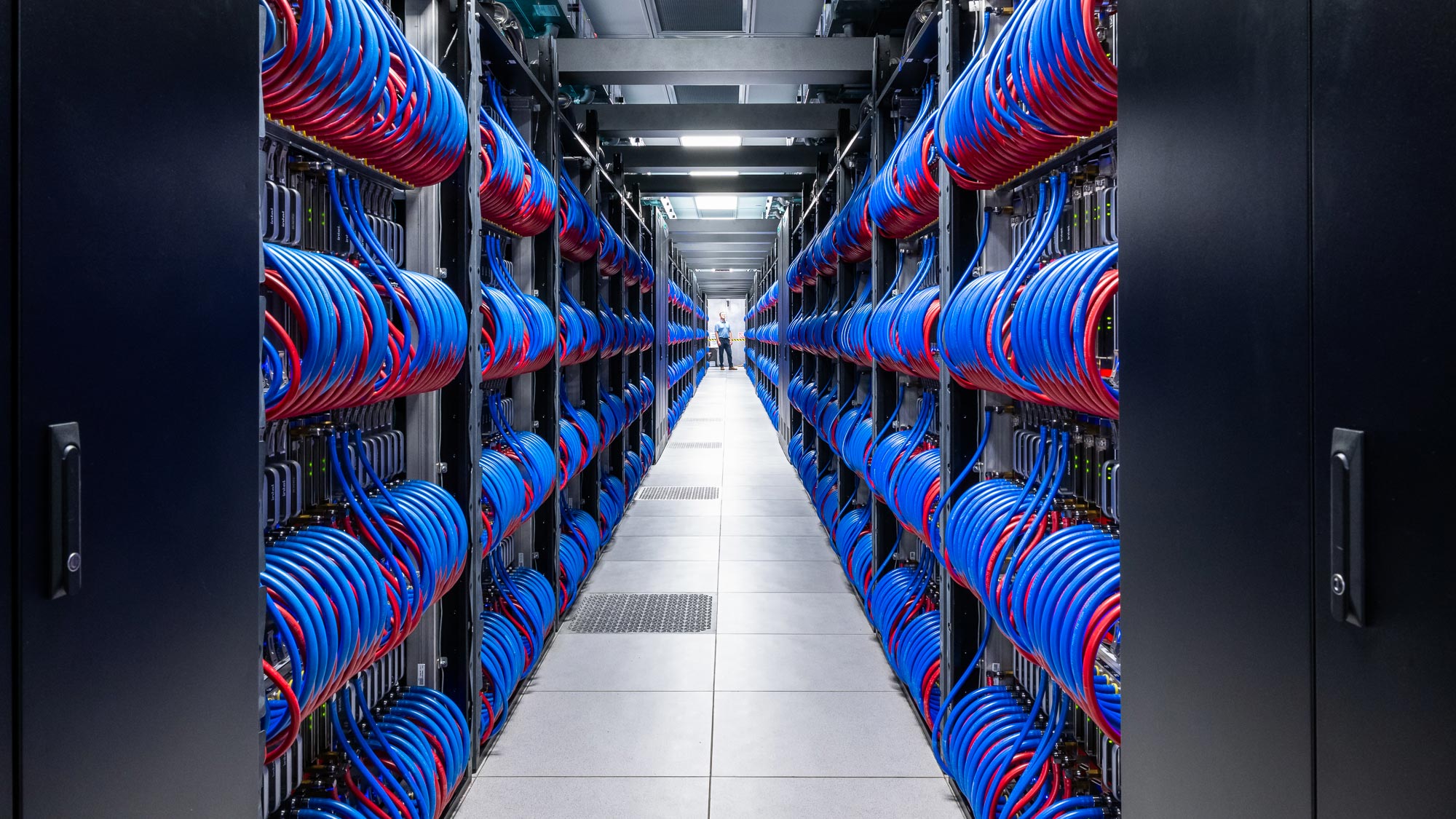
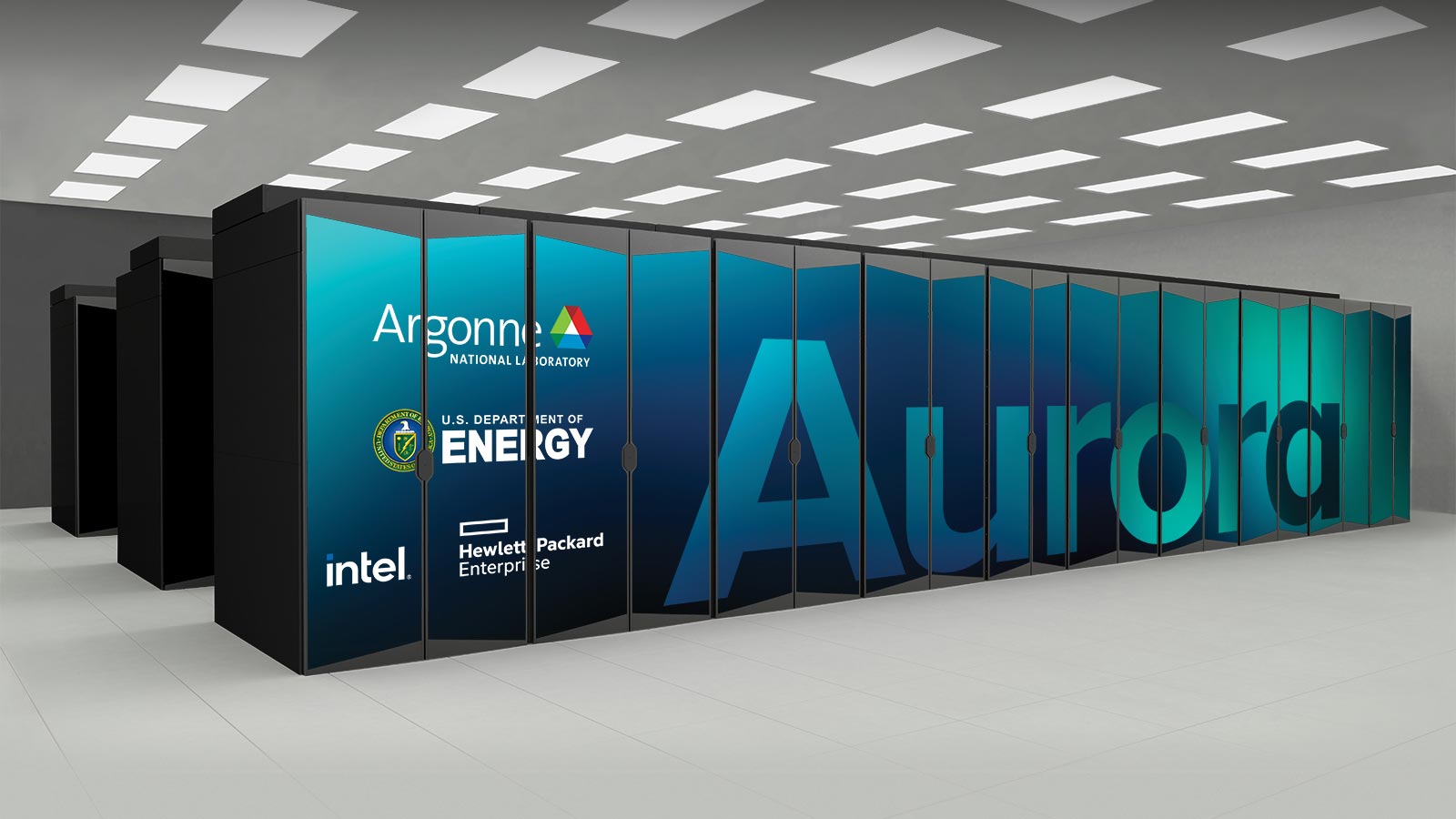
Through the program, the ALCF has worked with several research teams from across the nation to prepare a diverse set of codes and software for the scale and architecture of Argonne’s new exascale supercomputer, Aurora.
Aurora’s capacity to execute over a quintillion, or a billion billion, calculations per second is requisite for rapidly simulating and altering a multitude of physics-intense cosmic scenarios. Combining that capability with advanced artificial intelligence (AI) and statistical methods, the group hopes to provide a more robust description of the function and dynamics of dark matter and dark energy, and how they connect to the distribution and properties of galaxies in the universe.
Unanswered Questions: The Dark Side of the Universe
From Galileo to NASA’s groundbreaking James Webb Space Telescope, humans have amassed a dazzling catalog of illustrations and images that continue to shape our perception of the universe.
Just when it looked like science had a pretty good handle on the makeup and mechanics of this observable universe, dark forces began to make themselves known, throwing a sizeable wrench into well-established models of both physics and cosmology.
It turns out, the visible matter that we see only constitutes about 5% of the universe. Scientists believe that dark matter and dark energy account for 27% and 68%, respectively.
The Puzzle of Dark Matter
Intimations of dark matter reach back to the early 20th century, but the more contemporary impression is attributed to the Swiss astronomer Fritz Zwicky. In the 1930s, Zwicky considered the motions of individual galaxies in a galaxy cluster — the Coma cluster, which contains more than a thousand galaxies, all in relatively close proximity. Based on gravitational principles alone, he couldn’t fathom how the cluster remained bound together. To account for this phenomenon, he assumed the existence of an unseen “dark matter.”
The idea gained ground with more careful studies of individual galaxies in the 1960s and 1970s. And more recent measurements with other probes, such as gravitational lensing (the distortion of images of background galaxies as light bends around intervening masses), have provided striking evidence for dark matter’s existence.
Dark Energy: The Expanding Mystery
Still, something was missing. Even with the addition of dark matter, there was still imbalance in the current model of the universe. It would take measurements of bright exploding stars — supernovae that allow cosmologists to measure how the universe is expanding and whether the expansion rate is slowing or speeding up — to discover what we now call dark energy.
Soon, dark energy would join the rolls of cosmological forces as the possible culprit in the surprise discovery that the universe was not only expanding, but expanding at an accelerated rate, a surprise to many. Dark energy acts as something of an anti-gravity, pushing away at very large distances with greater force than gravity can hold things together.
“Remarkably, dark energy was just what was needed to make the large-scale clustering of galaxies come out right and, somehow, keep the cosmological model intact,” explains Habib.
Dark matter may not be such a crazy construct, he said, especially for a universe teeming with astounding phenomena. It is only mysterious in the sense that it doesn’t absorb or emit light, but we can “see” it because of its gravitational effects — much like a black hole.
“In a way, it’s just another particle we haven’t found yet, just like we knew that neutrinos existed, but we hadn’t found them,” notes Habib. “But dark energy is a very different proposition because it makes clear a fundamental problem in describing how gravity works. And that’s what causes a lot of heartburn.”
Untangling Dark Forces With Computing Power
Researchers use supercomputers like Aurora to build realistic models of the universe that allow them to investigate hundreds and thousands of possible scenarios by running their own virtual universes.
Virtual universes are examples of digital twins, sophisticated models of complex systems like the Earth’s climate or the spread of disease. Scientists use them to make fairly accurate predictions about a system’s evolution and as a tool for understanding the underlying issues related to unexpected events that occur within those systems — anomalies. It is these irregularities or inconsistencies in a model that could lead researchers to a discovery.
Currently, it is assumed that dark matter, whatever it is, doesn’t interact with itself or visible matter, but it does interact gravitationally, just like everything else. Yet even this limited understanding still presents several scenarios in which the presence of dark matter might be detected and its properties investigated.
If, in fact, dark matter is self-interacting, such interactions could alter gravitational dynamics. For example, you can track the orbits of stars near the center of a small galaxy to determine whether the pattern is different from what you would predict through gravity alone.
And because it is dynamic, researchers can simulate it.
“If you give me a model for how the dark matter interacts with itself, I can put that in my simulation code, and I can work out what happens,” says Habib. “I can predict at small scales how the mass distribution will change.”
Because a compelling model of dark matter interactions does not yet exist, researchers can run and rerun different models many times, changing parameters along the way. The process continues until a model is achieved that closely aligns with observation and provides some inkling of the nature of the interactions.
That example is just one way of investigating the nooks and crannies of the vast space of cosmological models, notes Habib. Such a process would have taken years using Aurora’s predecessors — powerful supercomputers in their own right and in their own time. But Aurora’s exascale computing power, coupled with integrated AI and statistical methods, dramatically reduces the number of simulations and time needed to get results.
AI and Machine Learning Accelerate Discoveries
For example, AI is powering a technique called emulation to tackle inverse problems — that is, problems where the goal is determining the cause or system properties from observed effects or data. The new technique tries to match simulations to observations and measurements of some cosmological feature or dynamical property. Until recently, it could take thousands of simulations to explore parameters that might solve a particular problem.
Emulation is a powerful machine learning-based statistical approach that requires only a fraction of that number of simulations to determine parameters that best fit a set of observations.
“So, the point is, we can make the process way more efficient,” says Habib.
This is a huge advantage, especially when modeling cosmos-encompassing scenarios, like the expansion of the universe and the role played by dark energy.
“Dark energy is more subtle than dark matter,” he says, “because there are no small-scale dynamical factors associated with it. And because it is affecting the expansion rate of the universe, dark energy is really changing how the universe is behaving on very large scales.”
To get a better handle on the magnitude of the problem, researchers first must measure both the expansion rate of the universe and the speed at which galaxies are moving away from each other. These calculations require the development of extremely large and computationally costly sky maps to virtually visualize and manipulate the forces at work.
And just as with dark matter, researchers can simulate different models of dark energy using infinite variations of this force, changing parameters until the models begin to agree with observation.
One trajectory of models requires going back to the early stages of the universe to measure its expansion rate and then figure out whether it has changed over time.
“And if so, does it correspond to what you would expect, or is it different?” asks Habib. “It turns out that the differences are fairly subtle. But part of the reason is that the current model of dark energy is very simple.
“So, at the moment, we’re trying to make more and more accurate predictions for the model with the idea that, if you find the measurements to be at variance with what you’re predicting, then you know there’s something wrong,” he continued. “It won’t tell you what the right answer is, but it tells us that the simple model we have is incorrect. So, then we can develop new ones.”
Rinse and repeat. Thousands, perhaps millions of times.
Illuminating the Dark Universe
The team will leverage Aurora’s immense computing power to perform massive simulations of the cosmos, helping to advance the arena of computational cosmology and prepare the way for the effective launch of new telescopes and probes.
The work may return answers as to the nature of dark energy and dark matter, in addition to addressing the conundrum of neutrinos, which remain a perplexing piece of the Standard Model of particle physics. Characterizing the total mass of neutrinos has been a Holy Grail of sorts since experiments revealed evidence of three different kinds or “flavors” of the particle, each with its own mass.
But for Habib, the project affords us much more than an answer to these particular riddles. The use of cutting-edge technologies, particularly in computing, has exciting implications for innovations that we often don’t anticipate.
The work also affirms our long relationship with the sky, and through it, the development of some rational understanding of nature that in the past led to calendars and precision navigation, among other human achievements.
“Fundamentally, what we’re doing right now is simply an extension of that long history of humanity’s connection to the stars, the galaxies and everything else,” he says. “There’s an inherent beauty in the whole thing. I mean, look at how excited people get when they see images from Hubble or the new James Webb Space Telescope. The ability to look deep into the universe is pretty astounding because it also tells us a lot about our own place in the big scheme of things.”
The Argonne Leadership Computing Facility (ALCF) offers powerful supercomputing resources to scientists and engineers, helping to drive breakthroughs across a wide range of research fields. Supported by the U.S. Department of Energy’s Office of Science through its Advanced Scientific Computing Research (ASCR) program, the ALCF is one of two DOE Leadership Computing Facilities in the country dedicated to open, unclassified scientific research.
Never miss a breakthrough: Join the SciTechDaily newsletter.
Follow us on Google and Google News.
1 Comment
Ambitious, no doubt, but hardly scientific.