
New Analysis Finds Evidence for Many Exoplanets Made of Water and Rock Around Small Stars
Water is the one thing all life on Earth requires. Additionally, the cycle of rain to river to ocean to rain is an essential part of what maintains our planet’s stable and hospitable climate conditions. Planets with water are always at the top of the list when scientists discuss where to search for signs of life throughout the galaxy.
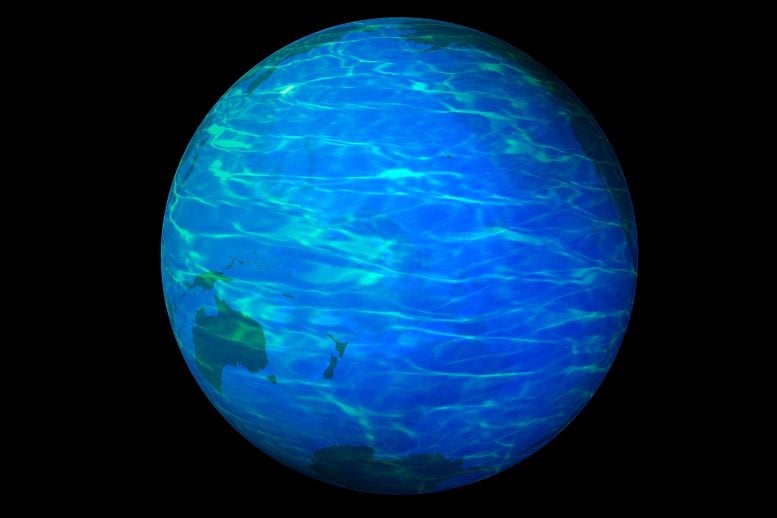
Many more planets may have large amounts of water than previously thought—as much as half water and half rock, according to a new study. The catch? All that water is likely embedded in the rock, rather than flowing as oceans, lakes, or rivers on the surface.
“It was a surprise to see evidence for so many water worlds orbiting the most common type of star in the galaxy,” said Rafael Luque. He is first author on the new paper and a postdoctoral researcher at the University of Chicago. “It has enormous consequences for the search for habitable planets.”
Planetary Population Patterns
Because of improved telescope instruments, scientists are finding signs of more and more exoplanets—planets in distant solar systems. With a larger sample size, scientists are better able to identify demographic patterns. This is similar to how looking at the population of an entire town can reveal trends that are hard to see at an individual level.
Luque, along with co-author Enric Pallé of the Institute of Astrophysics of the Canary Islands and the University of La Laguna, decided to take a population-level look at a group of planets that are seen around a type of star called an M-dwarf. These stars are the smallest and coolest kind of star in the main sequence and the most common stars we see around us in the galaxy. Scientists have cataloged dozens of planets around them so far.
However, because stars are so much brighter than their planets, we cannot see the actual planets themselves directly. Instead, astronomers detect faint signs of the planets’ effects on their stars—the shadow created when a planet crosses in front of its star, or the tiny tug on a star’s motion as a planet orbits. This means that many questions remain about what these planets actually look like.
“The two different ways to discover planets each give you different information,” said Pallé. By catching the shadow created when a planet crosses in front of its star, astronomers can determine the diameter of the planet. By measuring the tiny gravitational pull that a planet exerts on a star, astronomers can calculate its mass.
Scientists can get a sense of the makeup of the planet by combining the two measurements. Perhaps it’s a big-but-airy planet made mostly out of gas like Jupiter, or a small, dense, rocky planet like Earth.
These analyses had been done for individual planets, but much more rarely for the entire known population of such planets in the Milky Way galaxy. As the scientists looked at the numbers—43 planets in all—they saw a surprising picture emerging.
“I was shocked when I saw this analysis—I and a lot of people in the field assumed these were all dry, rocky planets.”
Prof. Jacob Bean
The densities of a large percentage of the planets suggested that they were too light for their size to be made up of pure rock. Instead, these planets are probably something like half rock and half water, or another lighter molecule. Imagine the difference between picking up a bowling ball and a soccer ball: they’re roughly the same size, but one is made up of much lighter material.
Searching for Water Worlds
It may be tempting to imagine these planets like something out of Kevin Costner’s Waterworld: entirely covered in deep oceans. However, these planets are so close to their suns that any water on the surface would exist in a supercritical gaseous phase, which would enlarge their radius. “But we don’t see that in the samples,” explained Luque. “That suggests the water is not in the form of surface ocean.”
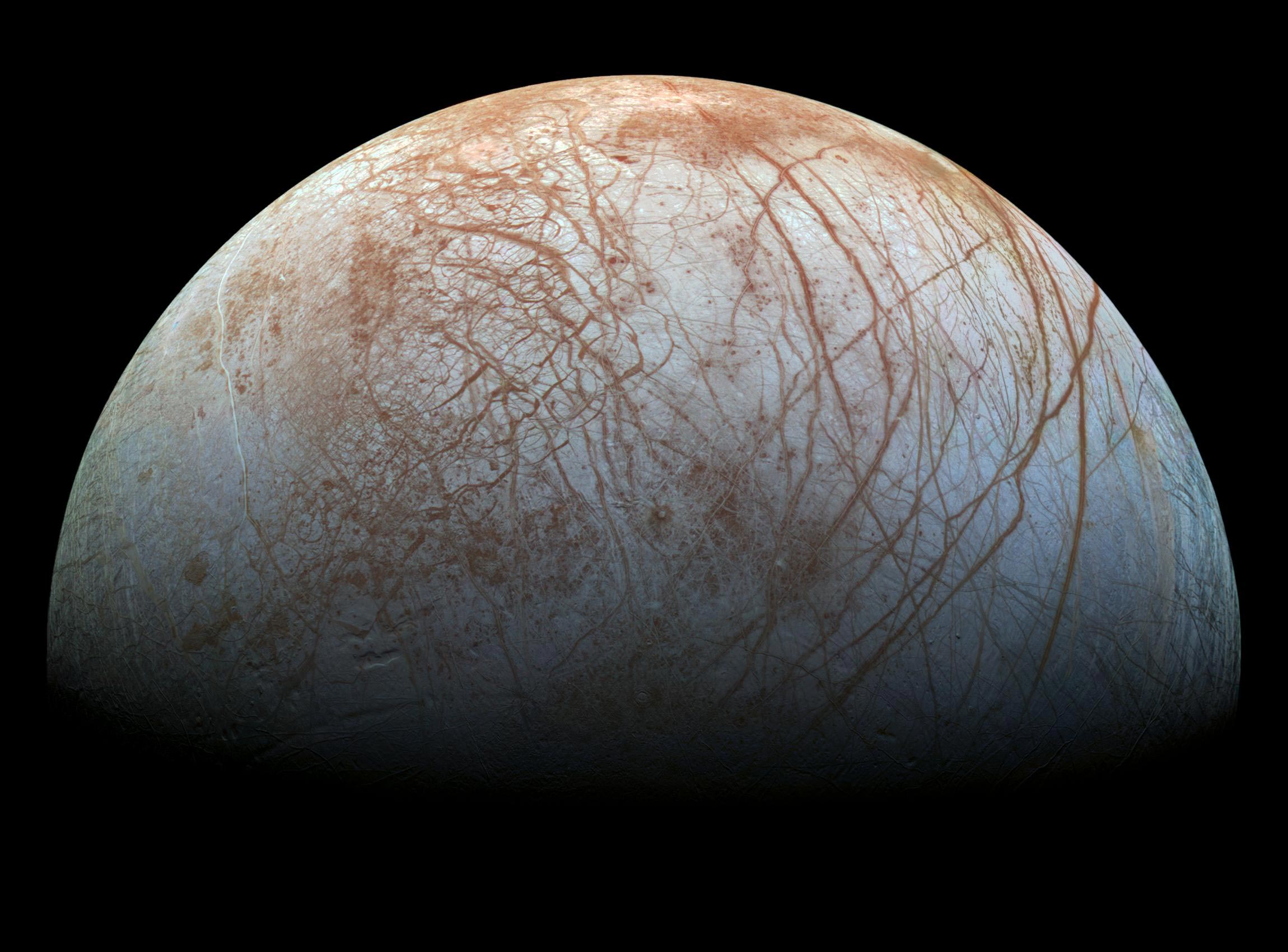
Instead, the water could exist mixed into the rock or in pockets below the surface. Those conditions would be similar to Jupiter’s moon Europa, which is thought to have liquid water underground.
“I was shocked when I saw this analysis—I and a lot of people in the field assumed these were all dry, rocky planets,” said UChicago exoplanet scientist Jacob Bean, whose group Luque has joined to conduct further analyses.
The finding matches a theory of exoplanet formation that had fallen out of favor in the past few years, which suggested that many planets form farther out in their solar systems and migrate inward over time. Imagine clumps of rock and ice forming together in the cold conditions far from a star, and then being pulled slowly inward by the star’s gravity.
Although the evidence is compelling, Bean said he and the other researchers would still like to see “smoking gun proof” that one of these planets is a water world. That’s something the scientists are hoping to do with the James Webb Space Telescope, NASA’s newly launched space telescope that is the successor to Hubble.
Reference: “Density, not radius, separates rocky and water-rich planets orbiting M dwarf stars” by Rafael Luque and Enric Pallé, 8 September 2022, Science.
DOI: 10.1126/science.abl7164
The majority of the research was performed as Luque’s Ph.D. thesis at the Institute of Astrophysics of the Canary Islands.
Funding: Spanish Ministry of Science and Innovation, Centre of Excellence “Severo Ochoa” award to the Institute of Astrophysics of Andalusia, Spanish Ministry of Economics and Competitiveness, Spanish Ministry of Universities, Next Generation EU.
Never miss a breakthrough: Join the SciTechDaily newsletter.
Follow us on Google and Google News.
1 Comment
See Genesis 1:2, the earth had water but no life until “God said…”