

Close Menu
    Facebook X (Twitter) Instagram
    SciTechDaily
    • Biology
    • Chemistry
    • Earth
    • Health
    • Physics
    • Science
    • Space
    • Technology
    Facebook X (Twitter) Pinterest YouTube RSS
    SciTechDaily
    Home»Technology»Terahertz Breakthrough: New Technique Offers Unprecedented Control Over Light
    Technology

    Terahertz Breakthrough: New Technique Offers Unprecedented Control Over Light

    By Chinese Academy of SciencesJuly 15, 2024No Comments3 Mins Read
    Facebook Twitter Pinterest Telegram LinkedIn WhatsApp Email Reddit
    Share
    Facebook Twitter LinkedIn Pinterest Telegram Email Reddit
    Terahertz Wave Technology Concept Art
    Researchers have created a new method to generate structured terahertz light beams using programmable spintronic emitters, marking a significant advancement in terahertz technology. This innovation allows for the generation and precise manipulation of light with both spin and orbital angular momentum. The technology has potential applications in security, medical imaging, and communication. This development overcomes previous challenges in generating and controlling terahertz light, paving the way for novel devices with enhanced capabilities. Credit: SciTechDaily.com

    Researchers have developed a new method to generate and manipulate structured terahertz light beams using programmable spintronic emitters, advancing applications in security, medical imaging, and communication.

    Scientists have created a new technique to produce structured terahertz light beams with programmable spintronic emitters. This advancement represents a major step forward in terahertz technology, allowing for the first time the generation and manipulation of light that possesses both spin and orbital angular momentum at these frequencies.

    Terahertz radiation lies between microwaves and infrared light on the electromagnetic spectrum. It holds great promise for various applications, including security scanners, medical imaging, and ultrafast communication. However, generating and controlling terahertz light effectively has proven challenging.

    This new research, led by Prof. Zhensheng Tao, Prof. Yizheng Wu from Fudan University, and Prof. Yan Zhang from Capital Normal University, overcomes these limitations by employing programmable spintronic emitters based on exchange-biased magnetic multilayers. These devices consist of thin layers of magnetic and non-magnetic materials that convert laser-induced spin-polarized currents into broadband terahertz radiation.
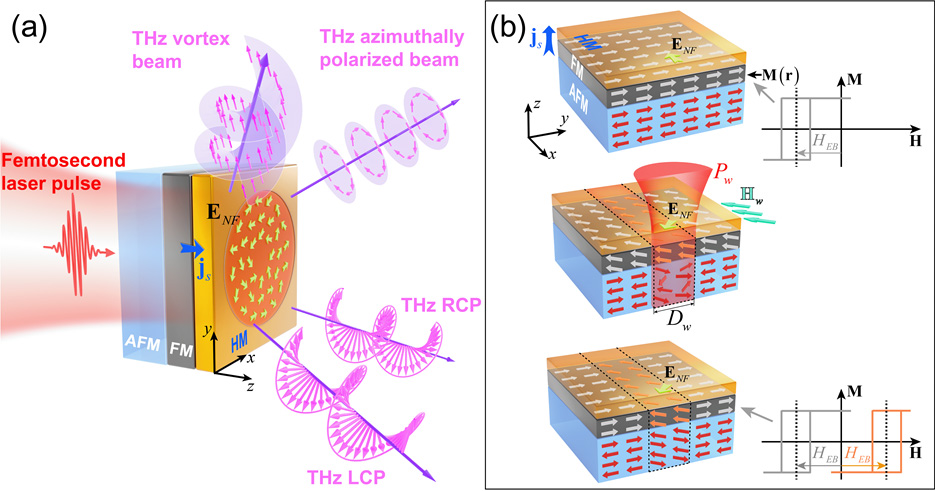
    General Concept of Programmable Spintronic Emitters Graphic
    (a) Schematic diagram of the experimental setup. (b) Schematics of the laser-assisted-magnetic-programming method. Credit: Shunjia Wang, Wentao Qin, Tongyang Guan, Jingyu Liu, Qingnan Cai, Sheng Zhang, Lei Zhou, Yan Zhang, Yizheng Wu, Zhensheng Tao

    Innovations in Light Polarization

    “The key innovation lies in our ability to flexibly program the magnetization pattern within the emitter with high precision and high spatial resolution,” graduate student and first author Shunjia Wang explains. “This allows us to design and generate terahertz beams with complex polarization states, including beams with spatially separated circular polarizations, azimuthal or radial polarization states, and even a full Poincaré beam.”

    A Poincaré beam exhibits all possible states of light polarization within its cross-section. This unique property has applications in areas like generating special optical forces, achieving flat-top intensity profiles, and single-shot polarimetry measurements.
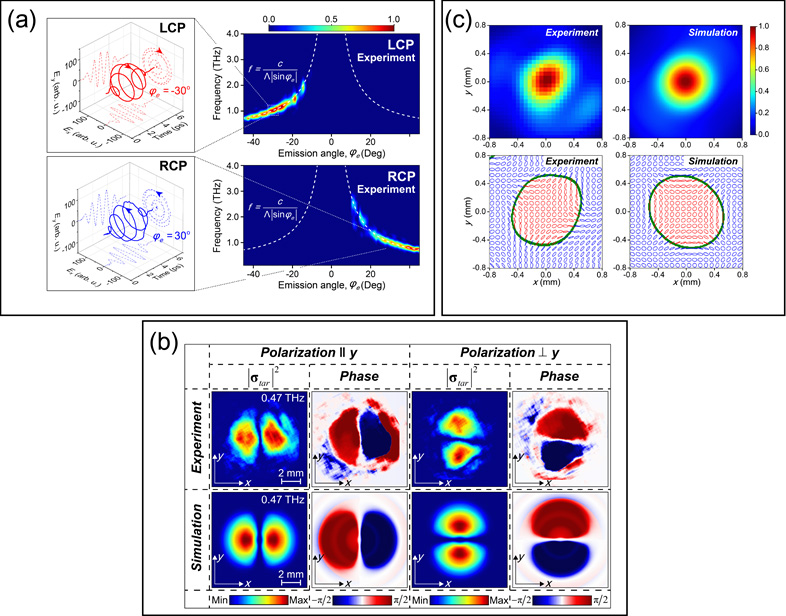
    Structured Terahertz Light Beams Graphic
    (a) Programmed terahertz emitter for spatially separated left- and right-circularly polarized terahertz radiation. (b) Programmed terahertz emitter for azimuthal polarization. (c) Programmed terahertz emitter for the full Poincaré beam. Credit: Shunjia Wang, Wentao Qin, Tongyang Guan, Jingyu Liu, Qingnan Cai, Sheng Zhang, Lei Zhou, Yan Zhang, Yizheng Wu, Zhensheng Tao

    The researchers successfully demonstrated the generation of various structured terahertz beams using their programmable emitters. These beams hold promise for advancing terahertz technologies in numerous fields.

    “Our findings pave the way for the development of novel terahertz devices with enhanced functionalities,” concludes Prof. Zhensheng Tao. “The ability to manipulate terahertz light with such precision opens exciting possibilities for applications in spectroscopy, sensing, and communication.”

    Reference: “Flexible generation of structured terahertz fields via programmable exchange-biased spintronic emitters” by Shunjia Wang, Wentao Qin, Tongyang Guan, Jingyu Liu, Qingnan Cai, Sheng Zhang, Lei Zhou, Yan Zhang, Yizheng Wu and Zhensheng Tao, 8 July 2024, eLight.
    DOI: 10.1186/s43593-024-00069-3

    The study was funded by the National Key Research and Development Program of China, the National Natural Science Foundation of China, the Shanghai Municipal Science and Technology Basic Research Project, and the National Key Research Program of China.

    Never miss a breakthrough: Join the SciTechDaily newsletter.
    Follow us on Google and Google News.

    Chinese Academy of Sciences Light Spintronics
    Share. Facebook Twitter Pinterest LinkedIn Email Reddit

    Related Articles

    3D Microchip Allows Information to Travel in Three Dimensions

    Photon Devices Could Outperform Traditional Computers

    HARPES Technique Reveals Ferromagnetic Secrets of Dilute Magnetic Semiconductors

    Electronic Read-Out of the Quantum State of an Atom

    Converting Heat to Electricity in a Non-Magnetic Semiconductor

    A New Fiber Opens the Possibility of 3-D Displays Woven from Flexible Fibers

    New Metamaterial Design Extremely Efficient at Capturing Light

    Penn Researchers Build a Circuit with Light

    The Future Of Incandescent Bulbs Not So Bright

    Leave A Reply Cancel Reply

    • Facebook
    • Twitter
    • Pinterest
    • YouTube

    Don't Miss a Discovery

    Subscribe for the Latest in Science & Tech!

    Trending News

    The Universe Is Expanding Too Fast and Scientists Can’t Explain Why

    “Like Liquid Metal”: Scientists Create Strange Shape-Shifting Material

    Early Warning Signals of Esophageal Cancer May Be Hiding in Plain Sight

    Common Blood Pressure Drug Shows Surprising Power Against Deadly Antibiotic-Resistant Superbug

    Scientists Uncover Dangerous Connection Between Serotonin and Heart Valve Disease

    Scientists Discover a “Protector” Protein That Could Help Reverse Hair Loss

    Bone-Strengthening Discovery Could Reverse Osteoporosis

    Scientists Uncover Hidden Trigger Behind Stem Cell Aging

    Follow SciTechDaily
    • Facebook
    • Twitter
    • YouTube
    • Pinterest
    • Newsletter
    • RSS
    SciTech News
    • Biology News
    • Chemistry News
    • Earth News
    • Health News
    • Physics News
    • Science News
    • Space News
    • Technology News
    Recent Posts
    • Scientists Overcome Major Quantum Bottleneck, Potentially Transforming Teleportation and Computing
    • Quantum Physics’ Strangest Problem May Hold the Key to Time Itself
    • Scientists Create “Liquid Gears” That Spin Without Touching
    • The Simple Habit That Could Help Prevent Cancer
    • Forgotten Medicinal Plant Shows Promise in Fighting Dangerous Superbugs
    Copyright © 1998 - 2026 SciTechDaily. All Rights Reserved.
    • Science News
    • About
    • Contact
    • Editorial Board
    • Privacy Policy
    • Terms of Use

    Type above and press Enter to search. Press Esc to cancel.