
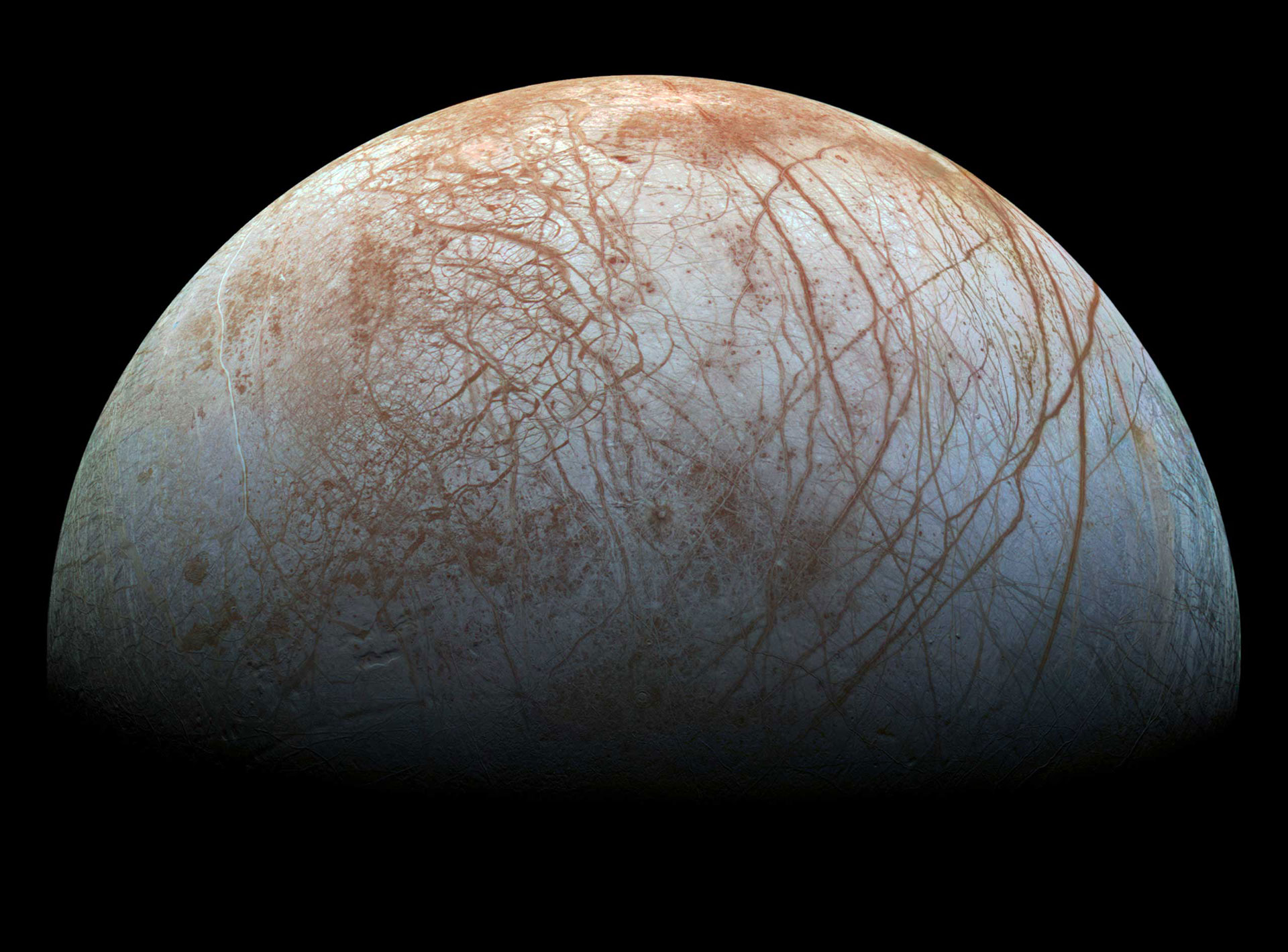
UMass Amherst microbiologist James Holden brings decades of expertise in rare microbes to a NASA mission searching for life on Jupiter’s icy moon, Europa.
Popular culture often imagines alien life as small green beings with oversized, oval heads. However, scientists agree that if life exists elsewhere in our solar system, it is far more likely to be microbial in nature.
To explore this possibility, NASA has granted $621,000 to microbiologist James Holden of the University of Massachusetts Amherst. Over the next three years, he will apply his deep expertise to investigate what potential life forms on Jupiter’s moon Europa might resemble.
Instead of looking to the stars, Holden is drawing insights from a surprising location: the deep-sea volcanoes found a mile below Earth’s ocean surface.
Jupiter’s moon, Europa, has a frozen surface, but astronomers believe that beneath all that ice lies a salty, liquid ocean that is in contact with a hot molten core. “We think, based on our own planet, that Europa may have conditions that can support life,” says Holden, who points to the hydrothermal vents deep beneath our oceans’ surface. In fact, NASA’s recently launched Europa Clipper satellite is expressly designed to ascertain how habitable Europa may be.
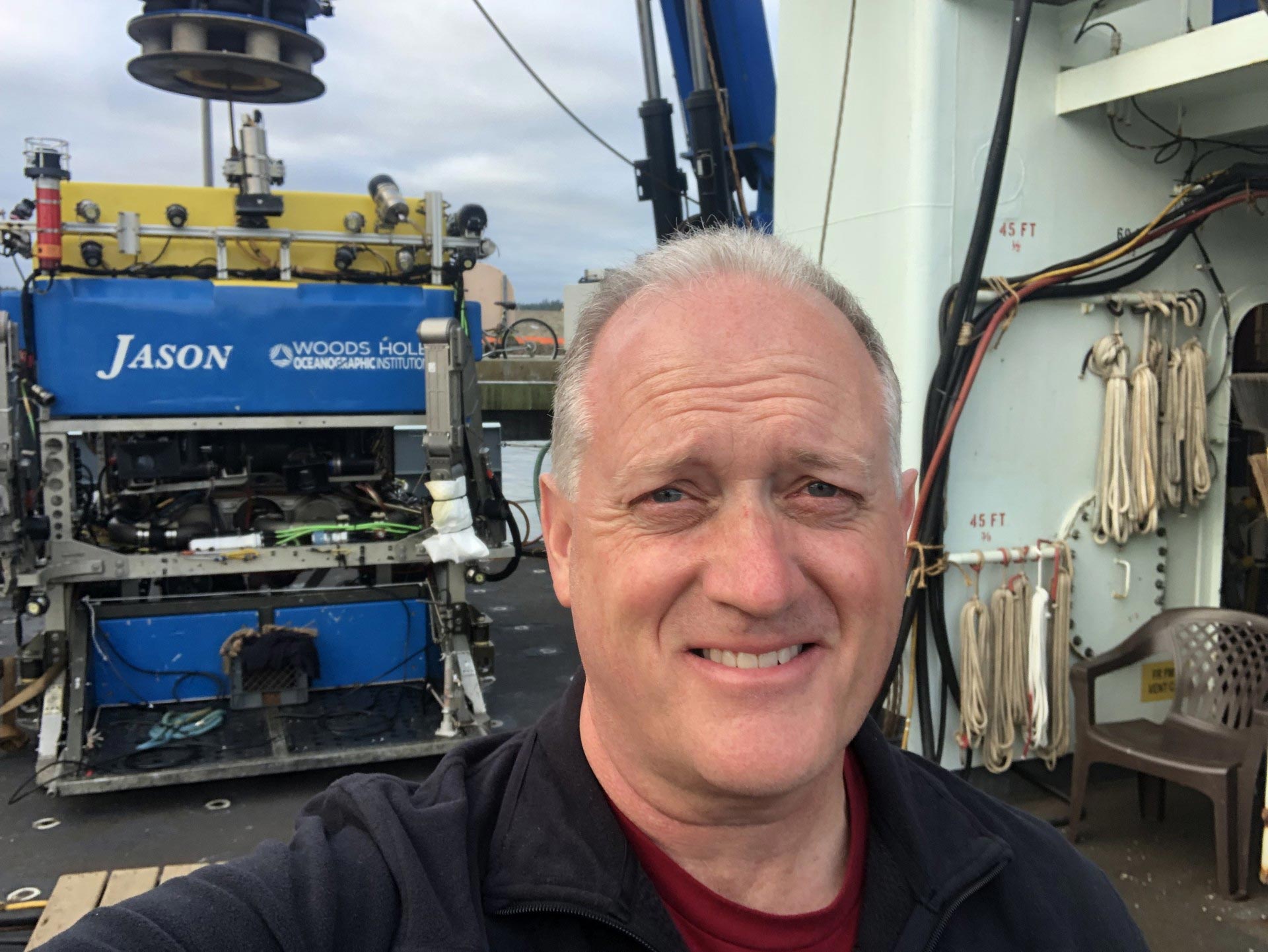
Holden has spent his entire academic career studying the deep-sea vents that may be key to alien life. “I’ve been looking at deep-sea volcanoes since 1988,” he says. “To get our microbes from them, we use submarines—sometimes human-occupied, sometime robotic—to dive a mile below the surface and bring the samples ashore and back into my lab at UMass Amherst.”
Studying Earth’s Deepest Secrets
Holden has built a lab that can reconstruct the lightless, oxygen-less conditions that these specialized microbes, which get their energy solely from the gases and minerals spewing out of the vents, love. “Because Europa’s conditions might be similar to the conditions these microbes come from,” Holden says, “we think that Europan life, if it exists, should look something like our own hydrothermal microbes.
The hydrothermal microbes Holden studies thrive in lightless, oxygen-less conditions a mile or more beneath the ocean’s surface. Credit: UMass Amherst
“We have long had a basic interest in knowing if there is life beyond our planet and how that life would function,” Holden adds. “It’s exciting to think that the answer to the secret might be here on our own planet.”
But Europa is not Earth, its oceans are not ours, and if microbial life does exist there, it probably doesn’t look exactly like ours.
Reimagining Life’s Chemistry
“So, we need to figure out the different chemical processes that Europan microbial life might be using in order to create energy,” Holden says. “Different chemistries could create very different kinds of microbes.”
The hydrothermal microbes on Earth that Holden studies get their energy by breaking hydrogen down using special enzymes called hydrogenases. But there are different kinds of hydrogenases, they work in different ways and may have different functions in different kinds of cells.
Organisms that rely on different sets of hydrogenases may look and function very differently from each other. Furthermore, iron, sulfur, and carbon coming from the vents are all adept at partnering with hydrogen by accepting its electrons to generate energy, but scientists aren’t yet sure exactly how those processes work biologically, especially as the amounts of hydrogen vary. “Our research will be to determine how the different chemical process contribute to an organism’s physiology,” says Holden.
Never miss a breakthrough: Join the SciTechDaily newsletter.
Follow us on Google and Google News.
2 Comments
Europa is not Earth, its oceans are not ours, and if microbial life does exist there, it probably doesn’t look exactly like ours.
VERY GOOD!
According to the Topological Vortex Theory (TVT), the Earth and Europa are not isolated from space, and life on Earth is closely related to the space environment in which it resides.
If researchers are interested in this, please visit https://zhuanlan.zhihu.com/p/1927657274920383767 and https://zhuanlan.zhihu.com/p/1930897490367973024 (If the link is not blocked).
Another person thinking inside the box. DNA infected this planet, and while we may think it’s all so very pretty, the change is total and, it is a closed system. Even moving a few travel-weary Conquistadors to Florida killed 90,000,000 inhabitants.
If we were to contact organisms which according to these fantasies are DNA-like, the probability that both systems would see utter collapse is high. Either our like-forms would eat theirs, or theirs ours. Little molecular ‘Pac-mans’ going to town in an horrendous calamity.
Remember, everything you see, from rainbows to slime mold, is a product of DNA/RNA all working together and eating each other in perfect harmony. Only imbeciles would not consider things regarding alien anything. If there are intelligent aliens out there, they most certainly have – but then we should feel confident they’d be smart enough to avoid interacting. (the numbers are right)