
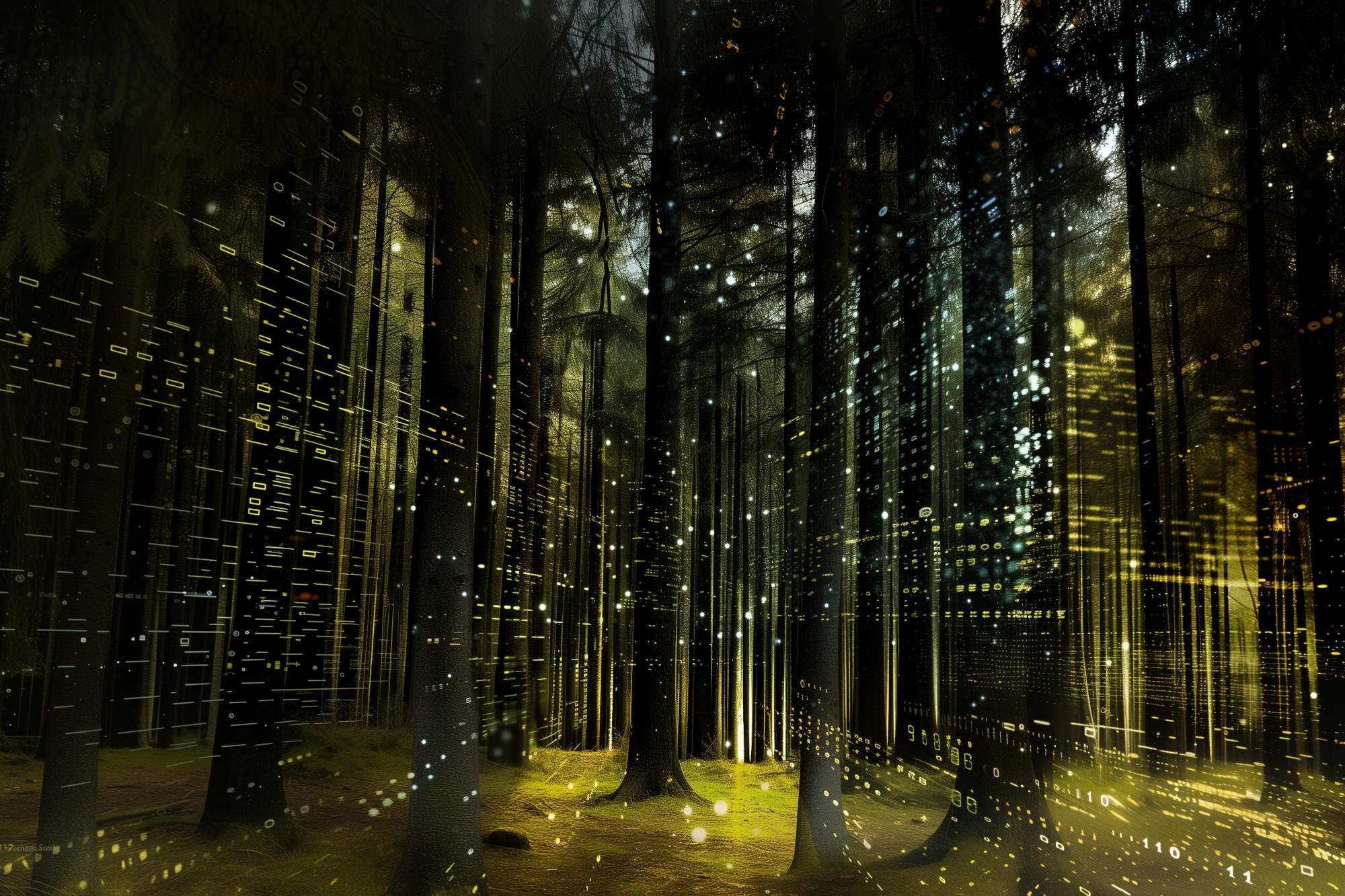
Scientists have found that the growth patterns of trees in a forest differ significantly from the way branches expand on an individual tree.
Nature is full of surprising repetitions. In trees, the large branches often look like entire trees, while smaller branches and twigs look like the larger branches they grow from. If seen in isolation, each part of the tree could be mistaken for a miniature version of itself.
It has long been assumed that this property, called fractality, also applies to entire forests but researchers from the University of Bristol have found that this is not the case.
The study, recently published in the Journal of Ecology, refutes claims that the self-similarity that is observed within individual trees can be extended to whole forest canopies and landscapes.
Fractality in Nature
Lead author Dr. Fabian Fischer explained: “Fractality can be found in many natural systems. Transport networks such as arteries or rivers often show self-similarity in the way they branch, and many organic structures, such as trees, ferns or broccoli, are composed of parts that look like the whole.
“Fractality provides a way of categorizing and quantifying these self-similar patterns we so often observe in nature, and has been hypothesized to be an emergent property that is shared by many natural systems.
“Intuitively, if you look at a picture of something and you can’t quite determine how big it is, then this is a good indicator of fractality. For instance, is this a large mountain in front of me or just a small rock looking like a mountain? Is it a branch or whole a tree?
“Scientifically, this self-similarity has the attractive property that it allows you to describe an apparently complex object using some very simple rules and numbers.”
If self-similarity extended from the small twigs of a single tree to entire forest ecosystems, it would help ecologists describe complex landscapes in much simpler ways, and potentially directly compare the complexity of very different ecosystems, such as coral reefs and forest canopies.
Research Findings
To test this idea that forest canopies behave like fractals, the team used airborne laser scanning data from nine sites spread across Australia’s Terrestrial Ecosystem Research Network (TERN). These sites span a large rainfall gradient and vary enormously in their structure: from sparse and short arid woodlands in Western Australia to towering, 90-m tall mountain ash forests in Tasmania. From each laser scan, they derived high-resolution forest height maps and compared these to what forest heights would look like if the forests were fractal in nature.
Dr. Fischer said: “We found that forest canopies are not fractal, but they are very similar in how they deviate from fractality, irrespective of what ecosystem they are in.
“That they are not fractal makes a lot of sense and was our hypothesis from the start. While it might be possible to confuse a branch for an entire tree, it’s usually easy to differentiate trees from a grove of trees or from an entire forest.
“But it was surprising how similar all forest canopies were in the way they deviated from true fractals, and how deviations were linked to the size of the trees and how dry their environment was.
“The consistency of deviations also gave us an idea of how we could compare complexity across ecosystems. Most ecosystems, like forests, will hit an upper limit – most likely determined by the maximum size of its organisms – beyond which their structure cannot vary freely anymore.
“If we could determine these upper limits, this could open up routes to understanding how very different organisms and systems (coral reefs, forests, etc.) work and to test whether they might share the same basic organizing principles.”
Implications and Future Research
Now the team plans to compare an even wider range of forest ecosystems across the globe, find out whether there are similar organizing principles in forests and beyond, and discover what drives these patterns by looking at multiple scans in time.
Dr. Fischer concluded: “A key question in science is whether there are generalizable patterns in nature, and an excellent candidate for this is fractality.
“The forests we studied were not fractal, but there were clear similarities across all sites in how they deviated from fractality. From a theoretical point of view, this points the way to a framework for finding general organizing principles in biology.
“But this also has practical implications: if we cannot understand the forest from its trees, and vice versa, then we must monitor forests both at small and large scales to understand how they respond to climatic changes and growing human pressure.”
Reference: “No evidence for fractal scaling in canopy surfaces across a diverse range of forest types” by Fabian Jörg Fischer and Tommaso Jucker, 18 December 2023, Journal of Ecology.
DOI: 10.1111/1365-2745.14244
Never miss a breakthrough: Join the SciTechDaily newsletter.
Follow us on Google and Google News.
2 Comments
After a few minutes with this article, I’m pretty certain that the inadequacy is not with the Math here.
It’s maths – not math!