
Close Menu
    Facebook X (Twitter) Instagram
    SciTechDaily
    • Biology
    • Chemistry
    • Earth
    • Health
    • Physics
    • Science
    • Space
    • Technology
    Facebook X (Twitter) Pinterest YouTube RSS
    SciTechDaily
    Home»Science»The Mysterious Limestone Spheroids of ’Ubeidiya: Unlocking the Secrets of an Ancient Puzzle
    Science

    The Mysterious Limestone Spheroids of ’Ubeidiya: Unlocking the Secrets of an Ancient Puzzle

    By The Hebrew University of JerusalemSeptember 18, 20231 Comment3 Mins Read
    Facebook Twitter Pinterest Telegram LinkedIn WhatsApp Email Reddit
    Share
    Facebook Twitter LinkedIn Pinterest Telegram Email Reddit
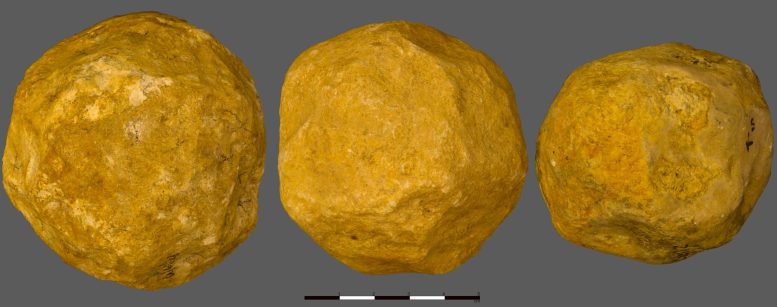
    Limestone Spheroids
    Recent research indicates that ancient limestone spheroids were intentionally crafted with advanced skills by early hominins, challenging previous beliefs. The study, utilizing 3D analysis, suggests these spheroids may represent the earliest known instance of hominins achieving intentional symmetry in stone tool crafting. Credit: Muller et al.

    Ancient limestone spheroids, long thought to be accidental by-products of tool-making, may have been intentionally crafted by early hominins.

    For years, the mysterious limestone spheroids—ancient, enigmatic stone relics—have baffled archaeologists. Dating back from the Oldowan era to the Middle Palaeolithic period, the exact reasons behind their creation continue to be a fiercely debated topic.

    In a recent development, researchers from the Computational Archaeology Laboratory at the Hebrew University of Jerusalem have teamed up with experts from Tel Hai College and Rovira i Virgili University to delve deeper into the secrets surrounding these puzzling objects, potentially uncovering clues to the intentions and skills of the early hominins who crafted them.

    Spheroids are among the most enduring yet least understood archaeological artifacts, often considered by-products of percussive tasks. However, the team’s research challenges this conventional wisdom. The central question at the heart of this study is whether these spheroids were unintentional by-products or intentionally crafted tools designed for specific purposes.

    Cutting-Edge 3D Analysis Reveals Clues

    To answer this question, cutting-edge 3D analysis methods, including spherical harmonics and surface curvature, were applied to a collection of 150 limestone spheroids from the ‘Ubeidiya archaeological site, dating back to approximately 1.4 million years ago. These methods were developed at the Computational Archaeology Laboratory of the Hebrew University, directed by Professor Leore Grosman. ‘Ubeidiya is presently recognized as the earliest known Acheulean occurrence outside of Africa, making it a crucial location for investigating the evolution of early hominin technology.

    The research team meticulously reconstructed the spheroid reduction sequence based on the trends observed in scar facets and geometry. Their findings revealed a remarkable pattern: the spheroids at ‘Ubeidiya were crafted with a premeditated reduction strategy. Contrary to the notion that they were accidental by-products, the spheroids did not become smoother during their manufacture; instead, they became markedly more spherical. This transformation towards an ideal sphere required exceptional knapping skills and a clear preconceived goal.

    Reevaluating Early Hominin Technological Skills

    This discovery challenges existing beliefs about the capabilities of early hominins and their relationship with technology. While Acheulean bifaces are traditionally thought to represent the earliest evidence of hominins imposing intentional, symmetrical shapes on stone, the intentional production of sphere-like objects at ‘Ubeidiya similarly suggests that these early hominins had a desire for and achieved intentional geometry and symmetry in stone. Slightly older spheroids exist at sites in Africa. If this same intentionality can be demonstrated there, this would represent the oldest evidence of hominins desiring and achieving symmetrical shapes in stone.

    The team’s research opens new avenues for understanding the cognitive abilities and technological achievements of our distant ancestors. It also raises questions about the purpose and significance of these spheroids in the daily lives of early hominins.

    Reference: “The limestone spheroids of ‘Ubeidiya: intentional imposition of symmetric geometry by early hominins?” by Antoine Muller, Deborah Barsky, Robert Sala-Ramos, Gonen Sharon, Stefania Titton, Josep-Maria Vergès and Leore Grosman, 6 September 2023, Royal Society Open Science.
    DOI: 10.1098/rsos.230671

    Never miss a breakthrough: Join the SciTechDaily newsletter.
    Follow us on Google and Google News.

    Archaeology Hominin The Hebrew University of Jerusalem
    Share. Facebook Twitter Pinterest LinkedIn Email Reddit

    Related Articles

    1.9-Million-Year-Old Site Rewrites the Story of Humanity’s First Migration

    A Surprising Finding Indicates That 800,000-Year-Old Hominins Utilized Fire

    Human Populations Survived a Volcanic Super-Eruption 74,000 Years Ago – 5,000 Times Larger Than Mount St. Helen’s

    Earliest Interbreeding Between Ancient Human Populations Discovered – Evolutionary Puzzle Solved

    New Evidence Shows Humans Mastered Fire Earlier Than Thought

    Early Humans Moved Through Mediterranean Much Earlier Than Previously Believed

    New Discovery Suggests Humans Left Africa Earlier Than Previously Thought

    400,000 Year Old Fossil Helps Shed New Light on Human Evolution

    Million-Year-Old Ash in South African Cave Yields Evidence of Cooking

    1 Comment

    1. Gregory Nixon on September 18, 2023 9:09 am

      The case for purposeful crafting remains unproven.

      Reply
    Leave A Reply Cancel Reply

    • Facebook
    • Twitter
    • Pinterest
    • YouTube

    Don't Miss a Discovery

    Subscribe for the Latest in Science & Tech!

    Trending News

    Largest-Ever Study Finds Medicinal Cannabis Ineffective for Anxiety, Depression, PTSD

    250-Million-Year-Old Egg Solves One of Evolution’s Biggest Mysteries

    Living With Roommates Might Be Changing Your Gut Microbiome Without You Knowing

    Century-Old Cleaning Chemical Linked to 500% Increased Risk of Parkinson’s Disease

    What if Your Memories Never Happened? Physicists Take a New Look at the Boltzmann Brain Paradox

    One of the Universe’s Largest Stars May Be Getting Ready To Explode

    Scientists Discover Enzyme That Could Supercharge Ozempic-Like Weight Loss Drugs

    Popular Sweetener Linked to DNA Damage – “It’s Something You Should Not Be Eating”

    Follow SciTechDaily
    • Facebook
    • Twitter
    • YouTube
    • Pinterest
    • Newsletter
    • RSS
    SciTech News
    • Biology News
    • Chemistry News
    • Earth News
    • Health News
    • Physics News
    • Science News
    • Space News
    • Technology News
    Recent Posts
    • Scientists Say This Overlooked Organ Could Hold the Key to Longer Life
    • Want Less Stress? Landmark Study Points to a Simple Habit
    • Scientists Reveal Eating Fruits and Vegetables May Increase Your Risk of Lung Cancer
    • AI Reveals Explosive Growth of Floating Algae Across the World’s Oceans
    • 5.5 Million Bees Discovered Living Beneath a New York Cemetery
    Copyright © 1998 - 2026 SciTechDaily. All Rights Reserved.
    • Science News
    • About
    • Contact
    • Editorial Board
    • Privacy Policy
    • Terms of Use

    Type above and press Enter to search. Press Esc to cancel.