
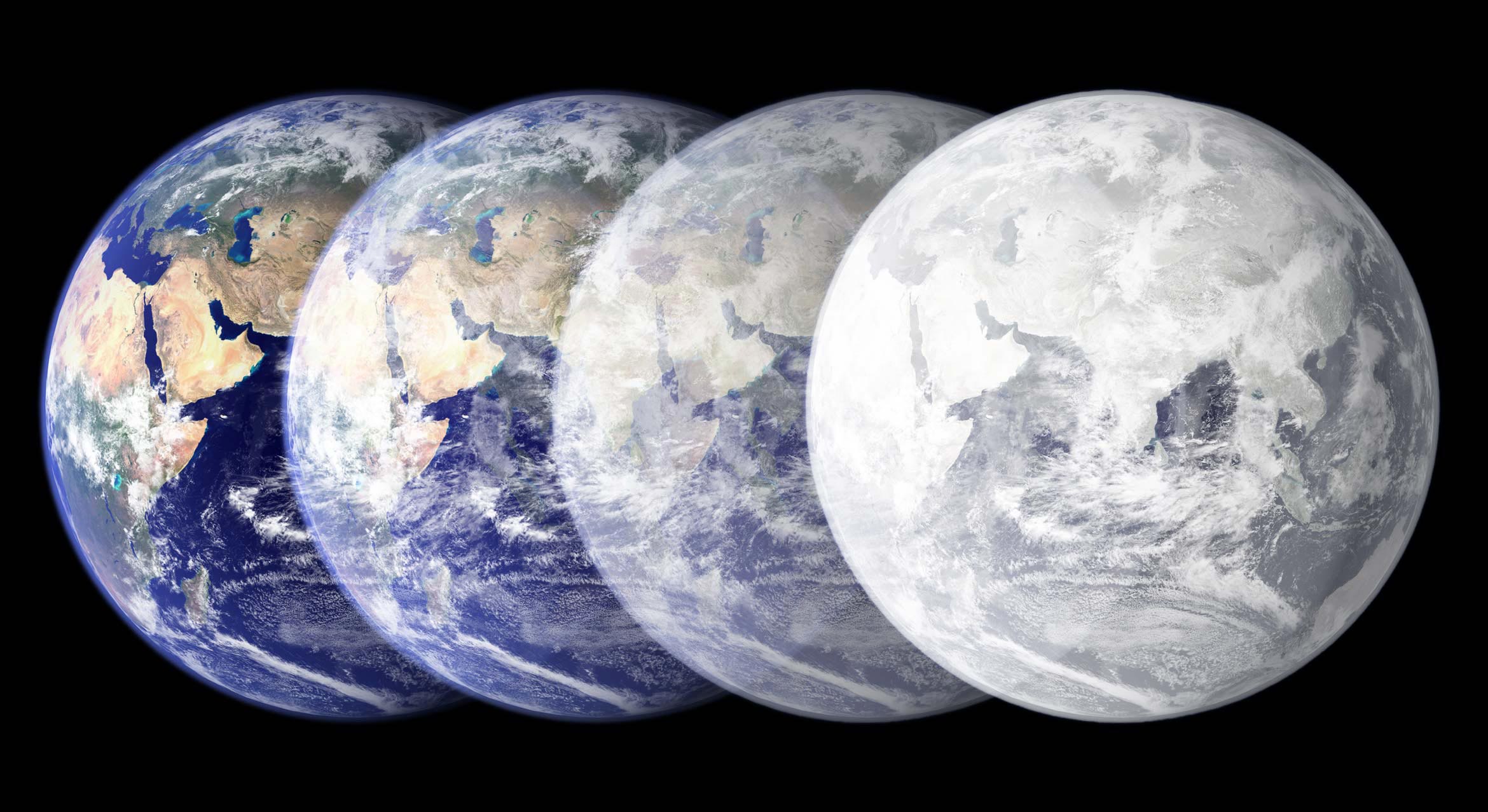
For millions of years, Earth’s climate has been driven by natural cycles linked to its orbit, shifting between ice ages and warm interglacial periods. A new study has uncovered a clear, predictable pattern in these shifts, revealing that the next ice age should naturally begin in about 10,000 years.
However, human activities — especially greenhouse gas emissions — have disrupted this cycle, making it unlikely that we’ll see another glaciation anytime soon. These findings not only help us understand past climate changes but also provide a crucial tool for predicting long-term future climate trends and assessing the real impact of human intervention.
The Ice Ages and Earth’s Climate Cycles
Around 2.5 million years ago, Earth entered a cycle of alternating ice ages and warmer interglacial periods. The most recent ice age ended about 11,700 years ago. Now, a new analysis suggests that the next ice age could naturally begin in approximately 10,000 years.
An international team of researchers, including scientists from the University of California, Santa Barbara, based their prediction on a fresh interpretation of subtle changes in Earth’s orbit around the sun. These small shifts have driven major climate changes over thousands of years. The study, which examines a million years of climate data, reveals new insights into Earth’s glacial cycles. Published in Science, the findings mark a significant advance in understanding the planet’s long-term climate patterns.
Uncovering Patterns in a Million Years of Climate Data
The team examined a million-year record of climate change, which documents changes in the size of land-based ice sheets across the Northern hemisphere together with the temperature of the deep ocean. They were able to match these changes with small cyclical variations in the shape of Earth’s orbit of the sun, its wobble and the angle on which its axis is tilted.
“We found a predictable pattern over the past million years for the timing of when Earth’s climate changes between glacial ‘ice ages’ and mild warm periods like today, called interglacials,” said co-author Lorraine Lisiecki, a professor in UCSB’s Earth Science Department. One type of change in Earth’s orbit was responsible for the end of ice ages, while another was associated with their return.
“We were amazed to find such a clear imprint of the different orbital parameters on the climate record,” added lead author Stephen Barker, a professor at Cardiff University, in the UK. “It is quite hard to believe that the pattern has not been seen before.”
Decoding the Triggers of Glacial Cycles
Predictions of a link between Earth’s orbit of the sun and fluctuations between glacial and interglacial conditions have been around for over a century but were not confirmed by real-word data until the mid-1970s. Since then, scientists have struggled to identify precisely which orbital parameter is most important for the beginning and ending of glacial cycles because of the difficulty of dating climatic changes so far back in time.
The team was able to overcome this problem by looking at the shape of the climate record through time. This allowed them to identify how the different parameters fit together to produce the climate changes observed.
Why the Next Ice Age Is Still Far Away
The authors found that each glaciation of the past 900,000 years follows a predictable pattern. This natural pattern — in the absence of human greenhouse gas emissions — suggests that we should currently be in the middle of a stable interglacial and that the next ice age would begin many millennia in the future, approximately 10,000 years from now.
“The pattern we found is so reproducible that we were able to make an accurate prediction of when each interglacial period of the past million years or so would occur and how long each would last,” Barker said. “This is important because it confirms the natural climate change cycles we observe on Earth over tens of thousands of years are largely predictable and not random or chaotic.” These findings represent a major contribution towards a unified theory of glacial cycles.
“And because we are now living in an interglacial period – called the Holocene – we are also able to provide an initial prediction of when our climate might return to a glacial state,” said co-author Chronis Tzedakis, a professor at University College London.
How Human Activity Disrupts Natural Climate Cycles
“But such a transition to a glacial state in 10,000 years’ time is very unlikely to happen because human emissions of carbon dioxide into the atmosphere have already diverted the climate from its natural course, with longer-term impacts into the future,” added co-author Gregor Knorr from the Alfred Wegener Institute, Helmholtz Centre for Polar and Marine Research.
Using Past Climate to Predict Our Future
The team plans to build on their findings to create a baseline of the Earth’s natural climate for the next 10,000-20,000 years by calibrating past changes. Used in combination with climate model simulations, researchers hope to quantify the absolute effects of human-made climate change into the far future.
“Now we know that climate is largely predictable over these long timescales, we can actually use past changes to inform us about what could happen in the future,” Barker added. “This is something we couldn’t do before with the level of confidence that our new analysis provides.”
“This is vital for better informing decisions we make now about greenhouse gas emissions, which will determine future climate changes.”
Explore Further: Ice Ages Follow a Hidden Pattern, and Scientists Just Cracked It
Reference: “Distinct roles for precession, obliquity, and eccentricity in Pleistocene 100-kyr glacial cycles” by Stephen Barker, Lorraine E. Lisiecki, Gregor Knorr, Sophie Nuber and Polychronis C. Tzedakis, 28 February 2025, Science.
DOI: 10.1126/science.adp3491
Never miss a breakthrough: Join the SciTechDaily newsletter.
Follow us on Google and Google News.
7 Comments
01-03-2025. Happy Saturday and Happy Worker’s day. Stay safe and happy Weekend. Thanks.
Earth requires ice age cycle to overhaul its surface at a natural pattern of interval.
Human intervention on surface & atmosphere may cause permanent change to the natural pattern of this cycle, making it uncertain to occur anytime. Unfortunately, due to overpopulation, now there is no solution to this crisis.
“Earth requires ice age cycle to overhaul its surface at a natural pattern of interval.”
Requires? Crisis? On what do you base those assertions? Plate tectonics effectively overwhelms any relatively minor surficial changes of glaciation. You “require” food to survive. Earth requires nothing. It just is.
“However, human activities — especially greenhouse gas emissions — have disrupted this cycle, making it unlikely that we’ll see another glaciation anytime soon.”
Such a bold assertion is calling out to have numbers attached to it, as any good science should have. That is, just what is the probability (along with its margin of error) that humans have “disrupted” the cycle? When (or at what concentration) did the greenhouse gas emissions overwhelm the natural orbital cycles that created continental glaciers nearly two miles thick?
Additionally, I think that explanations are due for 1) Why, during the pandemic shutdowns of 2020, with an average, annual anthropogenic CO2-decline of about 10%, and monthly declines of up to 14-18% during the month of April alone, the graph of the seasonal ramp-up phase for 2019-20 is indistinguishable from the previous and following years? 2) Why El Nino-year graphs show an anomalous steep slope and high peak for the seasonal CO2 ramp-up phase, and then go back to their typical shapes after the warming ends? 3) Why the Antarctic ice cores from Law Dome appear to show temperature changes occurring about 800-years before the changes in CO2 concentration?
While one of the more compelling arguments for the influence of anthropogenic CO2 on the atmospheric concentration is the isotopic ratio of 13C to 12C, there is no comprehensive analysis of isotopic fractionation that takes place with the chemical reactions involving the buffering of pH by the (bi)carbonate buffering system or the out-gassing of abyssal water (enriched in 12C by planktonic ‘rain’) as deep water up-wells along coast lines.
I suspect that they have got the cart before the horse.
We are currently in an ice age. Just ask google “are we currently in an ice age?” An ice age is defined as the period of time when glaciers exist. Earth was devoid of ice for nearly 280 million years before the current glaciers formed. It seems that scientists both on the side of and on the side against man-made global warming are confusing glacial maximums with individual ice ages.
Are you aware of the money being taken from our people, government and industry by the global warming groups. The whole thing stinks of “this is a great way to grab money yeehaw”
Greenhouse gas is described in my old science textbook as
‘an opaque gas the blocks the sun and hold the heat in the atmosphere’, A cloud is a form of greenhouse gas. CO2 is transparent.
I argued this with a scientist from a global warming group years ago, He had no reply until 2 weeks passed at which time he told me this idiotic theory (btw it is a theory only)
CO2 vibrates in a specific way that bounces light back down to the Earth but does not reflect new light coming from the sun. There is no experiment because it requires the whole atmosphere to test. Is this the science you believe in?
Am I the only MFer to realize this? Im not that smart, it makes no sense that I have my old textbook and can clearly read a greenhouse gas definition that says OPAQUE GAS. What the heck is going on with all of you not able to understand this?
Does anyone know how to read a definition. Ice Age is defined as the period of time when glaciers exist. Scientists keep referring to glacial maximums as ice ages. These glaciers formed 3 million years ago at that time we entered an ice age. The Earth was devoid of glaciers for 280 million years before the current glaciers formed, the previous ice age was from 320 million years ago until 280 million years ago. Earth existed without ice most of the dinosaur’s existence.
Anyone foolish enough to argue this? Type this into google “Are we currently in an ice age?”
I can’t be the only person who realizes this.
It has started with 4/1/22 Tonga ! It will take 40,000 years until 42022 ! All land will reconnect! Reversal of the poles is inevitable! It doesn’t happen overnight but a slow and years of movement and volcano eruptions ! Will always be happening and it will get colder!! We have ice age cave drawings from 40,000 years old to the last one’s dating only 7,500 years ago!! It happens over a long period of time! With some major disasters and human and animal migration!! It’s in motion now !!