
New research combining experimental and computational approaches provides deeper insights into proton spin contributions from gluons.
Nuclear physicists have been tirelessly exploring the origins of proton spin. A novel approach, merging experimental data with cutting-edge calculations, has now illuminated the spin contributions from gluons—the particles that bind protons. This advancement also sets the stage for three-dimensional imaging of the proton structure.
Joseph Karpie, a postdoctoral associate at the Center for Theoretical and Computational Physics (Theory Center) at the U.S. Department of Energy’s Thomas Jefferson National Accelerator Facility, led this groundbreaking research.
Historical Context
He said that this decades-old mystery began with measurements of the sources of the proton’s spin in 1987. Physicists originally thought that the proton’s building blocks, its quarks, would be the main source of the proton’s spin. But that’s not what they found. It turned out that the proton’s quarks only provide about 30% of the proton’s total measured spin. The rest comes from two other sources that have so far proven more difficult to measure.
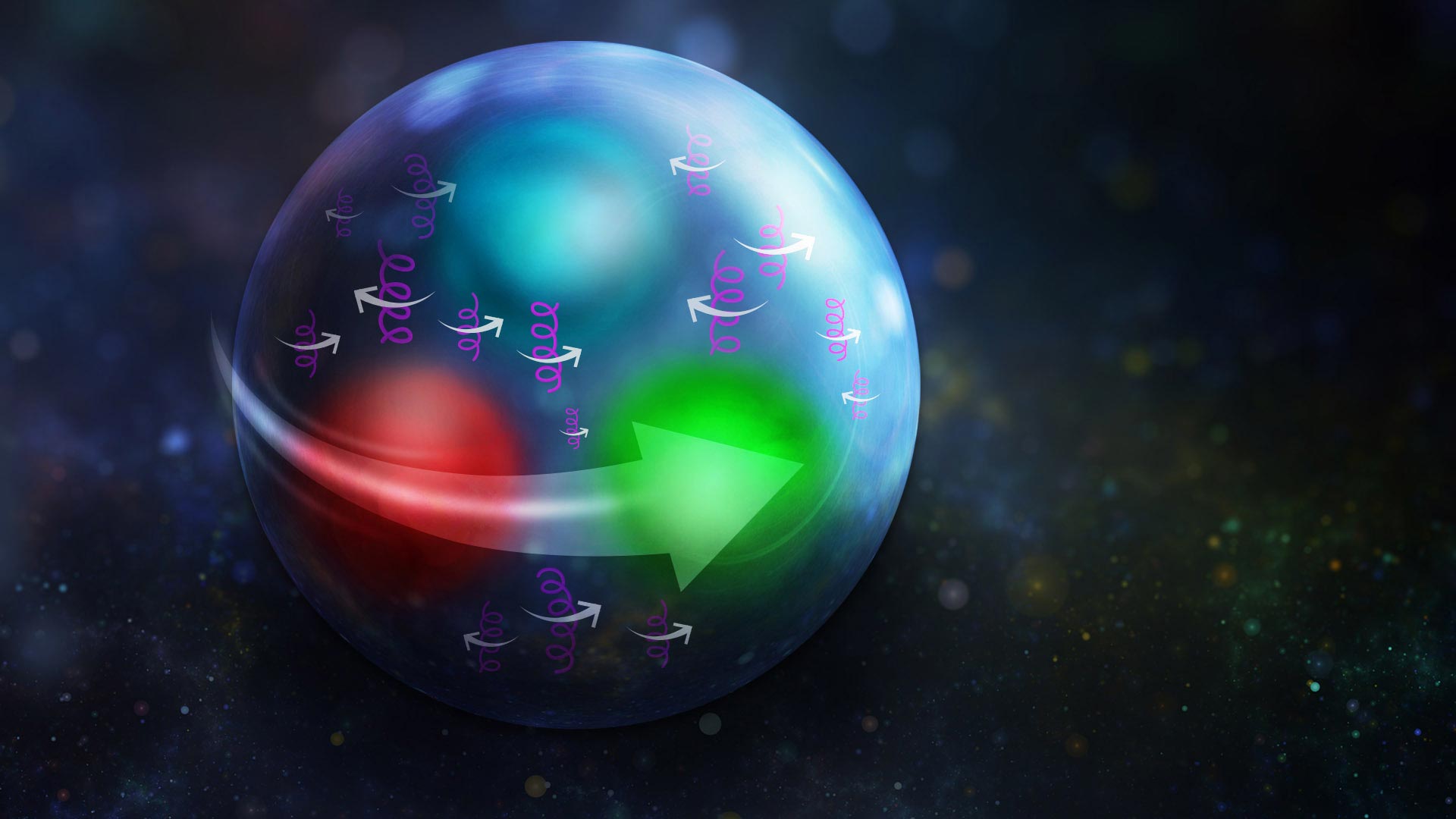
One is the mysterious but powerful strong force. The strong force is one of the four fundamental forces in the universe. It’s what “glues” quarks together to make up other subatomic particles, such as protons or neutrons. Manifestations of this strong force are called gluons, which are thought to contribute to the proton’s spin. The last bit of spin is thought to come from the movements of the proton’s quarks and gluons.
Experimental Challenges and Theoretical Advances
“This paper is sort of a bringing together of two groups in the Theory Center who have been working toward trying to understand the same bit of physics, which is how do the gluons that are inside of it contribute to how much the proton is spinning around,” he said.
He said this study was inspired by a puzzling result that came from initial experimental measurements of the gluons’ spin. The measurements were made at the Relativistic Heavy Ion Collider, a DOE Office of Science user facility based at Brookhaven National Laboratory in New York. The data at first seemed to indicate that the gluons may be contributing to the proton’s spin. They showed a positive result.
But as the data analysis was improved, a further possibility appeared.
“When they improved their analysis, they started to get two sets of results that seemed quite different, one was positive and the other was negative,” Karpie explained.
While the earlier positive result indicated that the gluons’ spins are aligned with that of the proton, the improved analysis allowed for the possibility that the gluons’ spins have an overall negative contribution. In that case, more of the proton spin would come from the movement of the quarks and gluons, or from the spin of the quarks themselves.
This puzzling result was published by the Jefferson Lab Angular Momentum (JAM) collaboration.
Collaborative Efforts in Proton Spin Analysis
Meanwhile, the HadStruc collaboration had been addressing the same measurements in a different way. They were using supercomputers to calculate the underlying theory that describes the interactions among quarks and gluons in the proton, Quantum Chromodynamics (QCD).
To equip supercomputers to make this intense calculation, theorists somewhat simplify some aspects of the theory. This somewhat simplified version for computers is called lattice QCD.
Karpie led the work to bring together the data from both groups. He started with the combined data from experiments taken in facilities around the world. He then added the results from the lattice QCD calculation into his analysis.
“This is putting everything together that we know about quark and gluon spin and how gluons contribute to the spin of the proton in one dimension,” said David Richards, a Jefferson Lab senior staff scientist who worked on the study.
“When we did, we saw that the negative things didn’t go away, but they changed dramatically. That meant that there’s something funny going on with those,” Karpie said.
Implications and Future Directions
Karpie is lead author on the study that was recently published in Physical Review D. He said the main takeaway is that combining the data from both approaches provided a more informed result.
“We’re combining both of our datasets together and getting a better result out than either of us could get independently. It’s really showing that we learn a lot more by combining lattice QCD and experiment together in one problem analysis,” said Karpie. “This is the first step, and we hope to keep doing this with more and more observables as well as we make more lattice data.”
The next step is to further improve the datasets. As more powerful experiments provide more detailed information on the proton, these data begin painting a picture that goes beyond one dimension. And as theorists learn how to improve their calculations on ever-more powerful supercomputers, their solutions also become more precise and inclusive.
The goal is to eventually produce a three-dimensional understanding of the proton’s structure.
“So, we learn our tools do work on the simpler one-dimension scenario. By testing our methods now, we hopefully will know what we need to do when we want to move up to do 3D structure,” Richards said. “This work will contribute to this 3D image of what a proton should look like. So it’s all about building our way up to the heart of the problem by doing this easier stuff now.”
Reference: “Gluon helicity from global analysis of experimental data and lattice QCD Ioffe time distributions” by Jefferson Lab Angular Momentum and HadStruc Collaborations, J. Karpie, R. M. Whitehill, W. Melnitchouk, C. Monahan, K. Orginos, J.-W. Qiu, D. G. Richards, N. Sato and S. Zafeiropoulos, 27 February 2024, Physical Review D.
DOI: 10.1103/PhysRevD.109.036031
Never miss a breakthrough: Join the SciTechDaily newsletter.
Follow us on Google and Google News.
2 Comments
Best
I enjoied
What’s behind the proton spin is a hidden topological filed that is intended to control all spins measured meticulously .