
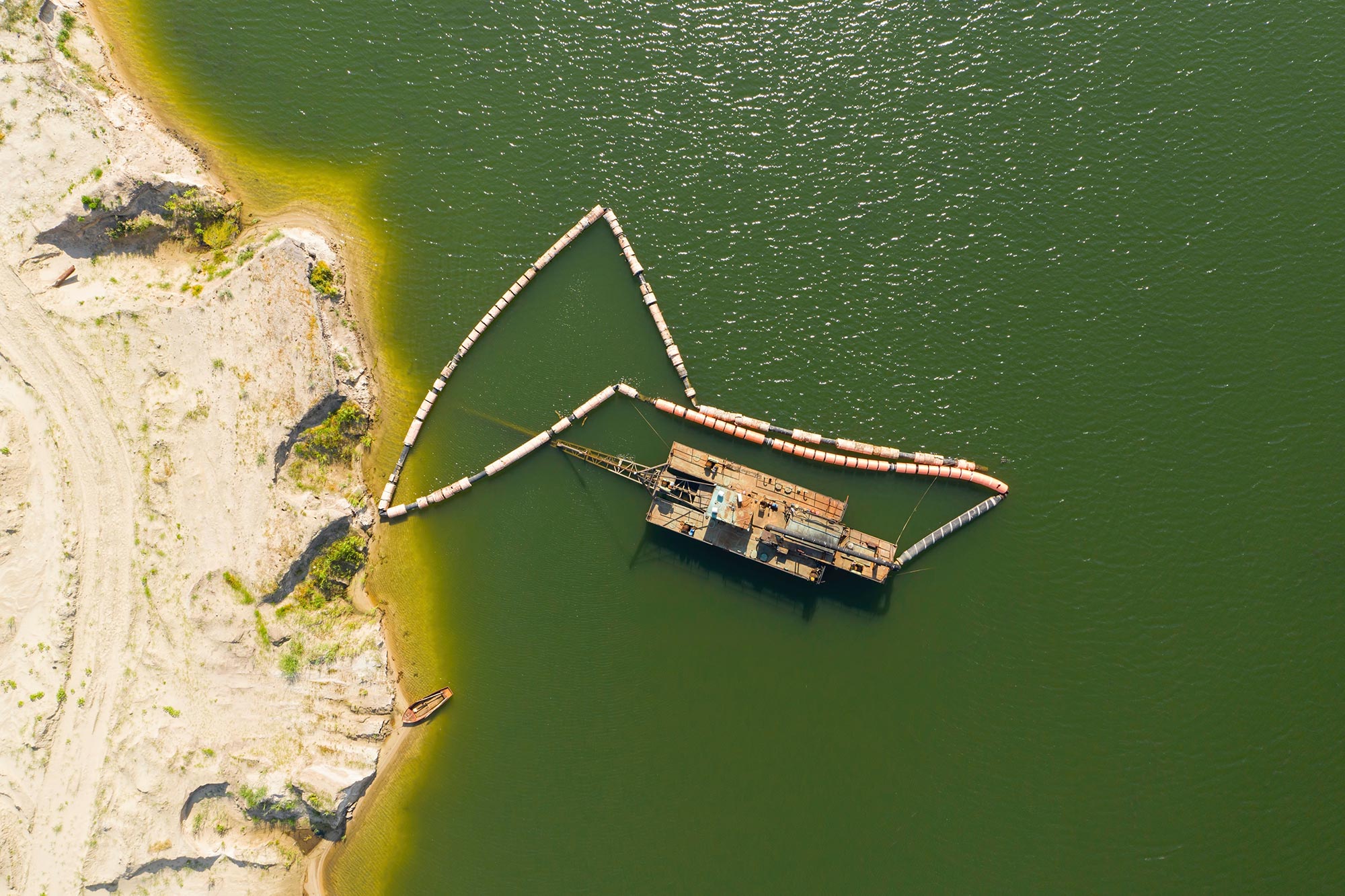
Sand is one of the most extracted natural resources on Earth, yet its environmental impact remains dangerously overlooked.
Sand, a resource essential to modern life, is being extracted at unsustainable rates, wreaking havoc on marine ecosystems. Unlike other industries, its impact is largely ignored, despite causing habitat destruction, biodiversity loss, and worsening climate vulnerabilities. Scientists are urging global action to regulate sand mining before the damage spirals further out of control.
Sand – A Hidden Environmental Crisis
Sand plays a crucial role in both human development and the natural world, but its extraction is tipping the balance in favor of human needs — often at the expense of fragile ecosystems.
A team of international scientists, writing in this week’s edition of the journal One Earth, is calling for greater recognition of the environmental damage caused by sand mining. They emphasize that sand and gravel — the most extracted solid materials on the planet — are an overlooked but significant threat to marine biodiversity.
Why Sand Matters More Than You Think
“Sand is a critical resource that shapes the built and natural worlds,” said senior author Jianguo “Jack” Liu, Michigan State University Rachel Carson Chair in Sustainability. “Extracting sand is a complex global challenge. Systems approaches such as the metacoupling framework are essential to untangle the complexity. They can help reveal the hidden cascading impacts not only on the sand extraction sites but also other places such as sand transport routes and sites using sand for construction.”
Sand is the literal foundation of human development across the globe, a key ingredient of concrete, asphalt, glass, and electronics. It is relatively cheap and easily extracted.
The Consequences of Unchecked Sand Mining
Unlike critical minerals or deep-sea mining — both of which have attracted significant scrutiny—sand extraction in marine environments remains largely overlooked, despite sand and sediment dredging being the second most widespread human activity in coastal areas after fishing, and its supply is often taken for granted.
Sand mining across the world is being linked to coastal erosion, habitat destruction, the spread of invasive species, and impacts on fisheries. Extracting sand can harm marine life by clouding water and riling sediment that can smother seagrasses and coral. Disrupting spans of ocean sand can fragment habitat, change the patterns of waves, and other issues that can throw marine life into disarray.
Sand’s Role in Climate and Conservation
“This resource is often seen as an inert, abundant material, but in reality, it is an essential resource that shapes coastal and marine ecosystems, protects shorelines, and sustains ecosystems and livelihoods,” said lead author Aurora Torres, a researcher at Spain’s University of Alicante. “Since sand extraction is closely linked to coastal erosion, climate adaptation, and biodiversity loss, integrating it into broader environmental policies—such as marine protected areas, blue carbon strategies, climate resilience plans, and strategic natural resource management—is crucial to ensuring it is not treated as an isolated issue.”
Elevating Sand Extraction to a Global Priority
Torres and Liu first brought the issues of sand to light in 2017 in the Science paper A looming tragedy of the sand commons. In the One Earth commentary, the two, former and current members of MSU’s Center for Systems Integration and Sustainability, call for sand to be elevated to the attention levels of fishing, aquaculture and tourism in the scale of global attention and action.
“Ultimately, the key to action is making sand extraction visible—through stronger data, improved governance, and direct links to pressing environmental and economic concerns. The more evident and tangible its impacts become, the harder it will be to ignore the need for responsible management,” Torres said, adding sand extraction near fragile populated coastlines can spur action as climate change exacerbates threats to human life.
Reference: “Reducing sand mining’s growing toll on marine biodiversity” by Aurora Torres, Jean-Baptiste Jouffray, Vera Van Lancker, Arnaud Vander Velpen and Jianguo Liu, 21 February 2025, One Earth.
DOI: 10.1016/j.oneear.2025.101202
“Reducing Sand Mining’s Growing Toll on Marine Biodiversity” is also written by Jean-Baptiste Jouffray, Vera Van Lancker and Arnaud Vander Velpen. The work was supported by the National Science Foundation, Michigan AgBioResearch, the Generalitat Valenciana, and the Knut and Alice Wallenberg Foundation.
Never miss a breakthrough: Join the SciTechDaily newsletter.
Follow us on Google and Google News.
8 Comments
There are whole deserts of shifting sands creating havoc and spreading through wind. Western Africa spreads sands all over the Atlantic and the Americas. Other deserts around the world also create and spread sands through winds. These “scientists” BS us in order to build a name and create a sky is falling exigency. Their talent would be better served to figure out how to stop desertification and feed the world.
Desert sand is “round” from being blown in the wind. It’s generally not used for construction because it doesn’t adhere well to anything and makes weak concrete— maybe they should research that.
As the other commenter pointed out, most sand is not suitable for construction. Look it up. But I agree that people often create problems that aren’t really there just to get attention. Case in point: “feeding the world”. That’s a narrative I’ve often wondered about. I’ve heard about the “war on hunger” all of my life. And yet, human population has grown exponentially, tripling in just my lifetime. It seems to me somebody must be eating ok?!
Apart from the grain shape of desert sand, mining sand in remote deserts, especially those hot ones, could well be more expensive than grabbing the rougher sand grains from easier places to work in. Now you don’t want to pay for yet more expensive concrete, do you? It could make the cost of building that nuclear reactor in your neighbourhood even more hideous.
There are a lot of generalizations being tossed around here in the comments. Material spread around the world is more typically silt-sized and smaller, rather than being sand-sized. Sands from dune areas can be expected to be well rounded, as well as sands from high-energy beaches, regardless of the temperature or precipitation, and similarly sands that have traveled great distances, like in the Mississippi River.
On the other hand, sand-sized particles resulting from the production of ‘gruss,’ a residual material from the mechanical weathering of granitic rocks in-place, with little transportation, can be quite angular, but have a silica content that is higher than desirable. (Similarly, beach sands are commonly enriched in quartz, undesirably enriching the silica content also.) The problem is, such material may be quite some distance from where it is needed and transportation can add significantly to its cost. Also, the larger size particles may have low strength because of some chemical weathering around the grain boundaries.
As a rule of thumb, transportation of aggregate is the major cost in supplying it. Additionally, desert material has to be excavated and screened to extract the size-range of particles desired. The alternative is quarrying solid rock with the desired chemistry, crushing and screening it, close to the need for the sand. Either approach will have associated costs. It is best to have someone like a geologist specializing in sediments examine the source material being considered for use.
The article expresses a legitimate concern about sand extraction. However, beach sands are typically too fine to be used exclusively for quality concrete, which also needs coarser aggregate fractions for strength suitable for building materials. The problem is often one of not having access to high-quality aggregate for concrete or fill, and those in need use lower quality material from the littoral or sublittoral zone because that is all that is affordable. As usual, the issue is more complex than the simplistic description found here in the article
Look, they can’t get funding unless there is a crisis. It is absurd that this article exists and a testament as to why people are distrusting academia. Instead of promoting a solution like heating conglomerated fine sand grains, cooling them then breaking them into the right shapes and sizes that are likely to lock in the crystalline structure of the concrete, they just say, you’re all doing bad things! We need more government!
What we need is people innovating to make better material processing using technology and stop behaving like crappy government dependents with a self serving mission and actually help make the world a better place.
To hell with these limited narrow minded morons. Adding more governance is not an answer, it’s a lazy cop out.
” and stop behaving like crappy government dependents with a self serving mission and actually help make the world a better place.”
Oddly enough, national geological surveys (government research institutes, by the way) on which civilisation depends for low-cost geological mapping for a great many things we take for granted, such as concrete and good aggregate, are best run as non-profit government departments. Where they lead, commercial miners follow.
Indeed, to hell with limited narrow-minded morons. Such are the antithesis of a decent, constructive civilisation
For reasons already stated desert sand – not good. And USA deserts are not close enough to where sand is needed. However, how about taking a close look at all that dredged material from shipping channels. Most of it may be finer grain but a percentage could be larger grain and sieved out for reuse.