
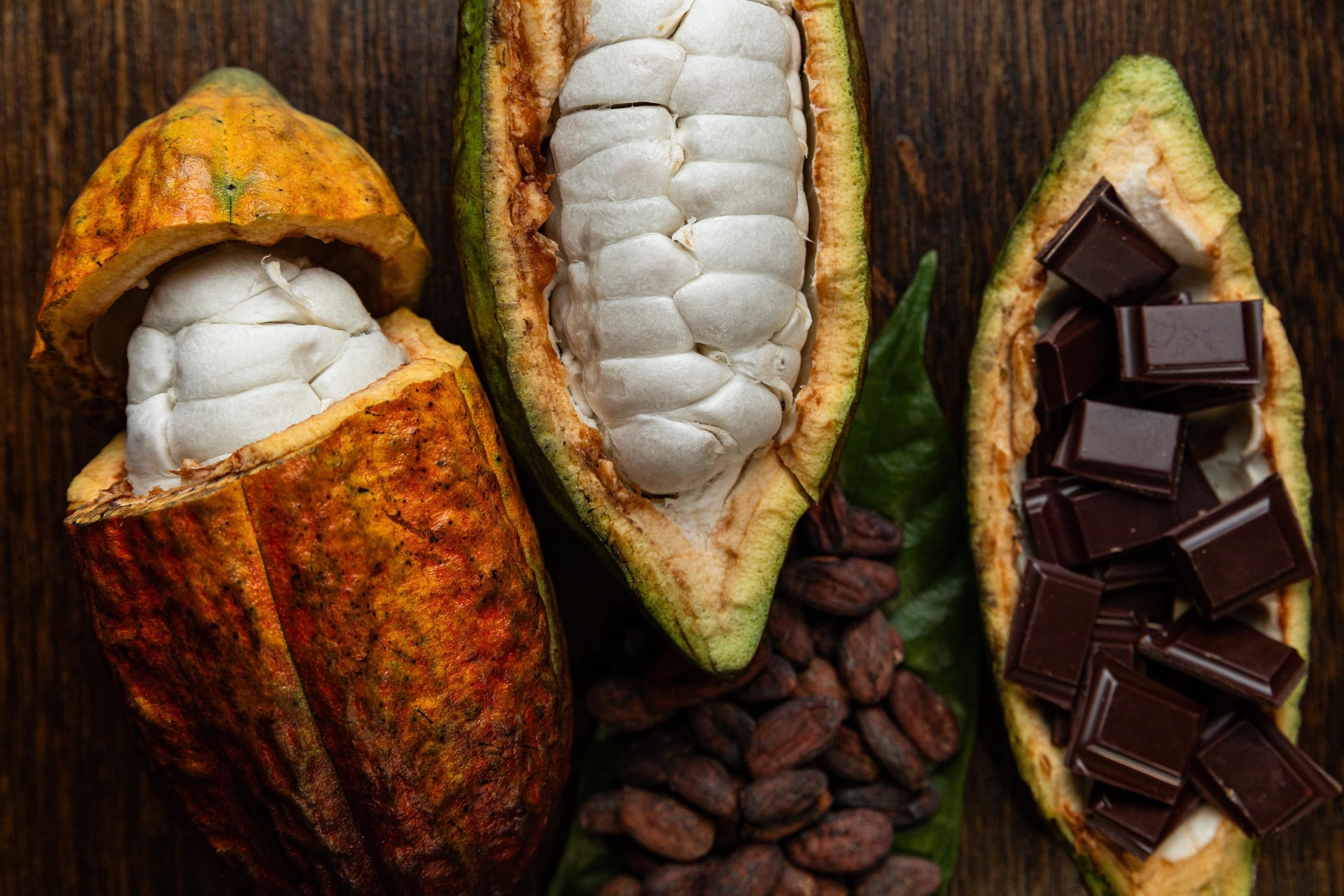
Chocolate’s irresistible taste may soon become more consistent and even more delicious thanks to a breakthrough in fermentation science.
Much like beer and cheese were revolutionized by controlled fermentation, chocolate may now be on the verge of its own transformation — promising consistency, new flavors, and a higher standard of quality worldwide.
Unlocking the Secrets of Chocolate Flavor
Researchers have pinpointed the key elements that shape chocolate’s taste during the fermentation of cocoa beans. Their findings could give chocolate makers a reliable way to produce consistently high-quality, richly flavored chocolate.
A team from the University of Nottingham’s School of Biosciences studied how temperature, pH, and microbial communities interact during cacao bean fermentation and how these factors influence flavor. They identified important microbial species and metabolic features linked to fine-flavor chocolate, showing that both abiotic factors (such as temperature and pH) and biotic factors (the microbial communities) serve as strong and consistent predictors of flavor development. The study was published recently in Nature Microbiology.
Why Fermentation Is Crucial
The journey to great chocolate begins with the cacao bean, whose quality and flavor are shaped by both pre-harvest and post-harvest conditions. Among these, fermentation is the very first and one of the most important steps after harvest. It is during this stage that the foundation is laid for aroma, flavor complexity, and the reduction of bitterness in the finished product.
Dr. David Gopaulchan, first author of the study, explains: “Fermentation is a natural, microbe-driven process that typically takes place directly on cocoa farms, where harvested beans are piled in boxes, heaps, or baskets. In these settings, naturally occurring bacteria and fungi from the surrounding environment break down the beans, producing key chemical compounds that underpin chocolate’s final taste and aroma. However, this spontaneous fermentation is largely uncontrolled. Farmers have little influence over which microbes dominate or how the fermentation process unfolds. As a result, fermentation, and thus the flavor and quality of the beans, varies widely between harvests, farms, regions, and countries.”
From Farms to Labs: Controlling Flavor
The researchers wanted to find out whether this unstable, natural process could be replicated and controlled in the lab. Working with Colombian farmers during the fermentation process, they identified the factors that influence flavor.
They were then able to use this knowledge to create a lab fermentation process and developed a defined microbial community, a curated mix of bacteria and fungi, capable of replicating the key chemical and sensory outcomes of traditional fermentations. This synthetic community successfully mimicked the dynamics of on-farm fermentations and produced chocolate with the same fine-flavor characteristics.
Toward a Chocolate Revolution
Dr. David Gopaulchan adds: “The discoveries we have made are really important for helping chocolate producers to be able to consistently maximize their cocoa crops as we have shown they can rely on measurable markers such as specific pH, temperature, and microbial dynamics, to reliably predict and achieve consistent flavor outcomes. This research signals a shift from spontaneous, uncontrolled fermentations to a standardized, science-driven process. Just as starter cultures revolutionized beer and cheese production, cocoa fermentation is poised for its own transformation, powered by microbes, guided by data, and tailored for flavor excellence. By effectively domesticating the fermentation process, this work lays the foundation for a new era in chocolate production, where defined starter cultures can standardize fermentation, unlock novel flavor possibilities, and elevate chocolate quality on a global scale.”
Reference: “A defined microbial community reproduces attributes of fine flavor chocolate fermentation” by David Gopaulchan, Christopher Moore, Naailah Ali, Darin Sukha, Sergio Leonardo Florez González, Fabio Esteban Herrera Rocha, Ni Yang, Mui Lim, Tristan P. Dew, Andrés Fernando González Barrios, Pathmanathan Umaharan, David E. Salt and Gabriel Castrillo, 18 August 2025, Nature Microbiology.
DOI: 10.1038/s41564-025-02077-6
Never miss a breakthrough: Join the SciTechDaily newsletter.
Follow us on Google and Google News.