
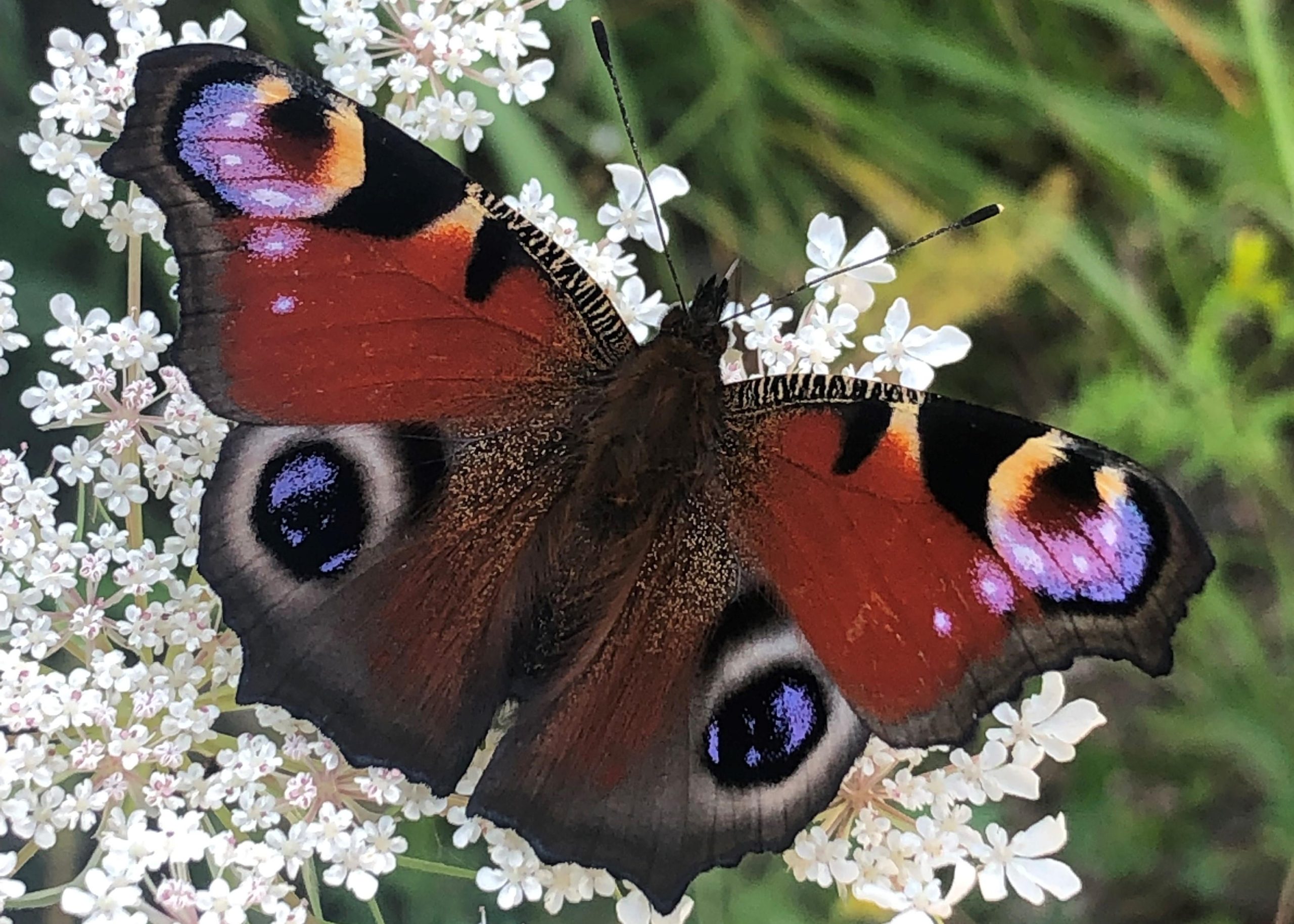
Dr. Hannah Rowland and Dr. John Skelhorn explain how these defensive patterns on moth wings persuade birds that assaulting the insects is not worth the risk.
Art Mirrors Real Life When It Comes to Moth Wings
Have you ever had the impression that someone in a portrait is keeping an eye on you or following you around a room? The Mona Lisa effect is the name given to this optical illusion in honor of Leonardo da Vinci’s famously enigmatic masterpiece. No matter where viewers stand, to the left, right, or in front of the picture, eye contact is assured when painters paint their sitter’s eyes with the pupils perfectly centered. Nature seems to have had the same thought. However, it could be a matter of life or death in the animal kingdom.
Eyespots
Many fish, butterflies, moths, praying mantids, and beetles have paired circular markings on their bodies that look like eyes. Eyespots may divert a predator’s attention away from vital body parts of a target (a prey is much more likely to survive a bite to its tail than its head). Additionally, eyespots have the power to intimidate and stop predators in their tracks.
One theory is that predators confuse eyespots with the eyes of their own predators. If this is the case, then eyespots that seem to be staring straight at them would be the most dangerous. Eyespots, like portraits whose eyes seem to follow you around the room, may seem to keep eye contact with predators regardless of their vantage point. If eyespots were shifted to the left or right, they would only defend victims against predators approaching from that direction.
Another explanation is that eyespots have nothing to do with eyes. Predators could be deterred not because eyespots look like eyes, but simply because they are patterns that stand out. There are many conspicuous colors and patterns in the animal kingdom that are aversive to predators but look nothing like eyes – for example, the red and black patterns of ladybirds. Humans might perceive eyespots to look like eyes, but that doesn’t necessarily mean that predators do too. They may simply see ‘scary’ conspicuous markings.
Creating the Ultimate Death Stare
We tested the idea that forward-facing eyespots appear to gaze at predators by pitting artificial moths against newly hatched domestic chicks. We created the moths by pinning paper triangles over mealworms – a favorite food of chicks. The paper triangles were printed with eyespots in one of three configurations: either perfectly concentric circles or with the center circle nudged to the right or left. All of the prey were designed to be equally conspicuous to the predators. To us, these appeared to gaze directly ahead or to one side. Would the direction of gaze affect the chicks’ motivation to attack?
Staring Death in the Eye
Next, we built three miniature catwalks (well, actually, chickwalks) to lead the chicks toward the moth. One led directly toward the prey, and the two others directed the chicks to approach the moth from either the left or right. We timed how long it took a chick to approach and attack each type of moth from each of the three directions.
Chicks were slow to approach from the left when the moth’s eyespots were shifted to the left, and slow to approach from the right when the moth’s eyespots were shifted to the right. However, when chicks approached these moths from the opposite direction, they quickly approached the moth and ate the mealworm. The chicks were slow to approach the moths with concentric circle eyespots from all three directions.
Our results are consistent with the idea that the chicks perceived our artificial eyespots as eyes, and that eyespots are most effective when they appear to gaze at predators. Eyespots that are concentric circles appear to stare at predators from a wider range of directions, just like the portraits that maintain eye contact from wherever you stand. This also probably explains why eyespots are so common in nature.
Reference: “Eyespot configuration and predator approach direction affect the antipredator efficacy of eyespots” by John Skelhorn and Hannah M. Rowland, 12 October 2022, Frontiers in Ecology and Evolution.
DOI: 10.3389/fevo.2022.951967
Dr. John Skelhorn is a Senior Lecturer in Animal Cognition at the Biosciences Institute at Newcastle University. The overarching theme of his research is how the sensory and cognitive processes of predators influence the evolution of their prey.
Dr. Hannah Rowland is a Research Group Leader at the Max Planck Institute for Chemical Ecology in Jena, Germany, where she researches evolutionary and ecological interactions between plants, insects, and predators.
Never miss a breakthrough: Join the SciTechDaily newsletter.
Follow us on Google and Google News.