
Close Menu
    Facebook X (Twitter) Instagram
    SciTechDaily
    • Biology
    • Chemistry
    • Earth
    • Health
    • Physics
    • Science
    • Space
    • Technology
    Facebook X (Twitter) Pinterest YouTube RSS
    SciTechDaily
    Home»Earth»“These Wrinkles Shouldn’t Exist” – A Geologist’s Hike Uncovers a 180-Million-Year-Old Mystery
    Earth

    “These Wrinkles Shouldn’t Exist” – A Geologist’s Hike Uncovers a 180-Million-Year-Old Mystery

    By University of Texas at AustinMarch 27, 2026No Comments5 Mins Read
    Facebook Twitter Pinterest Telegram LinkedIn WhatsApp Email Reddit
    Share
    Facebook Twitter LinkedIn Pinterest Telegram Email Reddit
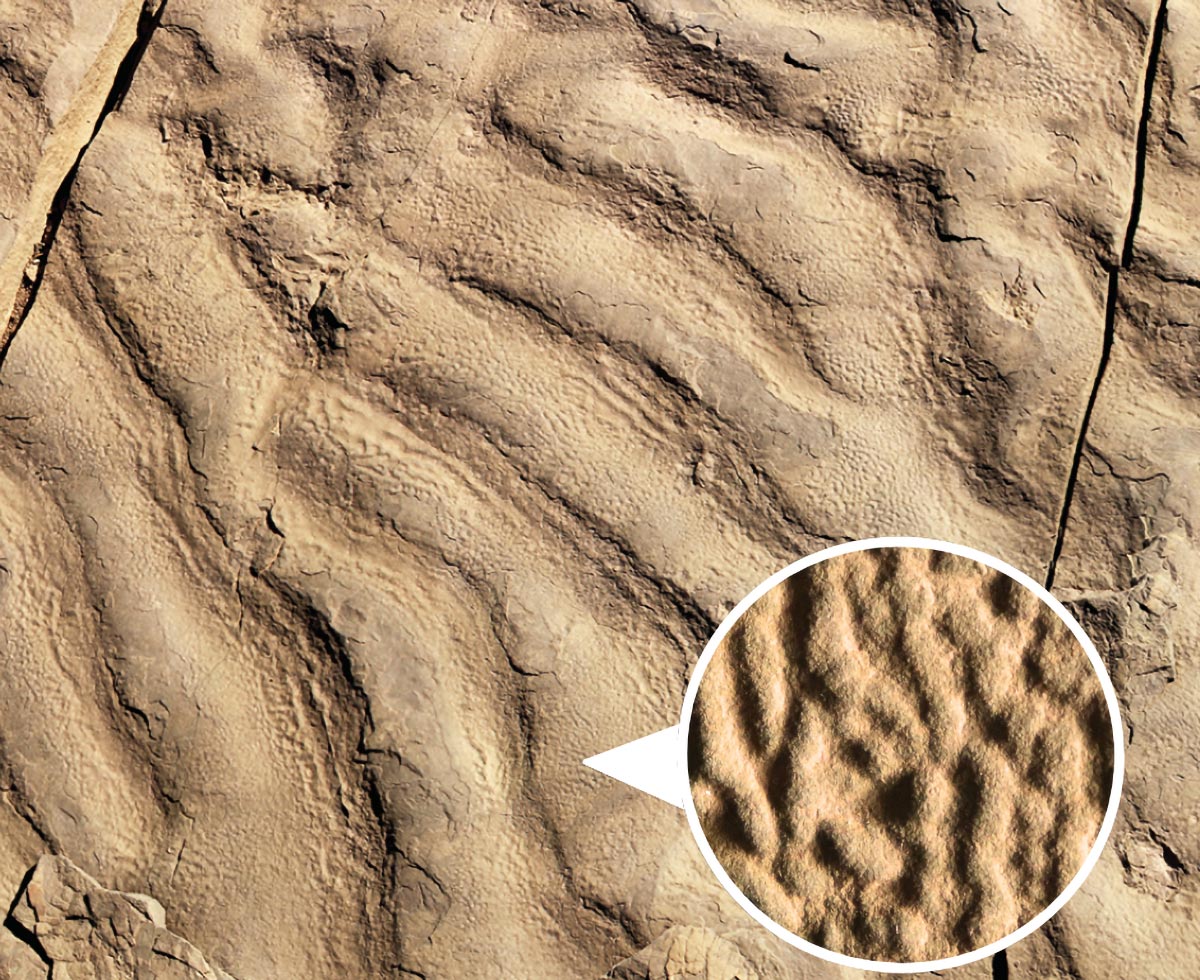
    Ripples and Wrinkle Structure Inset
    Preserved seabed ripples on an outcrop in Morocco covered with wrinkle structures thought to be formed by an ancient microbial community from the Early Jurassic. The inset shows a close-up of the wrinkle structures covering the ripples. Credit: Main photo: Rowan Martindale. Inset: Jackson School of Geosciences.

    Deepwater rock wrinkles likely formed from chemosynthetic microbes, not just physical processes, reshaping assumptions about ancient ecosystems.

    In 2016, geologist Rowan Martindale was hiking on a hillside in Morocco when she noticed something unusual: a slab of sedimentary rock marked by a wrinkled surface that resembled elephant skin.

    “I looked at the wrinkles, and I was like, ‘These aren’t supposed to be in rocks like this. What the heck is going on?’” said Martindale, an associate professor at The University of Texas at Austin’s Jackson School of Geosciences.

    Rock textures can reveal the processes that shaped them over time. To Martindale, the patterns looked like classic microbial mat fossils, preserving a dense community of bacteria that lived more than 180 million years ago during the Early Jurassic.
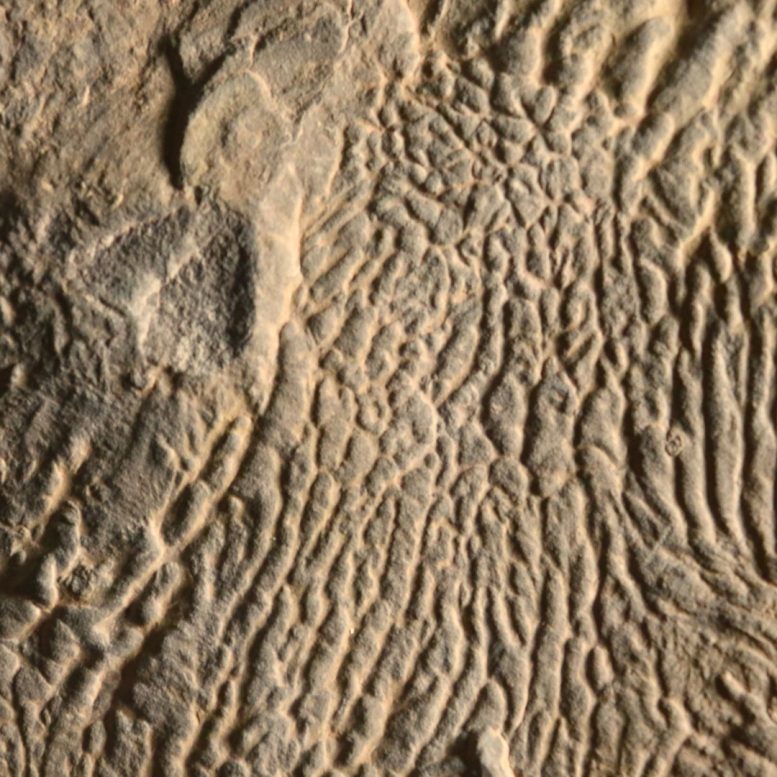
    Turbidite Wrinkles
    A sedimentary rock with a wrinkly texture not formed by microbial communities. These wrinkles are formed by flow-induced deformation as sediments move across the ocean floor during underwater landslides. Each feature is a few millimeters long. Credit: Jackson School of Geosciences.

    Microbial Fossils in an Unexpected Setting

    During graduate school, she had seen many examples of similar textures through photos and samples, thanks to a colleague who studied Early Triassic microbial fossils.

    But there was a major inconsistency: the surrounding geology did not match expectations.

    The sediment containing the wrinkles came from a deep ocean environment, roughly 600 feet (about 183 meters) below the surface. However, scientists have generally believed that microbial wrinkle structures form only in shallow waters under stressful conditions or after extinction events, where sunlight is available, and grazing marine life is limited.
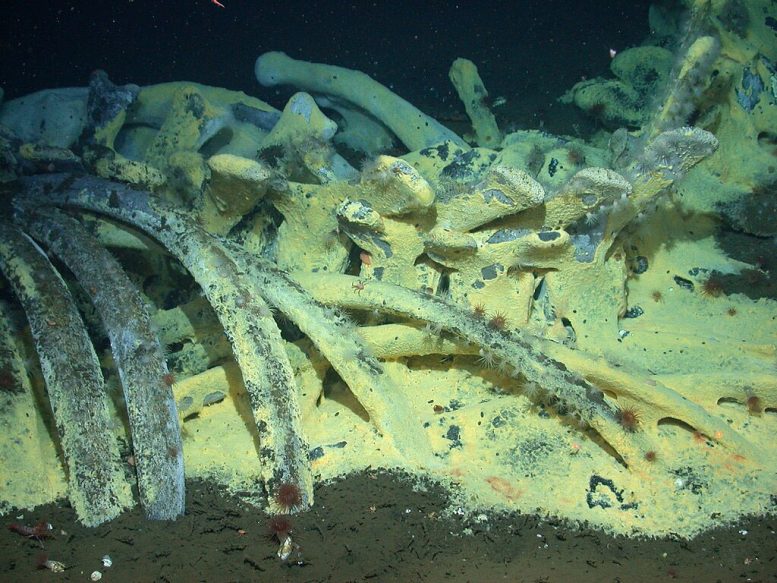
    Microbes on Whale Fall
    Whale bones covered in a chemosynthetic microbial mat (yellow). New research suggests that wrinkle structures found in deepwater rocks could be remnants of ancient relatives of these microbial communities. Credit: Craig Smith/ NOAA

    Challenging Landslide-Only Explanations for Wrinkled Textures

    In deepwater environments, such textures are usually explained as marks left by underwater landslides that reshape sediment into ridges and grooves. Martindale was not convinced. The patterns she saw looked distinctly biological.

    “It was one of those things, knowing what to look for and having that ‘search image’ of wrinkle structures in my head, that made me want to stop and dig into this,” she said.

    In a study published in Geology, Martindale and her colleagues present a new explanation that links geological processes with biology. They argue that while a landslide did not directly create the wrinkles, it likely delivered nutrients to the seafloor, allowing microbes to grow.

    New Theory: Landslides Enable Chemosynthetic Microbial Mats

    The researchers propose that the wrinkles were formed by microbial mats that relied on nutrients carried to deep waters by the landslide instead of sunlight. This energy strategy, known as chemosynthesis, may also have allowed the microbes to release toxic sulfur compounds that discouraged other marine organisms.
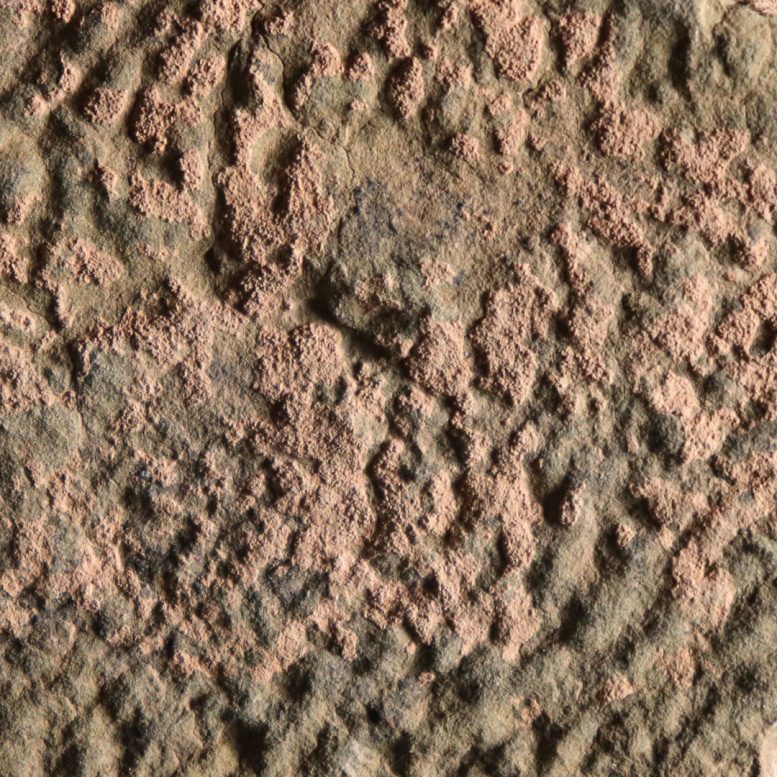
    Microbial Wrinkle Structures
    A sedimentary rock sample covered with wrinkles structures formed by microbial mats. Each wrinkle is a few millimeters long. Credit: UT Jackson School of Geosciences

    Similar communities exist today in the deep ocean. For example, microbial mats often grow on whale carcasses that sink to the seafloor, creating nutrient-rich and short-lived “whale fall” ecosystems.

    Deep-Ocean Microbes Reshape Understanding of Ancient Wrinkles

    Jake Bailey, a professor at the University of Minnesota who studies how microbes influence Earth’s systems, said the findings challenge the idea that all ancient wrinkle structures come from a single type of microbial life.

    “In the present, some of the largest microbial ecosystems on our planet are found in the dark ocean,” said Bailey, who was not involved with the research. “The research here shows that certain ancient sedimentary structures may record the presence of these chemolithotrophs rather than phototrophs (organisms that need sunlight to make energy). ”

    New Fossil Insights and an Unexpected Scientific Journey

    Martindale noted that the results suggest chemosynthetic microbial fossils may be more common than previously recognized. Interpreting wrinkle structures as purely physical features could lead scientists to overlook biological origins. This challenge is compounded by the lack of precise terminology for describing these textures.
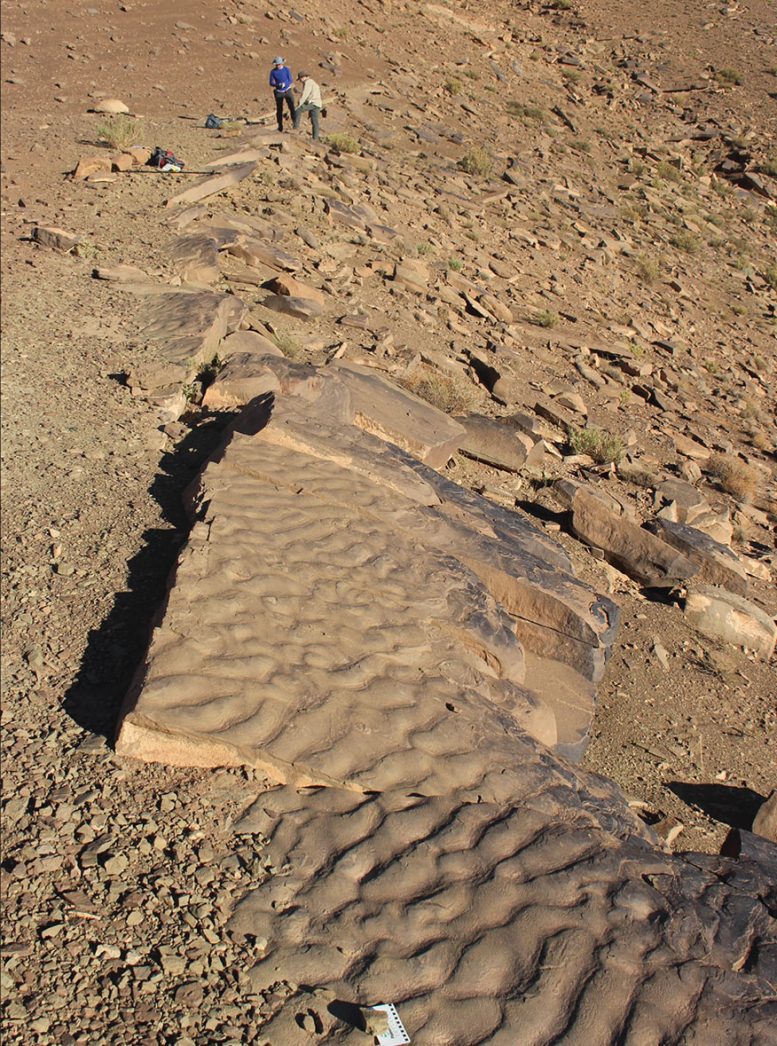
    Wrinkle Structure Outcrop
    The outcrop in Morocco where Associate Professor Rowan Martindale noticed the wrinkle structures formed by microbial communities. Note that the large ripples on the rock slab were formed by turbidity currents. The wrinkle structures are a more subtle texture that overlays the larger ripples. Credit: Rowan Martindale / UT Jackson School of Geosciences

    “The terminology is pretty lax,” Martindale said. “Wrinkly can mean lots of things, so there’s a lack of diagnostic language.”

    Martindale typically studies ancient coral reefs and mass extinctions, and she did not expect to shift her focus to deep-sea microbial mats. However, the discovery led her in a new direction.

    “It’s really cool to have gone in this direction that I totally wasn’t expecting,” she said. “There was no hypothesis that I would find these microbial mats here. It was just being in the right place at the right time, with the right search image. And then being so stubborn as to not let go of it.”

    Reference: “Chemosynthetic microbial communities formed wrinkle structures in ancient turbidites” by Rowan C. Martindale, Sinjini Sinha, Travis N. Stone, Tanner Fonville, Stéphane Bodin, François-Nicolas Krencker, Peter Girguis, Crispin T.S. Little and Lahcen Kabiri, 3 December 2025, Geology.
    DOI: 10.1130/G53617.1

    The research was funded by the National Science Foundation.

    Never miss a breakthrough: Join the SciTechDaily newsletter.
    Follow us on Google and Google News.

    Fossils Geology Paleontology University of Texas at Austin
    Share. Facebook Twitter Pinterest LinkedIn Email Reddit

    Related Articles

    Life Rebounded “Astoundingly” Fast After the Dinosaur-Killing Asteroid, Study Finds

    300-Million-Year-Old Iridescent Fossil May Be One of Earth’s Rarest Prehistoric Gems

    An Unexpected Twist: What Really Makes “Golden” Fossils Shine?

    Scientists Have a Powerful New Tool to Investigate Triassic Dark Ages

    47 Million Years Ago, Horses Were About the Size of a Labrador Dog

    Ancestor of All Animals – Including Humans – Identified in Australian Fossils

    Mongolian Microfossils Shed Light on the Rise of Animals

    Evidence Suggests that Earth May Be Headed Toward an Irreversible Change in the Biosphere

    Mysterious “Godzillus” Fossil Discovered by Amateur Paleontologist

    Leave A Reply Cancel Reply

    • Facebook
    • Twitter
    • Pinterest
    • YouTube

    Don't Miss a Discovery

    Subscribe for the Latest in Science & Tech!

    Trending News

    Scientists Discover Game-Changing New Way To Treat High Cholesterol

    This Small Change to Your Exercise Routine Could Be the Secret to Living Longer

    Scientists Discover 430,000-Year-Old Wooden Tools, Rewriting Human History

    AI Could Detect Early Signs of Alzheimer’s in Under a Minute – Far Before Traditional Tests

    What if Dark Matter Has Two Forms? Bold New Hypothesis Could Explain a Cosmic Mystery

    This Metal Melts in Your Hand – and Scientists Just Discovered Something Strange

    Beef vs. Chicken: Surprising Results From New Prediabetes Study

    Alzheimer’s Breakthrough: Scientists Discover Key Protein May Prevent Toxic Protein Clumps in the Brain

    Follow SciTechDaily
    • Facebook
    • Twitter
    • YouTube
    • Pinterest
    • Newsletter
    • RSS
    SciTech News
    • Biology News
    • Chemistry News
    • Earth News
    • Health News
    • Physics News
    • Science News
    • Space News
    • Technology News
    Recent Posts
    • Largest-Ever Study Finds Medicinal Cannabis Ineffective for Anxiety, Depression, PTSD
    • Scientists Reveal Why a Common Drug Causes Birth Defects and Autism
    • A Medieval Japanese Diary Just Helped Scientists Detect a Dangerous Solar Event
    • Humans Returned to Britain 500 Years Earlier Than Scientists Thought
    • 250-Million-Year-Old Egg Solves One of Evolution’s Biggest Mysteries
    Copyright © 1998 - 2026 SciTechDaily. All Rights Reserved.
    • Science News
    • About
    • Contact
    • Editorial Board
    • Privacy Policy
    • Terms of Use

    Type above and press Enter to search. Press Esc to cancel.