
Close Menu
    Facebook X (Twitter) Instagram
    SciTechDaily
    • Biology
    • Chemistry
    • Earth
    • Health
    • Physics
    • Science
    • Space
    • Technology
    Facebook X (Twitter) Pinterest YouTube RSS
    SciTechDaily
    Home»Technology»This New Building Material Doesn’t Emit Carbon – It Traps It
    Technology

    This New Building Material Doesn’t Emit Carbon – It Traps It

    By Colleen Wamback, Worcester Polytechnic InstituteJanuary 5, 20261 Comment3 Mins Read
    Facebook Twitter Pinterest Telegram LinkedIn WhatsApp Email Reddit
    Share
    Facebook Twitter LinkedIn Pinterest Telegram Email Reddit
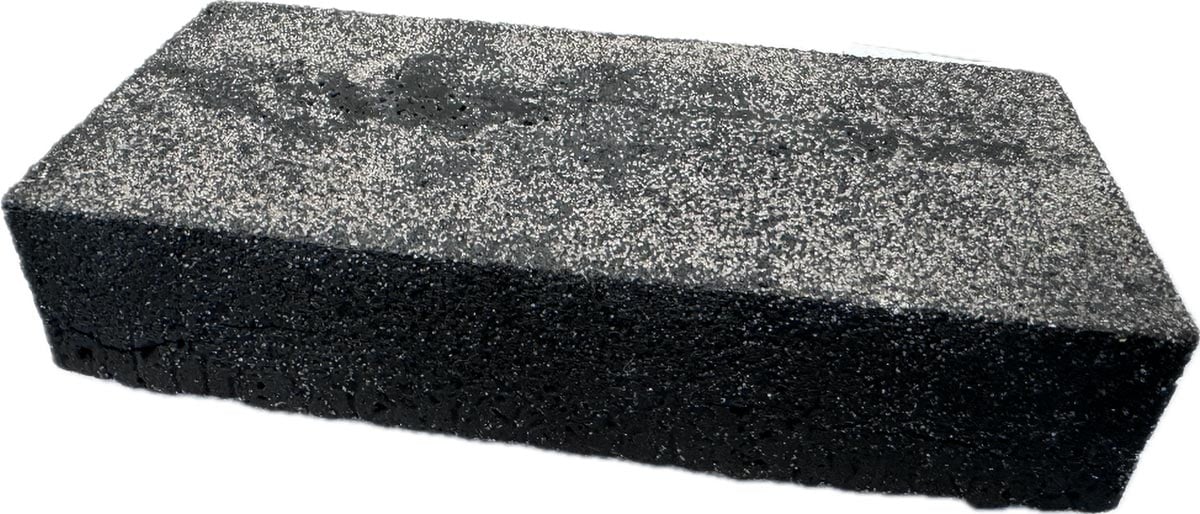
    Enzymatic Structural Material Construction Block
    Enzymatic structural material (ESM), a strong, durable, and recyclable construction material. Credit: Worcester Polytechnic Institute

    The fast-acting, long-lasting material provides a new option beyond traditional concrete.

    Researchers at Worcester Polytechnic Institute (WPI) have developed a new carbon-negative building material that could reshape approaches to sustainable construction.

    Described in the high-impact journal Matter, the advance introduces enzymatic structural material (ESM), a construction material that is strong, long-lasting, and recyclable, and is made using a low-energy process inspired by biological systems.

    Turning carbon dioxide into structure

    Under the leadership of Nima Rahbar, the Ralph H. White Family Distinguished Professor and head of the Department of Civil, Environmental, and Architectural Engineering, the team created ESM by harnessing an enzyme that converts carbon dioxide into solid mineral particles. These particles are then bonded together and allowed to cure under gentle conditions, making it possible to shape the material into structural components within a matter of hours. In contrast to conventional concrete, which depends on high temperatures and extended curing times, ESM can be produced quickly while significantly reducing environmental impact.

    “Concrete is the most widely used construction material on the planet, and its production accounts for nearly 8% of global CO2 emissions,” said Rahbar. “What our team has developed is a practical, scalable alternative that doesn’t just reduce emissions—it actually captures carbon. Producing a single cubic meter of ESM sequesters more than 6 kilograms of CO2, compared to the 330 kilograms emitted by conventional concrete.”

    Performance built for real construction

    ESM’s rapid curing, tunable strength, and recallability make it especially promising for real-world applications such as roof decks, wall panels, and modular building components. Its repairability could cut long-term construction costs and drastically reduce the volume of material sent to landfills each year.

    “If even a fraction of global construction shifts toward carbon-negative materials like ESM, the impact could be enormous,” added Rahbar.

    This innovation has potential value for industries ranging from affordable housing and climate-resilient construction to disaster relief, where lightweight, quickly produced structural materials can accelerate rebuilding efforts. Because ESM is produced with low energy and renewable biological inputs, it also aligns with global goals for carbon-neutral infrastructure and circular manufacturing.

    Reference: “Durable, high-strength carbon-negative enzymatic structural materials via a capillary suspension technique” by Shuai Wang, Pardis Pourhaji, Dalton Vassallo, Sara Heidarnezhad, Suzanne Scarlata and Nima Rahbar, 3 December 2025, Matter.
    DOI: 10.1016/j.matt.2025.102564

    The authors gratefully acknowledge financial support from the National Science Foundation under award no. 2223664.

    Never miss a breakthrough: Join the SciTechDaily newsletter.
    Follow us on Google and Google News.

    Architecture Carbon Capture Civil Engineering Green Technology Materials Science Popular
    Share. Facebook Twitter Pinterest LinkedIn Email Reddit

    Related Articles

    Bridges in North America Are in Worse Shape Than Anywhere Else on Earth

    Scientists Create Living Computers Powered by Mushrooms

    Supercomputers and AI Unlock Secret Materials for Next-Gen Carbon Capture

    Revolutionary Self-Aware Materials Build the Foundation for Living Structures

    New Efficiency Record for Quantum-Dot Photovoltaics

    Scientists Achieve Solar Hydrogen Production Breakthrough

    MOF Powered by Sunlight Could Help Drastically Cut Carbon Emissions

    Photochemical Upconversion Adds “Turbo” to Solar Cell Efficiency

    Researchers Develop a Computational Tool for Identifying Carbon Capture Technologies

    1 Comment

    1. Robert on January 6, 2026 9:36 am

      producing mineral-like substance that ‘can be bonded together’ – bonded with what? epoxy?

      Reply
    Leave A Reply Cancel Reply

    • Facebook
    • Twitter
    • Pinterest
    • YouTube

    Don't Miss a Discovery

    Subscribe for the Latest in Science & Tech!

    Trending News

    Your Blood Pressure Reading Could Be Wrong Because of One Simple Mistake

    Astronomers Stunned by Ancient Galaxy With No Spin

    Physicists May Be on the Verge of Discovering “New Physics” at CERN

    Scientists Solve 320-Million-Year Mystery of Reptile Skin Armor

    Scientists Say This Daily Walking Habit May Be the Secret to Keeping Weight Off After Dieting

    New Therapy Rewires the Brain To Restore Joy in Depression Patients

    Giant Squid Detected off Western Australia in Stunning Deep-Sea Discovery

    Popular Sugar-Free Sweetener Linked to Liver Disease, Study Warns

    Follow SciTechDaily
    • Facebook
    • Twitter
    • YouTube
    • Pinterest
    • Newsletter
    • RSS
    SciTech News
    • Biology News
    • Chemistry News
    • Earth News
    • Health News
    • Physics News
    • Science News
    • Space News
    • Technology News
    Recent Posts
    • Hidden Warm Water Beneath Antarctica Could Rapidly Raise Global Sea Levels
    • Scientists Revive Ancient Chemistry Trick To Engineer Next-Generation Glass
    • Scientists Use AI To Supercharge Ultrafast Laser Simulations by More Than 250x
    • Scientists Just Found a Surprising Way To Destroy “Forever Chemicals”
    • Popular Supplement Ingredient Linked to Shorter Lifespan in Men
    Copyright © 1998 - 2026 SciTechDaily. All Rights Reserved.
    • Science News
    • About
    • Contact
    • Editorial Board
    • Privacy Policy
    • Terms of Use

    Type above and press Enter to search. Press Esc to cancel.