
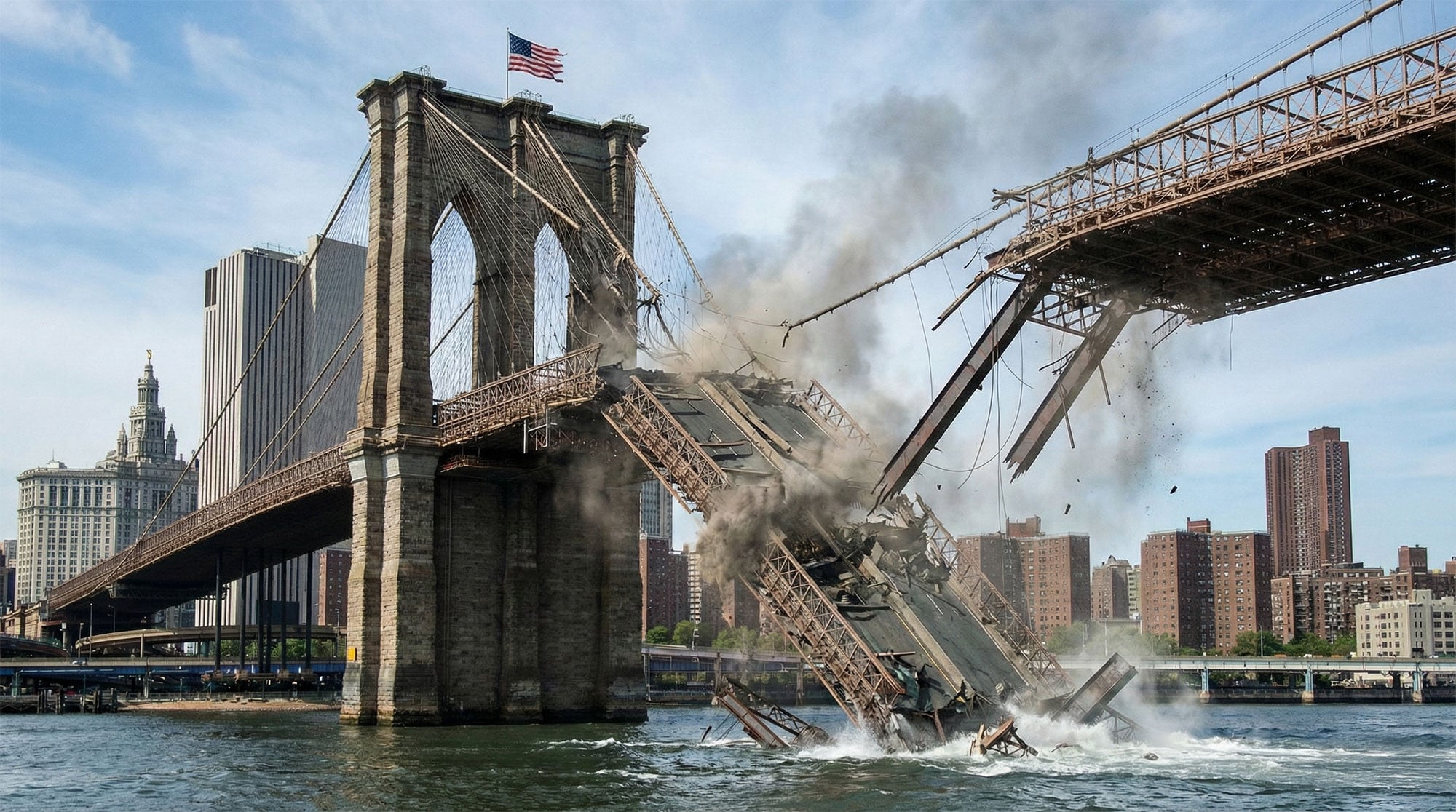
A new study finds that bridges in North America and Africa face the highest risk of failure, and researchers suggest using satellite monitoring to help detect problems early and prevent collapses.
A scientist at the University of Houston is helping identify the world’s most vulnerable bridges and pointing to ways they could be repaired before failures occur.
In a global analysis of 744 bridges published in Nature Communications, Pietro Milillo and an international group of researchers found that bridges in North America are, on average, in the worst condition, with African bridges close behind. The team proposes a new approach to infrastructure protection that could reshape how risks are managed worldwide by tracking bridge stability from space and spotting early warning signs long before collapse becomes likely.
Aging infrastructure drives global risk
The elevated risk is closely linked to the age of many bridges, particularly in North America, where construction peaked during the 1960s. As a result, a large number of structures are now approaching or exceeding their original design lifespans. To address this challenge, the researchers point to space-based monitoring using Synthetic Aperture Radar, which can deliver frequent, high-resolution observations across the globe and draw on extensive historical data.
“Our research shows that spaceborne radar monitoring could provide regular oversight for more than 60 percent of the world’s long-span bridges,” said Milillo, co-author of the study and an associate professor of civil and environmental engineering at UH. “By integrating satellite data into risk frameworks, we can significantly lower the number of bridges classified as high-risk, especially in regions where installing traditional sensors is too costly.”
The international team, which included Dominika Malinowska from Delft University of Technology (TU Delft) and the University of Bath, Cormac Reale and Chris Blenkinsopp from the University of Bath, and Giorgia Giardina from TU Delft, relied on a remote sensing method known as Multi-Temporal Interferometric Synthetic Aperture Radar (MT InSAR). Their results show that this technique can strengthen traditional inspection methods by detecting millimeter-scale ground or structural movement linked to slow processes such as landslides or subsidence, as well as by identifying unusual patterns across large areas that might otherwise go unnoticed.
Bridges are among the most vulnerable parts of the transportation networks, yet traditional monitoring has limitations. In-person visual inspections can be subjective and expensive, while inspectors may miss signs of early deterioration between typical bi-yearly inspection cycles. Structural Health Monitoring (SHM) sensors offer a more cost-effective solution, but their implementation remains limited primarily to newer bridges and specific concern cases, with the study confirming that they are installed on fewer than 20% of the world’s long-span bridges. This leaves a significant gap in the understanding of the structural condition of bridges.
A solution from the skies
“Remote sensing offers a complement to SHM sensors, can reduce maintenance costs, and can support visual inspections, particularly when direct access to a structure is challenging,” said Millilo. “For bridges specifically, MT-InSAR allows for more frequent deformation measurements across the entire infrastructure network, unlike traditional inspections, which typically occur only a few times per year and require personnel on the ground”
Said Malinowska. “While using MT-InSAR to monitor bridges is well-established in academic circles, it has yet to be routinely adopted by the authorities and engineers responsible for them. Our work provides the global-scale evidence showing this is a viable and effective tool that can be deployed now.
Researchers found that incorporating data from MT-InSAR, particularly pixels with stable scattering properties known as persistent scatterers (PS), into risk assessments provides more accurate risk registers through uncertainty reduction, enabling better risk prioritization and maintenance planning.
The method proposed by this international research team integrates the availability of monitoring from both SHM sensors and satellites like the European Space Agency’s Sentinel-1 or the recently launched NASA NISAR into a bridge’s structural vulnerability score. By providing more frequent updates than typical visual inspections, this combined monitoring approach reduces uncertainty about a bridge’s current condition, leading to more accurate risk classification.
Reference: “Global geo-hazard risk assessment of long-span bridges enhanced with InSAR availability” by Dominika Malinowska, Pietro Milillo, Cormac Reale, Chris Blenkinsopp and Giorgia Giardina, 13 October 2025, Nature Communications.
DOI: 10.1038/s41467-025-64260-x
Disclosure: Part of this work was performed at the University of Houston under a contract with the Commercial Smallsat Data Scientific Analysis Program of NASA (NNH22ZDA001N-CSDSA) and the NASA Decadal Survey Incubation Program: Science and Technology (NNH21ZDA001N-DSI) (PM).
Never miss a breakthrough: Join the SciTechDaily newsletter.
Follow us on Google and Google News.
11 Comments
It’s almost like we send most of our money gets sent elsewhere to do nonsense
It’s almost like we send most of our money elsewhere to do nonsense
It gets put into the bank accounts of politicians and their donors. There’s also the fact that public funds are used as weapons in political warfare, to the point that modern infrastructure is held hostage by political rivals
The crude AI generated Brooklyn Bridge of the illustration is not accurate. The bridge is 143 years old. If all the cables snapped, the bridge would still stand. It took 14 years to build and cost the lives of at least 20 workers.
It’s almost like that’s utterly untrue on several levels.
Oh please. Africa.
Say it aint so, infrastructure averages 75 years old in America.
Please, send more money to other countries.
Instead of wishing for Nobel prizes and building a dance hall, why can’t Mr Government start rebuilding our bridges, roads and electrical grid?
Slco: Big Pharma knows there are cures out there for the likes of cancer and diabetes, etc. The rich crooks need to be knocked off their shiny thrones!
It’s almost like spending all of your money to support the rich and military while simultaneously cutting funding for stuff that actually makes your country function is a terrible idea. Who knew?
Don’t be dramatic, look, china makes its bridges out of styrofoam and mud…
No one will talk about tofu dredge, or other infrastructure problems there. This article is hyperbolic for engagements sake alone.