

Scientists have uncovered the strongest evidence yet for the existence of elusive intermediate-mass black holes (IMBHs), long thought to be the missing link between stellar-mass and supermassive black holes.
By tracking a hypervelocity star, J0731+3717, that appears to have been ejected from the dense star cluster M15 at blistering speeds, researchers pinpointed the presence of a black hole weighing several thousand solar masses. This gravitational slingshot scenario, only possible if such a massive object exists, offers definitive proof of an IMBH hiding in the cluster’s core, opening a new chapter in black hole research.
The Mystery of Intermediate-Mass Black Holes
Stellar-mass black holes, like the famous Cygnus X-1, which once cost Stephen Hawking a bet, form when massive stars collapse at the end of their lives. At the other extreme, supermassive black holes sit at the centers of large galaxies, including Sagittarius A* in the heart of the Milky Way. Both types are well-documented and widely accepted by astronomers.
But there’s a puzzling gap in between: intermediate-mass black holes (IMBHs). Thought to represent a key evolutionary step between small stellar black holes and the giants that anchor galaxies, IMBHs have remained elusive. A few candidates have been proposed, but none have been confirmed, keeping their existence one of the biggest open questions in black hole research.
Astronomers believe globular clusters, spherical collections of stars packed tightly together, are promising places to search for IMBHs. These dense environments could support two main pathways for IMBH formation: one involves fast, repeated mergers of stars that create a massive object that eventually collapses; the other is a slower buildup, where smaller black holes merge over time to form a larger one.
Early Clues from Hubble Observations
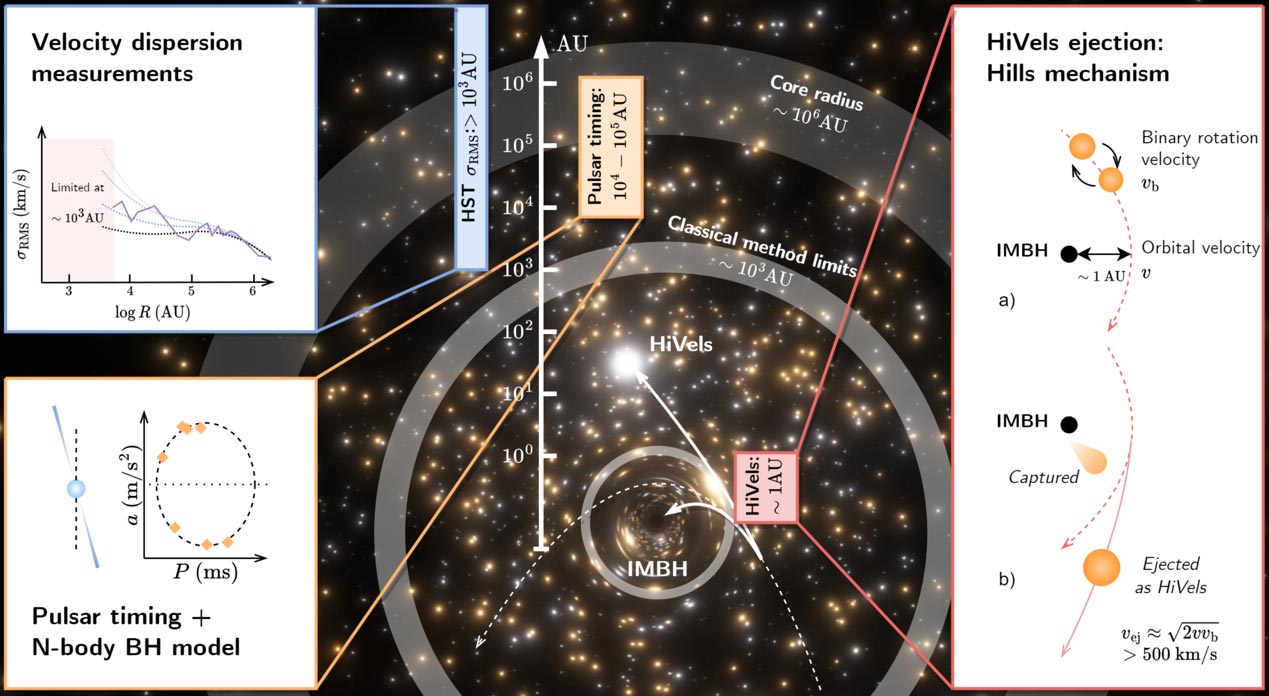
As early as the early 2000s, astronomers used the Hubble Space Telescope (HST) to observe M15 with its ultra-high spatial resolution Space Telescope Imaging Spectrograph (STIS) and derived its line-of-sight velocity dispersion curve. Using N-body numerical simulations, researchers suggested that M15 might host an IMBH with a mass between 1,700 and 3,200 solar masses.
However, this conclusion faced skepticism. The HST velocity dispersion curve was measured at a projected radius of 0.5 arcseconds from the cluster center (about 5,000 AU at the distance of M15), a region where thousands of compact stars might exist in addition to a black hole.
Follow-up studies using pulsar timing also hinted at the presence of IMBHs in globular clusters, but since these pulsars were located even farther from the cluster centers, they could not rule out the possibility of a dense cluster of stellar remnants.
The Search for a Better Method
Thus, finding an effective method to detect IMBHs as close as possible to the centers of globular clusters has become the final missing piece of evidence (see Figure 1, which illustrates the measurement principles).
“To overcome this challenge, we propose a systematic search for hypervelocity/high-velocity stars accelerated by the gravitational slingshot effect (Hills mechanism), where a cluster hosting an IMBH can disrupt a tight binary system orbiting nearby, concentrating the black hole’s mass into a much smaller region,” says Jifeng Liu, Director of National Astronomical Observatories, Chinese Academy of Sciences and lead author of the study.
“By tracing nearly a thousand high-velocity stars (with total velocities exceeding 400 km/s) and over a hundred globular clusters using data from Gaia, LAMOST, SDSS, and other spectroscopic surveys, we have discovered that J0731+3717 was ejected from M15—marking the first time a high-velocity star originating from a globular cluster has been identified—at nearly 550 km/s (over 1 million mile per hour) approximately 20 million years ago,” says Yang Huang, researcher at School of Astronomy and Space Science, University of the Chinese Academy of Sciences and first-author of the study.
Chemical Clues and Explosive Evidence
Remarkably, J0731+3717 shares striking similarities with M15 in both chemical composition and age.
To eject a star at such an extreme velocity from a globular cluster, a tight binary system must have passed within one astronomical unit (AU) of an IMBH with a mass of several thousand solar masses.
“The strong tidal forces of the IMBH would have torn the binary apart—capturing one star while flinging the other away at high speed,” explains Xiaobo Dong, researcher at Yunnan Observatories, Chinese Academy of Sciences and lead author of the study.
Final Proof and Future Prospects
This unique discovery confines a few thousand solar masses within just a few AU, effectively ruling out the possibility that the mass is composed of thousands of neutron stars or stellar-mass black holes. The only plausible explanation is a single black hole, thereby confirming the existence of an IMBH in M15. By identifying the first-ever high-velocity star ejected by an IMBH in a globular cluster, this study completes the final missing link in the evidence chain for IMBHs.
“With the continuous accumulation of data from Gaia and large-scale spectroscopic surveys such as LAMOST, we expect to discover several more stars like J0731+3717 in the near future, which will greatly advance our understanding of the elusive IMBHs,” says Huawei Zhang, Director of Department of Astronomy, School of Physics, Peking University and lead author of the study.
Reference: “A high-velocity star recently ejected by an intermediate-mass black hole in M15” by Yang Huang, Qingzheng Li, Jifeng Liu, Xiaobo Dong, Huawei Zhang, Youjun Lu and Cuihua Du, 3 October 2024, National Science Review.
DOI: 10.1093/nsr/nwae347
Associate Professor Yang Huang from the University of Chinese Academy of Sciences is the co-first author and corresponding author of the paper. Dr. Qingzheng Li (a graduate of Yunnan Astronomical Observatory, Chinese Academy of Sciences) is also a co-first author. Researcher Jifeng Liu from the National Astronomical Observatories, Chinese Academy of Sciences, Researcher Xiaobo Dong from Yunnan Astronomical Observatory, Chinese Academy of Sciences, and Professor Huawei Zhang from Peking University are co-corresponding authors.
Never miss a breakthrough: Join the SciTechDaily newsletter.
Follow us on Google and Google News.