

A star’s colossal flare has revealed an unexpected origin for some of the universe’s heaviest elements, including gold and platinum.
In a stunning breakthrough, scientists linked a mysterious 2004 space signal to a magnetar flare that forged massive amounts of these elements—possibly explaining up to 10% of their presence in the galaxy. This new source challenges long-held assumptions that only neutron star collisions created such materials, and hints at other, undiscovered stellar factories lurking in the cosmos.
A Rare Cosmic Factory for Gold and Platinum
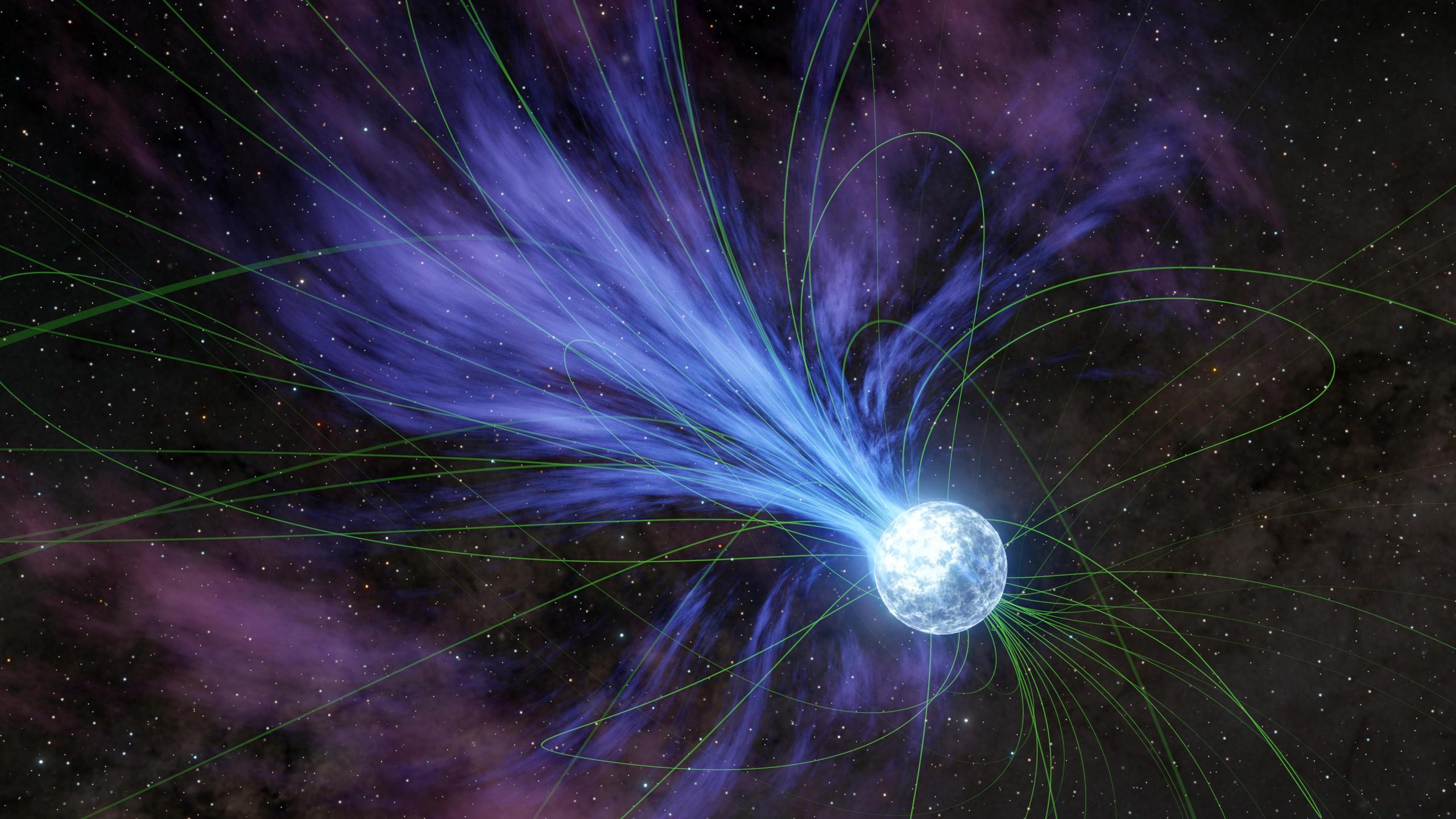
Astronomers have identified a previously unknown birthplace of some of the universe’s rarest elements: a giant flare from an ultra-magnetized star known as a magnetar. Their calculations suggest that these powerful stellar eruptions could account for up to 10 percent of the galaxy’s supply of heavy elements, including gold and platinum.
The finding also solves a 20-year-old mystery linked to a bright flash of light and particles detected by a space telescope in December 2004. The source of the burst was a magnetar—a neutron star with magnetic fields trillions of times stronger than Earth’s—that had released a brief but intense flare. Though the flare lasted only a few seconds, it unleashed more energy than the Sun produces in a million years. While the main flare was quickly understood, a second, weaker signal detected about 10 minutes later remained unexplained—until now.
A Historic Clue Reveals a Heavy Element Birth
Researchers at the Flatiron Institute’s Center for Computational Astrophysics in New York City recently determined that this second signal was evidence of heavy element formation, including gold and platinum. According to their analysis, the 2004 flare may have produced a mass of heavy elements equal to roughly one-third the mass of Earth.
The discovery, published April 29 in The Astrophysical Journal Letters, marks just the second time scientists have directly observed the formation of such elements. The first confirmed source was the collision of two neutron stars, observed in 2017.
“This is really just the second time we’ve ever directly seen proof of where these elements form,” the first being neutron star mergers, says study co-author Brian Metzger, a senior research scientist at the CCA and a professor at Columbia University. “It’s a substantial leap in our understanding of heavy elements production.”
The Origins of the Elements Around Us
Most of the elements we know and love today weren’t always around. Hydrogen, helium, and a dash of lithium were formed in the Big Bang, but almost everything else has been manufactured by stars in their lives, or during their violent deaths. While scientists thoroughly understand where and how the lighter elements are made, the production locations of many of the heaviest neutron-rich elements — those heavier than iron — remain incomplete.
These elements, which include uranium and strontium, are produced in a set of nuclear reactions known as the rapid neutron-capture process, or r-process. This process requires an excess of free neutrons — something that can be found only in extreme environments. Astronomers thus expected that the extreme environments created by supernovae or neutron star mergers were the most promising potential r-process sites.
Neutron Star Collisions Weren’t Enough
It wasn’t until 2017 that astronomers were able to confirm an r-process site when they observed the collision of two neutron stars. These stars are the collapsed remnants of former stellar giants and made of a soup of neutrons so dense that a single tablespoon would weigh more than 1 billion tons. The 2017 observations showed that the cataclysmic collision of two of these stars creates the neutron-rich environment needed for the formation of r-process elements.
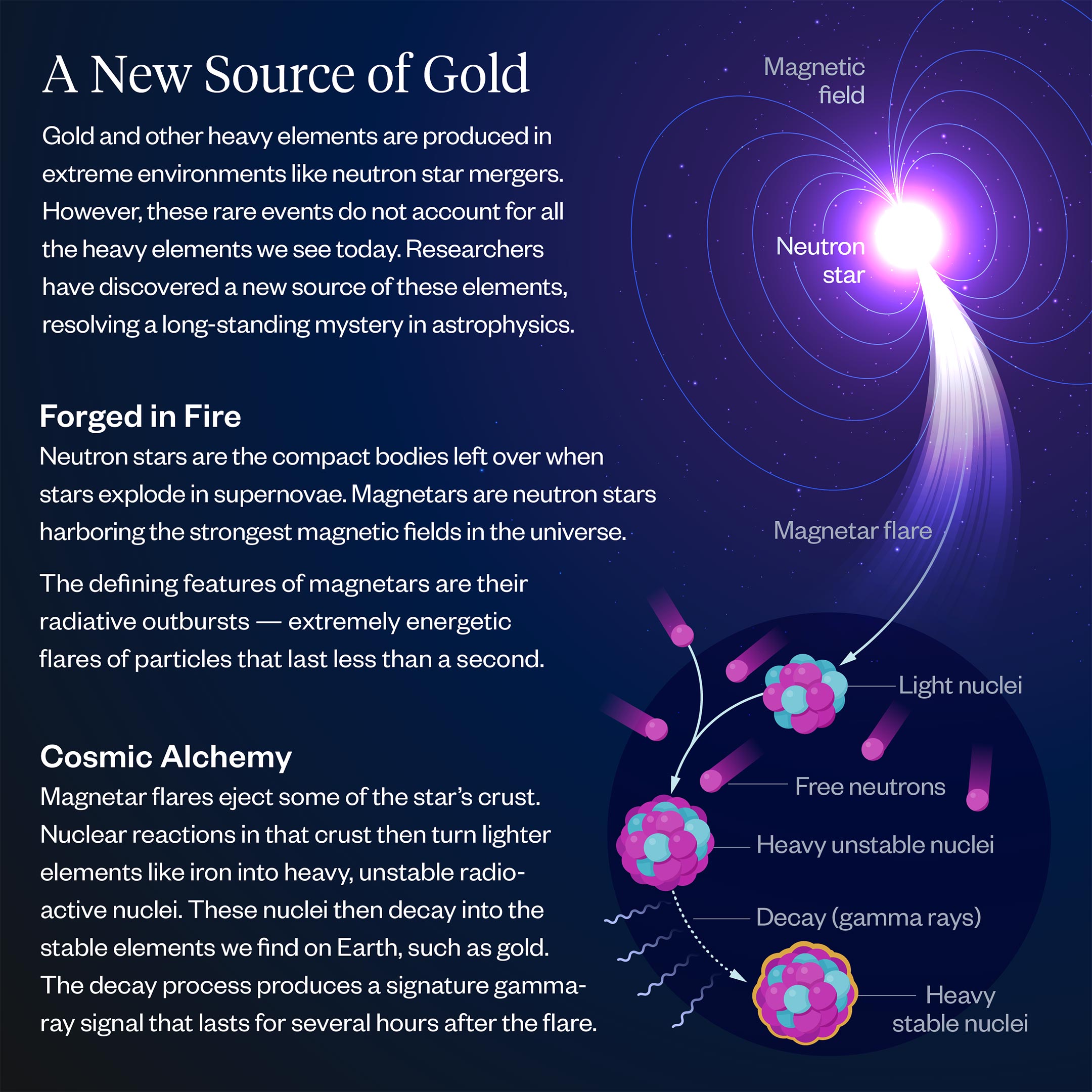
However, astronomers realized that these rare collisions alone can’t account for all the r-process-produced elements we see today. Some suspected that magnetars, which are highly magnetized neutron stars, could also be a source.
How Magnetar Flares Create Precious Metals
Metzger and colleagues calculated in 2024 that giant flares could eject material from a magnetar’s crust into space, where r-process elements could form.
“It’s pretty incredible to think that some of the heavy elements all around us, like the precious metals in our phones and computers, are produced in these crazy extreme environments,” says Anirudh Patel, a doctoral candidate at Columbia University and lead author on the new study.
“It’s pretty incredible to think that some of the heavy elements all around us, like the precious metals in our phones and computers, are produced in these crazy extreme environments.”
Anirudh Patel
The group’s calculations show that these giant flares create unstable, heavy radioactive nuclei, which decay into stable elements such as gold. As the radioactive elements decay, they emit a glow of light, in addition to minting new elements.
A Forgotten Signal, Reinterpreted
The group also calculated in 2024 that the glow from the radioactive decays would be visible as a burst of gamma rays, a form of highly energized light. When they discussed their findings with observational gamma-ray astronomers, the group learned that, in fact, one such signal had been seen decades earlier that had never been explained. Since there’s little overlap between the study of magnetar activity and heavy-element synthesis science, no one had previously proposed element production as a cause of the signal.
“The event had kind of been forgotten over the years,” Metzger says. “But we very quickly realized that our model was a perfect fit for it.”
Massive Element Output from One Flare
In the new paper, the astronomers used the observations of the 2004 event to estimate that the flare produced 2 million billion billion kilograms of heavy elements (roughly equivalent to Mars’ mass). From this, they estimate that one to 10 percent of all r-process elements in our galaxy today were created in these giant flares. The remainder could be from neutron star mergers, but with only one magnetar giant flare and one merger ever documented, it’s hard to know exact percentages — or if that’s even the whole story.
“We can’t exclude that there could be third or fourth sites out there that we just haven’t seen yet,” Metzger says.
Early Galaxies, Missing Pieces
“The interesting thing about these giant flares is that they can occur really early in galactic history,” Patel adds. “Magnetar giant flares could be the solution to a problem we’ve had where there are more heavy elements seen in young galaxies than could be created from neutron star collisions alone.”
To narrow down the percentages, more magnetar giant flares need to be observed. Telescopes like NASA’s Compton Spectrometer and Imager mission, set to launch in 2027, will help better capture these signals. Large magnetar flares seem to occur every few decades in the Milky Way and about once a year across the visible universe — but the trick is to catch it in time.
“Once a gamma-ray burst is detected, you have to point an ultraviolet telescope at the source within 10 to 15 minutes to see the signal’s peak and confirm r-process elements are made there,” Metzger says. “It’ll be a fun chase.”
Explore Further: The Magnetar That Forged a Planet’s Worth of Gold in Half a Second
Reference: “Direct Evidence for r-process Nucleosynthesis in Delayed MeV Emission from the SGR 1806–20 Magnetar Giant Flare” by Anirudh Patel, Brian D. Metzger, Jakub Cehula, Eric Burns, Jared A. Goldberg and Todd A. Thompson, 29 April 2025, The Astrophysical Journal Letters.
DOI: 10.3847/2041-8213/adc9b0
Never miss a breakthrough: Join the SciTechDaily newsletter.
Follow us on Google and Google News.
1 Comment
That magnetic reconnection can be part of nature’s gold forges is a bit poetic, IMHO.
The estimates for heavy element production comes up as minor source (1-10 %) but for cosmic rays they claim it can be a “major if not dominant contributors to the r-process cosmic ray flux at Earth.”
“The merger of neutron stars momentarily creates an environment of such extreme neutron flux that the r-process can occur. This reaction accounts for the nucleosynthesis of around half of the isotopes in elements heavier than iron.[4]” – Wikipedia
So there should be more sources. But as the scientist quotes seem to hint at, now we know some of the processes we should look for.