
Close Menu
    Facebook X (Twitter) Instagram
    SciTechDaily
    • Biology
    • Chemistry
    • Earth
    • Health
    • Physics
    • Science
    • Space
    • Technology
    Facebook X (Twitter) Pinterest YouTube RSS
    SciTechDaily
    Home»Space»This Week @NASA: Total Lunar Eclipse, Hunting Marsquakes, Boeing Starliner, and Supersonic X-Plane Mission
    Space

    This Week @NASA: Total Lunar Eclipse, Hunting Marsquakes, Boeing Starliner, and Supersonic X-Plane Mission

    By NASAMay 22, 20222 Comments4 Mins Read
    Facebook Twitter Pinterest Telegram LinkedIn WhatsApp Email Reddit
    Share
    Facebook Twitter LinkedIn Pinterest Telegram Email Reddit
    Lunar Eclipse Marsquakes Boeing Starliner
    This Week at NASA!

    The next commercial crew test mission to the space station …

    Outlining the agency’s objectives for deep space exploration ….

    And covering the total lunar eclipse on Earth and from space … a few of the stories to tell you about – This Week at NASA!

    Uncrewed Commercial Test Mission Launches to the Space Station

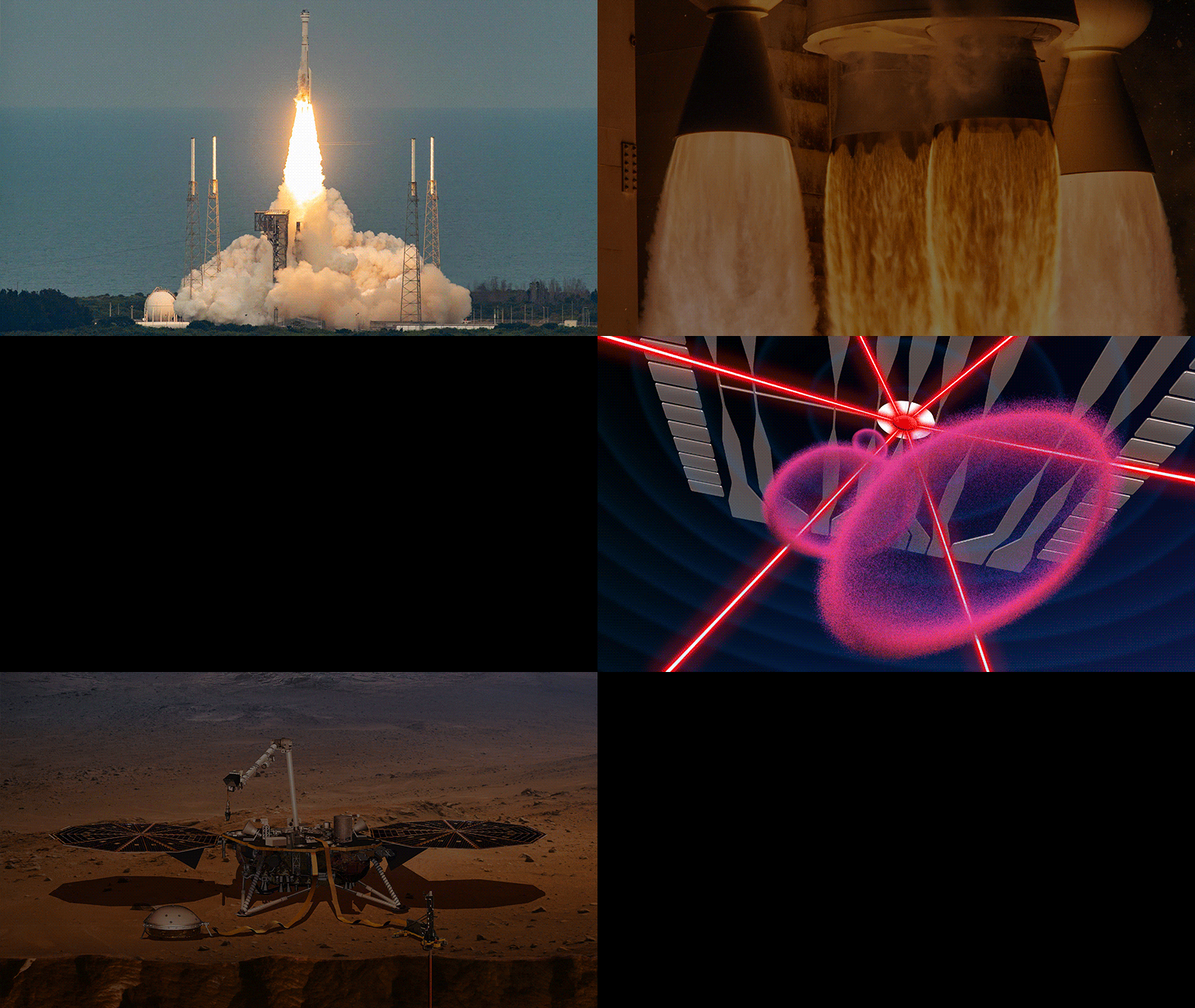
    On May 19, Boeing’s CST-100 Starliner spacecraft launched from Cape Canaveral Space Force Station in Florida on Orbital Flight Test-2 or OFT-2. The mission is the Starliner’s second uncrewed flight to the station for our Commercial Crew Program.

    NASA Outlines Moon to Mars Objectives

    On May 17, NASA released a draft set of high-level objectives identifying 50 points that fall under four overarching categories of exploration for future Artemis missions to return astronauts to the Moon in preparation for human exploration of Mars. The agency is asking U.S. industry, academia, international communities, and other stakeholders to provide input on these deep space exploration objectives. Learn more at nasa.gov/moontomars.

    Total Lunar Eclipse May 2022
    A telescopic visualization of the total lunar eclipse, happening May 15-16, 2022. Credit: NASA/Goddard/Ernie Wright

    NASA Covers Total Lunar Eclipse

    The latest episode of our NASA Science Live was all about the total lunar eclipse on the evening of May 15, overnight into May 16. It featured NASA experts and live views of the eclipse from around the world. Meanwhile, our Lucy spacecraft captured the imagery of the eclipse seen in this time-lapse when the traveling spacecraft was about 64 million miles from Earth. It shows Earth on the left and the Moon on the right, which can be seen disappearing into darkness as it passes through Earth’s shadow. The Lucy spacecraft is on its way to study Jupiter’s Trojan asteroids.

    NASA Mars InSight
    This illustration shows NASA’s Mars InSight lander on the Martian surface. Credit: NASA

    InSight Still Hunting Marsquakes as Power Levels Diminish

    Dust on the solar panels of our InSight Mars lander is causing the spacecraft to gradually lose power. As a result, the InSight team anticipates that the lander will become inoperative by the end of this year. InSight, which arrived at Mars in November 2018, has so far detected more than 1,300 marsquakes and collected information to help improve our understanding of the interiors of rocky planets, including Earth.

    Ultracold Bubbles on Space Station
    Inside NASA’s Cold Atom Lab, scientists form bubbles from ultracold gas, shown in pink in this illustration. Lasers, also depicted, are used to cool the atoms, while an atom chip, illustrated in gray, generates magnetic fields to manipulate their shape, in combination with radio waves. Credit: NASA/JPL-Caltech

    Ultracold Bubbles on Space Station Open New Paths for Quantum Research

    NASA’s Cold Atom Lab, the first-ever quantum physics facility aboard the International Space Station, has been used to shape atoms of gas cooled to nearly absolute zero – or about minus 459 degrees Fahrenheit – into extremely thin, hollow spheres. This is similar to how liquids behave in microgravity and can’t be duplicated on Earth. The accomplishment could lead to new kinds of experiments with a state of matter distinctly different from gases, liquids, solids, and plasmas, called a Bose-Einstein condensate or BEC. In a BEC, scientists can observe the quantum properties of atoms at a scale visible to the naked eye.

    X-59 QueSST
    Lockheed Martin X-59 QueSST. Credit: Lockheed Martin

    New Name for NASA’s Supersonic X-Plane Mission

    Our research mission to enable supersonic air travel over land has been renamed Quesst. The name, which includes an extra “s” to represent “supersonic,” replaces the mission’s original name: The Low-Boom Flight Demonstration. Through Quesst, NASA plans to demonstrate that the X-59 research aircraft can fly faster than sound without generating the loud sonic booms supersonic aircraft typically produce.

    That’s what’s up this week @NASA …

    Never miss a breakthrough: Join the SciTechDaily newsletter.
    Follow us on Google and Google News.

    NASA Popular
    Share. Facebook Twitter Pinterest LinkedIn Email Reddit

    Related Articles

    Solving the Baffling Mysteries of Invisible Frost and Dust Avalanches on Mars

    “Blood Moon” – What You Need To Know About the Lunar Eclipse

    Watch the Official Trailer: NASA’s Psyche Mission to a Metal World

    This Week @NASA: Webb Telescope Mission, Historic Black Hole Image, Monster Quake on Mars

    Don’t Miss: Total “Blood Moon” Lunar Eclipse

    NASA’s InSight Records Monster Quake on Mars – The Largest Ever Detected on Another Planet

    Incredibly Sharp Webb Space Telescope Test Images Hint at New Possibilities for Science

    NASA’s Ingenuity Mars Helicopter in Contact With Perseverance Rover After Communications Dropout

    NASA’s Ingenuity Mars Helicopter Scouts Ridgeline for Perseverance Science Team

    2 Comments

    1. Jos on May 22, 2022 1:27 pm

      When is the next exploration launch?

      Reply
    2. Bill on May 22, 2022 2:06 pm

      Is there no way to get rid of the “dust” on the Mars explorer? If not, is this an oversight? What steps are being taken to handle those kinds of things in the future? At the enormous cost of building and sending one of these things to Mars, wouldn’t mission longevity would be a priority?

      Reply
    Leave A Reply Cancel Reply

    • Facebook
    • Twitter
    • Pinterest
    • YouTube

    Don't Miss a Discovery

    Subscribe for the Latest in Science & Tech!

    Trending News

    Popular Sugar-Free Sweetener Linked to Liver Disease, Study Warns

    What Is Hantavirus? The Deadly Disease Raising Alarm Worldwide

    Scientists Just Discovered How the Universe Builds Monster Black Holes

    Scientists Unveil New Treatment Strategy That Could Outsmart Cancer

    A Simple Vitamin May Hold the Key to Treating Rare Genetic Diseases

    Scientists Think the Real Fountain of Youth May Be Hiding in Your Gut

    Ravens Don’t Follow Wolves, They Predict Them

    This Common Knee Surgery May Be Doing More Harm Than Good

    Follow SciTechDaily
    • Facebook
    • Twitter
    • YouTube
    • Pinterest
    • Newsletter
    • RSS
    SciTech News
    • Biology News
    • Chemistry News
    • Earth News
    • Health News
    • Physics News
    • Science News
    • Space News
    • Technology News
    Recent Posts
    • Popular Supplement Ingredient Linked to Shorter Lifespan in Men
    • Scientists May Have Found a Way To Repair Nerve Damage in Multiple Sclerosis
    • GLP-1 Weight Loss Linked To Dramatically Lower Risk of Sleep Apnea, Kidney Disease and More
    • Scientists Uncover the Surprising Source of Strange Clouds Near the Milky Way’s Supermassive Black Hole
    • This Dazzling Green Snake Was Hiding in Plain Sight for Decades
    Copyright © 1998 - 2026 SciTechDaily. All Rights Reserved.
    • Science News
    • About
    • Contact
    • Editorial Board
    • Privacy Policy
    • Terms of Use

    Type above and press Enter to search. Press Esc to cancel.