
Close Menu
    Facebook X (Twitter) Instagram
    SciTechDaily
    • Biology
    • Chemistry
    • Earth
    • Health
    • Physics
    • Science
    • Space
    • Technology
    Facebook X (Twitter) Pinterest YouTube RSS
    SciTechDaily
    Home»Space»Twin X-Class Flares: NASA Captures Epic Solar Showdown
    Space

    Twin X-Class Flares: NASA Captures Epic Solar Showdown

    By SciTechDaily.comMay 16, 2024No Comments3 Mins Read
    Facebook Twitter Pinterest Telegram LinkedIn WhatsApp Email Reddit
    Share
    Facebook Twitter LinkedIn Pinterest Telegram Email Reddit
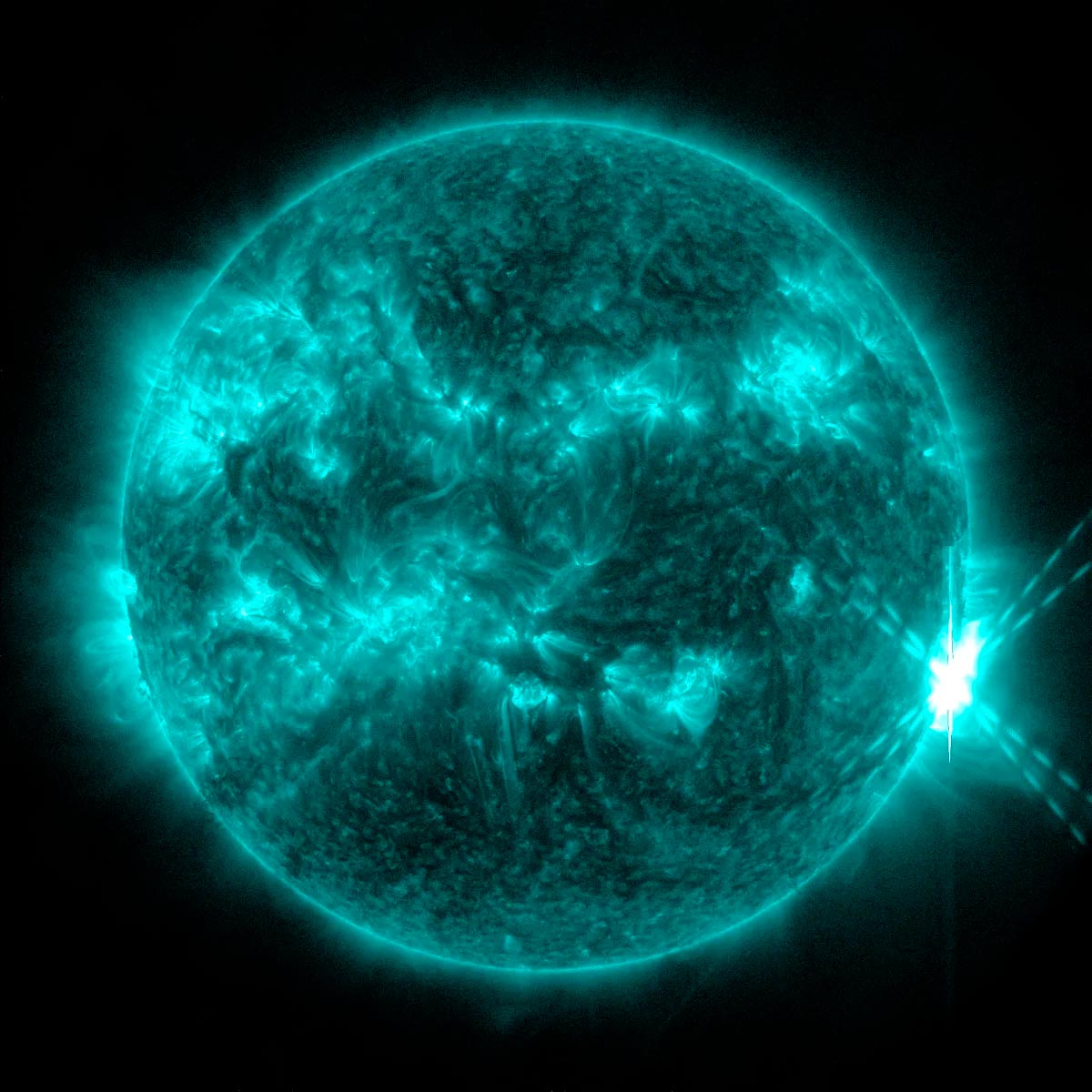
    X3.4 Solar Flare May 2024
    NASA’s Solar Dynamics Observatory captured this image of a solar flare – as seen in the bright flash on the right – on May 15, 2024. The image shows a subset of extreme ultraviolet light that highlights the extremely hot material in flares and which is colorized in teal. Credit: NASA/SDO

    On May 15, 2024, NASA’s Solar Dynamics Observatory, which continually monitors the Sun, captured images of two powerful X-class solar flares. The first was classified as an X3.4 class flare and peaked at 4:37 a.m. ET. The second flare, classified as X2.9, peaked at 10:38 a.m. ET.

    Solar flares are intense bursts of radiation emanating from the release of magnetic energy associated with sunspots. These flares are visible across the electromagnetic spectrum, from radio waves to gamma rays, and are among the solar system’s most powerful phenomena. When directed towards Earth, solar flares can influence our planet in several ways, including disrupting satellite communications, affecting power grid operations, and enhancing auroral displays (Northern and Southern Lights).

    The impact on Earth primarily involves the interaction of solar radiation with Earth’s magnetic field, which can lead to geomagnetic storms. These storms can disrupt technology and infrastructure and expose astronauts and high-altitude flights to higher levels of radiation.
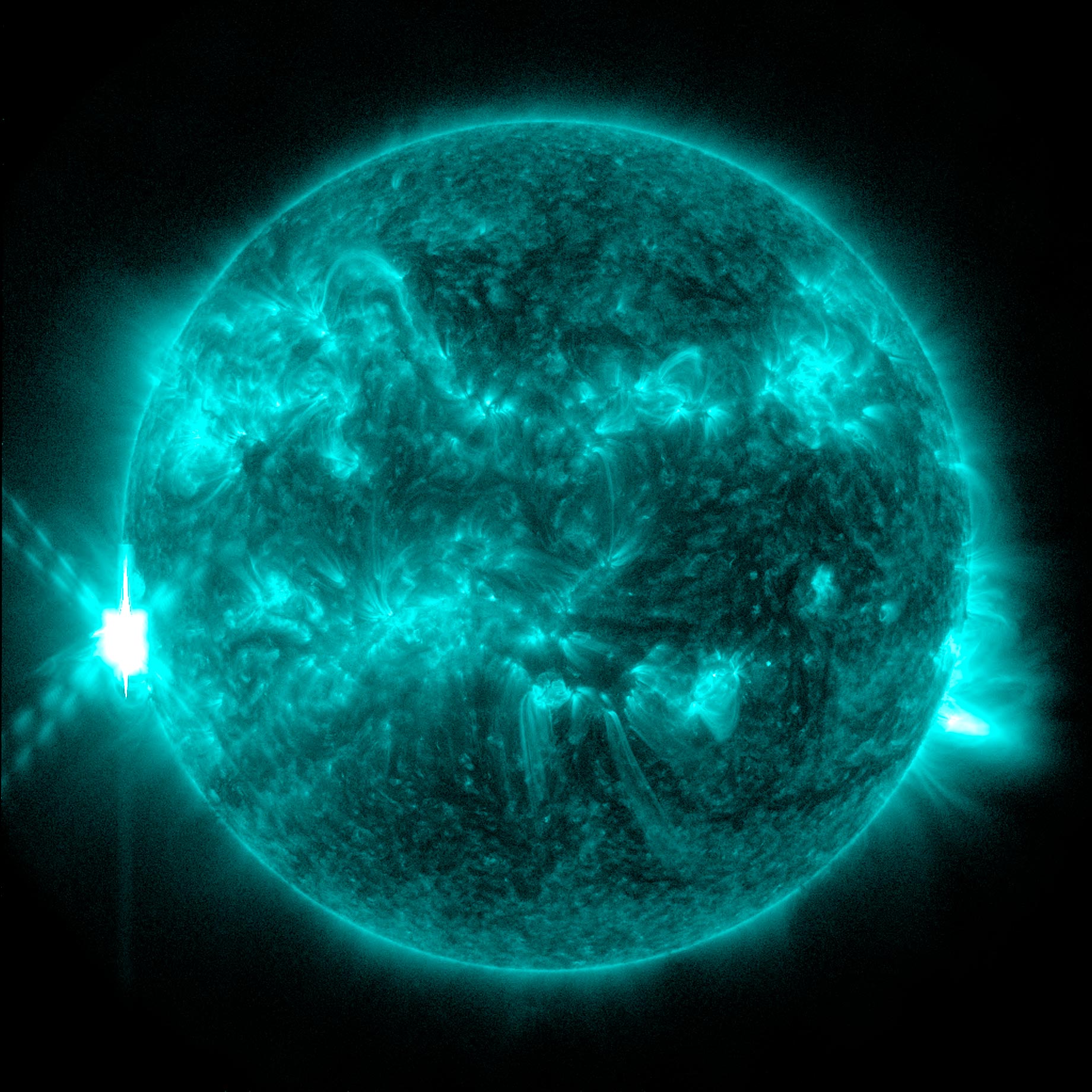
    X2.9 Solar Flare May 2024
    NASA’s Solar Dynamics Observatory captured this image of a solar flare – as seen in the bright flash on the left – on May 15, 2024. The image shows a subset of extreme ultraviolet light that highlights the extremely hot material in flares and which is colorized in teal. Credit: NASA/SDO

    Solar flares are categorized by their intensity in the X-ray wavelengths, ranging from class A (the weakest) to class X (the strongest). Each class has a tenfold increase in energy output, and within each class, a finer scale from 1 to 9 further distinguishes the flare’s strength. X-class flares are the largest explosions in the solar system and can trigger planet-wide radio blackouts and long-lasting radiation storms.

    NASA’s Solar Dynamics Observatory (SDO) is a mission dedicated to understanding the Sun’s influence on Earth and Near-Earth space by studying the solar atmosphere on small scales of space and time and in many wavelengths simultaneously. Launched on February 11, 2010, SDO is part of NASA’s Living With a Star (LWS) program.
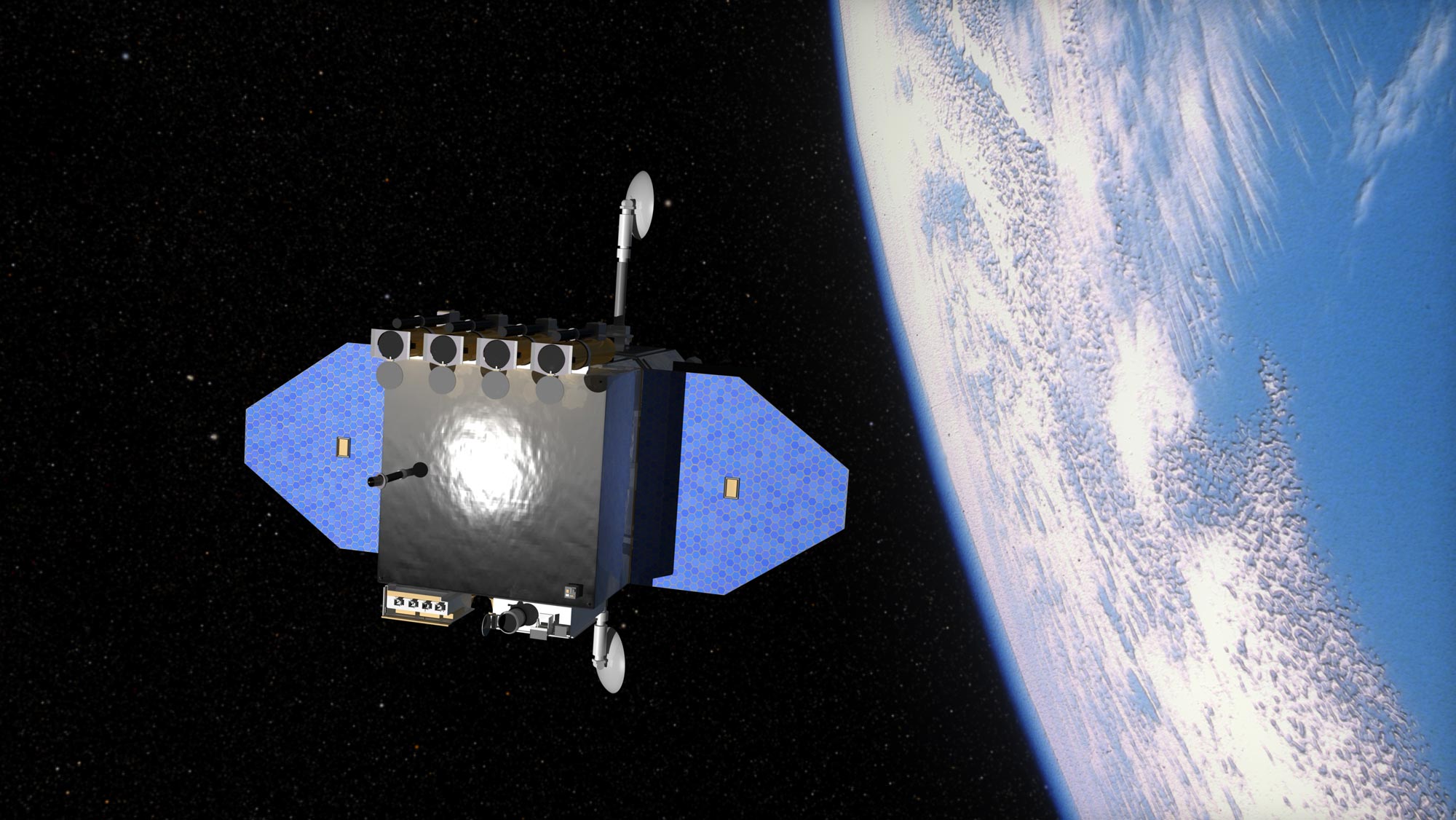
    NASA Solar Dynamics Observatory Orbiting Earth
    Artist’s concept image of the SDO satellite orbiting Earth. Credit: NASA

    The observatory is equipped with a suite of instruments that provide observations leading to a more complete understanding of the solar dynamics driving variability in the Earth’s environment. One of these instruments is the Atmospheric Imaging Assembly (AIA), which produces images of the solar disk in multiple wavelengths every 12 seconds, providing insights into the solar corona’s structure and dynamics. Another crucial instrument, the Helioseismic and Magnetic Imager (HMI), studies solar variability and characterizes the Sun’s interior and the various components of magnetic activity.

    SDO’s data are vital in helping scientists understand the Sun’s influence on Earth and the space environment by observing solar flares, coronal mass ejections (CMEs), and other solar phenomena. This information is crucial for improving the ability to forecast space weather events that can affect satellite operations, astronauts, and Earth-based systems.

    Never miss a breakthrough: Join the SciTechDaily newsletter.
    Follow us on Google and Google News.

    Astronomy NASA Solar Dynamics Observatory Solar Flares Sun
    Share. Facebook Twitter Pinterest LinkedIn Email Reddit

    Related Articles

    Solar Fury Erupts: Sun Rings In the New Year With X1.8 Flare

    X1.8 Flare Unleashed: NASA Captures Powerful Solar Eruption

    Sun Unleashes Monumental X9.0 Solar Flare – Most Intense in 7 Years – Captured by NASA Observatory

    Monster X7.1 Solar Flare Unleashed: Intense Blast Captured by NASA’s Solar Dynamics Observatory

    Sun Ignites: Unleashing a Powerful X4.5 Solar Flare

    NASA’s Solar Dynamics Observatory Spots Burst of Light and Energy on the Sun: A B-Class Flare

    NASA’s Solar Dynamics Observatory Views M-Class Solar Flare

    NASA’s SDO Reveals Images of X4.9-Class Solar Flare

    NASA’s Solar Dynamics Observatory Views Two New Solar Flares

    Leave A Reply Cancel Reply

    • Facebook
    • Twitter
    • Pinterest
    • YouTube

    Don't Miss a Discovery

    Subscribe for the Latest in Science & Tech!

    Trending News

    Scientists Uncover Potential Brain Risks of Popular Fish Oil Supplements

    Scientists Discover a Surprising Way To Make Bread Healthier and More Nutritious

    After 60 Years, Scientists Uncover Unexpected Brain Effects of Popular Diabetes Drug Metformin

    New Research Uncovers Hidden Side Effects of Popular Weight-Loss Drugs

    Scientists Rethink Extreme Warming After Surprising Ocean Discovery

    Landmark Study Links Never Marrying to Significantly Higher Cancer Risk

    Researchers Discover Unknown Beetle Species Just Steps From Their Lab

    Largest-Ever Study Finds Medicinal Cannabis Ineffective for Anxiety, Depression, PTSD

    Follow SciTechDaily
    • Facebook
    • Twitter
    • YouTube
    • Pinterest
    • Newsletter
    • RSS
    SciTech News
    • Biology News
    • Chemistry News
    • Earth News
    • Health News
    • Physics News
    • Science News
    • Space News
    • Technology News
    Recent Posts
    • Not Just Alzheimer’s: Scientists Uncover Clues to a Second, Overlooked Disorder
    • Scientists Uncover Dangerous Connection Between Serotonin and Heart Valve Disease
    • Scientists Discover a “Protector” Protein That Could Help Reverse Hair Loss
    • Powerful Lasers Reveal How Matter Becomes Plasma in Trillionths of a Second
    • A Simpler Path to Super-Resolution: Scientists Reinvent Microscopy
    Copyright © 1998 - 2026 SciTechDaily. All Rights Reserved.
    • Science News
    • About
    • Contact
    • Editorial Board
    • Privacy Policy
    • Terms of Use

    Type above and press Enter to search. Press Esc to cancel.