
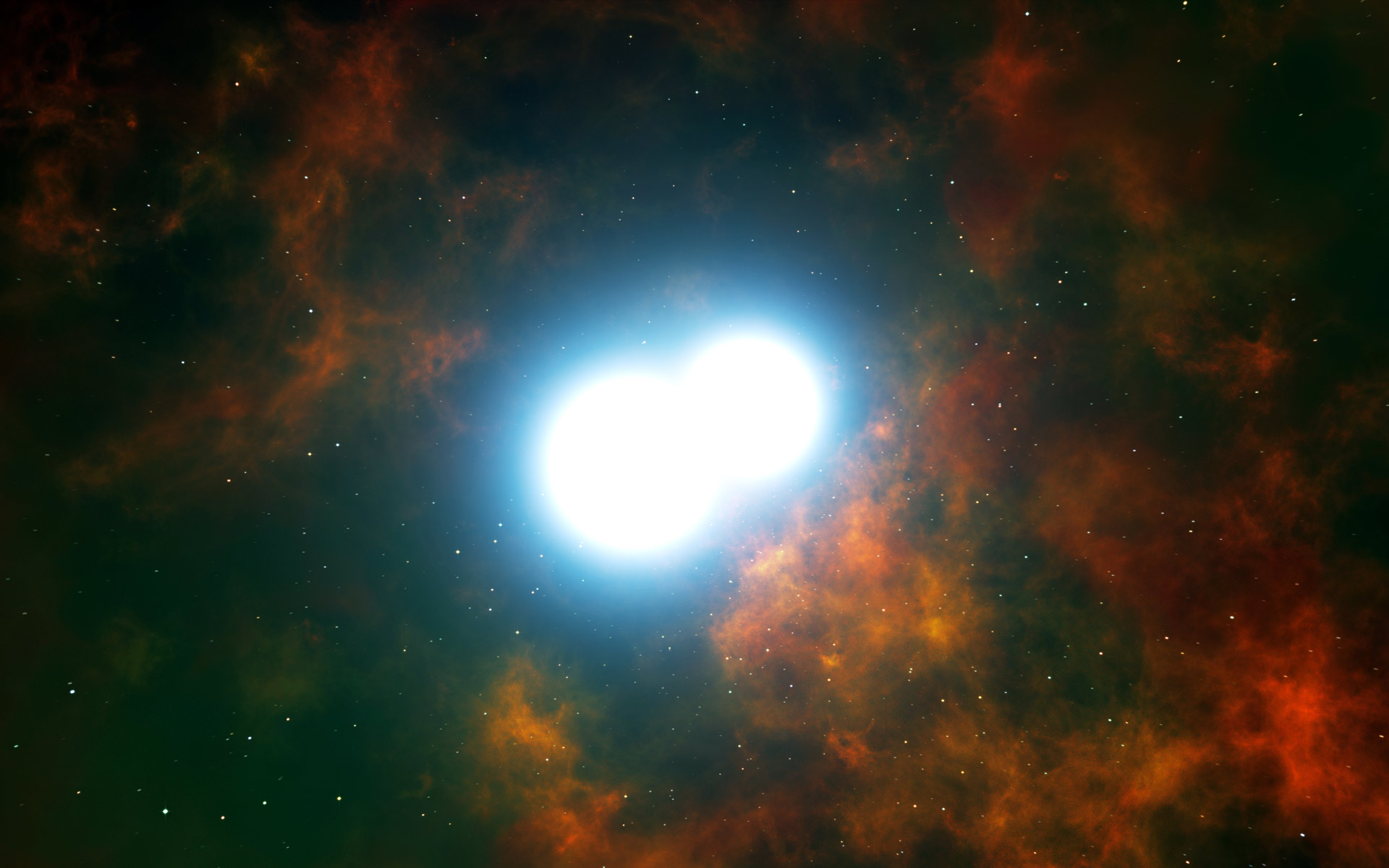
A newly published study reveals that two massive stars at the heart of the planetary nebula Henize 2-428 should merge in 700 million years, triggering a type Ia supernova event.
Astronomers using ESO facilities in combination with telescopes in the Canary Islands have identified two surprisingly massive stars at the heart of the planetary nebula Henize 2-428. As they orbit each other the two stars are expected to slowly get closer and closer, and when they merge, about 700 million years from now, they will contain enough material to ignite a vast supernova explosion. The results appear online in the journal Nature.
The team of astronomers, led by Miguel Santander-García (Observatorio Astronómico Nacional, Alcalá de Henares, Spain; Instituto de Ciencia de Materiales de Madrid (CSIC), Madrid, Spain), has discovered a close pair of white dwarf stars — tiny, extremely dense stellar remnants — that have a total mass of about 1.8 times that of the Sun. This is the most massive such pair yet found[1] and when these two stars merge in the future they will create a runaway thermonuclear explosion leading to a Type Ia supernova.[2]
The team who found this massive pair actually set out to try to solve a different problem. They wanted to find out how some stars produce such strangely shaped and asymmetric nebulae late in their lives. One of the objects they studied was the unusual planetary nebula[3] known as Henize 2-428.
“When we looked at this object’s central star with ESO’s Very Large Telescope, we found not just one but a pair of stars at the heart of this strangely lopsided glowing cloud,” says coauthor Henri Boffin from ESO.
This supports the theory that double central stars may explain the odd shapes of some of these nebulae, but an even more interesting result was to come.
This artist’s impression video shows the central part of the planetary nebula Henize 2-428. The core of this unique object consists of two white dwarf stars, each with a mass a little less than that of the Sun. They are expected to slowly draw closer to each other and merge in around 700 million years. This event will create a dazzling supernova of Type Ia and destroy both stars. Credit: ESO/L. Calçada
“Further observations made with telescopes in the Canary Islands allowed us to determine the orbit of the two stars and deduce both the masses of the two stars and their separation. This was when the biggest surprise was revealed,” reports Romano Corradi, another of the study’s authors and researcher at the Instituto de Astrofísica de Canarias (Tenerife, IAC).
They found that each of the stars has a mass slightly less than that of the Sun and that they orbit each other every four hours. They are sufficiently close to one another that, according to Einstein’s theory of general relativity, they will grow closer and closer, spiraling in due to the emission of gravitational waves, before eventually merging into a single star within the next 700 million years.
The resulting star will be so massive that nothing can then prevent it from collapsing in on itself and subsequently exploding as a supernova. “Until now, the formation of supernovae Type Ia by the merging of two white dwarfs was purely theoretical,” explains David Jones, coauthor of the article and ESO Fellow at the time the data were obtained. “The pair of stars in Henize 2-428 is the real thing!”
“It’s an extremely enigmatic system,” concludes Santander-García. “It will have important repercussions for the study of supernovae Type Ia, which are widely used to measure astronomical distances and were key to the discovery that the expansion of the Universe is accelerating due to dark energy.”
Notes
- The Chandrasekhar limit is the greatest mass that a white dwarf star can have and support itself against gravitational collapse. It has a value of about 1.4 times the mass of the Sun.
- Type Ia supernovae occur when a white dwarf star acquires extra mass — either by accretion from a stellar companion or by merging with another white dwarf. Once the mass exceeds the Chandrasekhar limit the star loses its ability to support itself and starts to contract. This increases the temperature and a runaway nuclear reaction occurs and blows the star to pieces.
- Planetary nebulae have nothing to do with planets. The name arose in the eighteenth century as some of these objects resembled the discs of distant planets when seen through small telescopes.
Reference: “The double-degenerate, super-Chandrasekhar nucleus of the planetary nebula Henize 2-428” by M. Santander-García, P. Rodríguez-Gil, R. L. M. Corradi, D. Jones, B. Miszalski, H. M. J. Boffin, M. M. Rubio-Díez and M. M. Kotze, 9 February 2015, Nature.
DOI: 10.1038/nature14124
Never miss a breakthrough: Join the SciTechDaily newsletter.
Follow us on Google and Google News.