
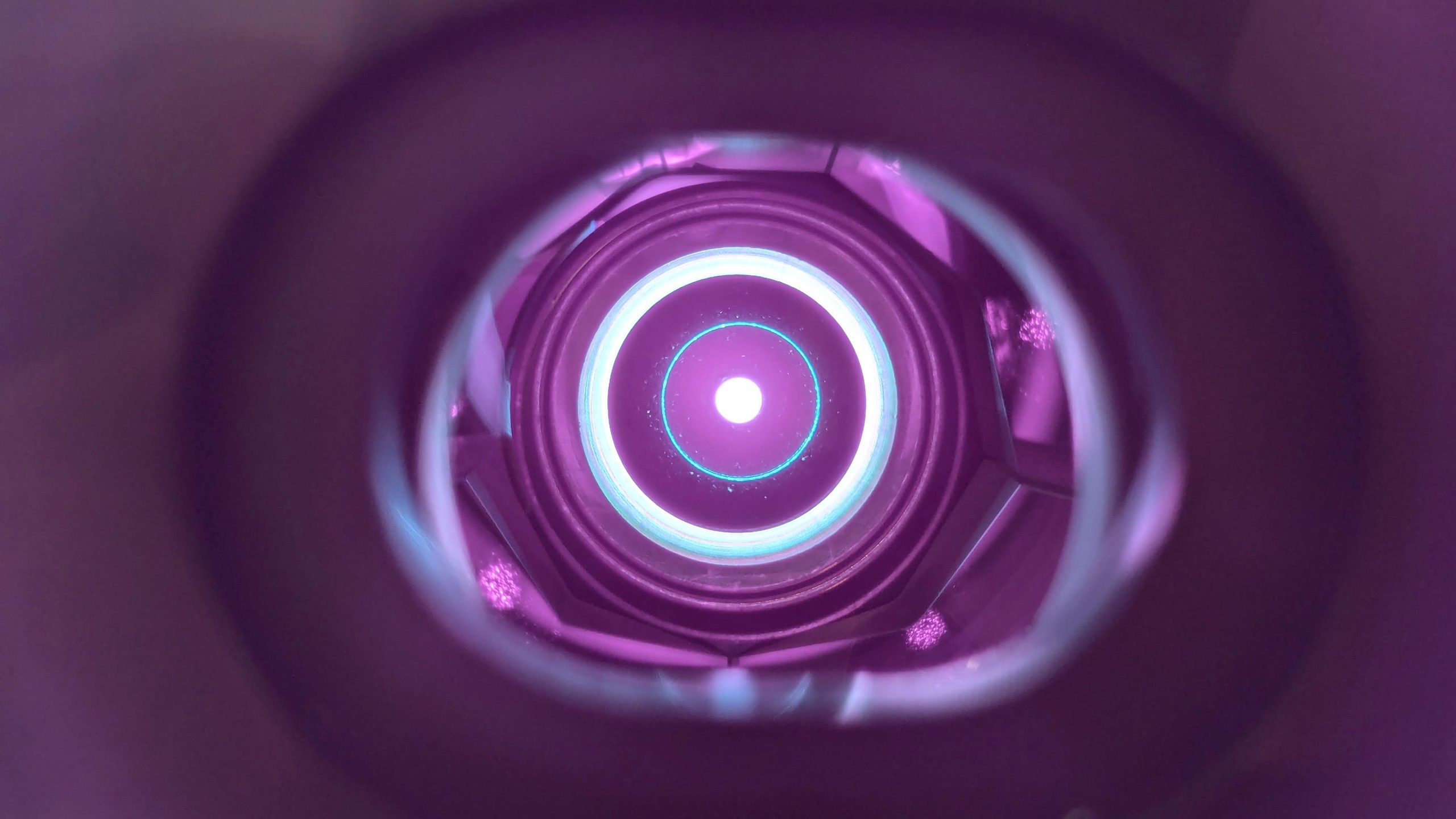
Researchers at ETH Zurich have developed a laser that produces the strongest ultra-short laser pulses to date. In the future, such high-power pulses could be used for precision measurements or materials processing.
- Researchers have developed a laser that can produce extremely short pulses with peak powers up to 100 megawatts and 550 watts of average power.
- This was made possible by an optimized arrangement of the mirrors in the laser and improvements of a special mirror, which causes the laser to emit pulses.
- In the future, these record-breaking laser pulses could, for example, be used for precision measurements.
Advanced Laser Technologies
When people think of lasers, they often imagine a powerful, continuous beam of light. These types of lasers are indeed common and serve many practical purposes. Yet, in both science and industry, there’s also a crucial need for laser light that comes in very short, intense bursts. These laser pulses can be used to shape materials or to generate high harmonic frequencies that extend into the X-ray range, helping to reveal processes that occur on the attosecond scale—a billionth of a billionth of a second.
Record-Breaking Laser Pulses
Recently, a research team led by Ursula Keller, a professor at the Institute for Quantum Electronics at ETH Zurich, achieved a major breakthrough in this area. They created the most powerful laser pulses ever produced by a laser oscillator, with an average power output of 550 watts—over 50% higher than the previous record. These pulses are not only incredibly powerful but also remarkably brief, lasting less than a picosecond (a millionth of a millionth of a second). They are emitted in a rapid, regular pattern of five million pulses per second, with each pulse reaching peak powers of up to 100 megawatts—enough, in theory, to power 100,000 vacuum cleaners briefly. The team’s findings were published in the scientific journal Optica.
“This record is the result of a long an exciting journey with lots of interesting laser physics.”
Ursula Keller
Enhancements in Laser Design
For the past 25 years, Keller’s research group has been working on the continuous improvement of so-called short pulsed disk lasers, in which the laser material consists of a thin disk, only 100 micrometers thick, of a crystal containing ytterbium atoms.
Over and over again, Keller and her coworkers encountered new problems that initially impeded a further increase in power. Quite often, spectacular incidents happened in which different parts inside the laser were destroyed. Solving the problems led to new insights that made short pulsed lasers, which are also popular in industrial applications, more reliable.
Innovations in Laser Pulse Generation
“The combination of even higher power and pulse rates of 5.5 megahertz, which we have now achieved, is based on two innovations,” explains Moritz Seidel, a PhD student in Keller’s laboratory. For one thing, he and his colleagues used a special arrangement of mirrors that send the light inside the laser through the disk several times before it leaves the laser through an outcoupling mirror. “This arrangement allows us to amplify the light extremely without the laser becoming unstable,” says Seidel.
The second innovation regards the centerpiece of the pulsed laser: a special mirror made of semiconductor material, which was invented by Keller already thirty years ago and goes by the memorable abbreviation SESAM (Semiconductor Saturable Absorber Mirror). Unlike normal mirrors, the reflectivity of a SESAM depends on the strength of the light hitting it.

Pulses Thanks to SESAM
Using the SESAM, the researchers coax their laser into sending out short pulses rather than a continuous beam. Pulses have a higher intensity because the light energy is concentrated in a shorter period of time. For a laser to send out laser light at all, the light intensity inside it has to exceed a certain threshold value. This is where the SESAM comes into play: it reflects the light, which has already passed through the amplifying disk several times, particularly efficiently if the light intensity is high. As a result, the laser automatically goes into pulsed mode.
“Pulses with powers comparable to the ones we have now achieved could, up to now, only be achieved by sending weaker laser pulses through several separate amplifiers outside the laser,” says Seidel. The disadvantage of this is that the amplification also leads to more noise, corresponding to fluctuations in the power, which causes problems particularly in precision measurements. To create the high power directly using the laser oscillator, the researchers had to solve a number of tricky technical problems – for instance, how to attach to the semiconductor layer of the SESAM mirror a thin sapphire window, which strongly improves the properties of the mirror. “When it finally worked and we watched how the laser created pulses – that was really cool,” says Seidel.

Alternative Applications and Future Prospects
Ursula Keller is also thrilled by these results and emphasizes: “The support by ETH Zurich over the years and the reliable funding of my research by the Swiss National Fund have helped me and my collaborators reach this great outcome. We now also expect to be able to shorten these pulses very efficiently to the regime of a few cycles, which is very important for creating attosecond pulses.”
According to Keller, the fast and strong pulses made possible by the new laser could also see applications in new so-called frequency combs in the ultraviolet to X-ray regime, which could lead to even more precise clocks. “A dream would be to show, one day, that the natural constants aren’t constant after all,” says Keller. Also, terahertz radiation, which has a much longer wavelength than visible or infrared light, can be created with the laser and then used, for example, to test materials. “All in all, one can say that with our pulses lasers, we have shown that laser oscillators are a good alternative to amplifier-based laser systems and that they enable new and better measurement,” Keller summarizes.
Reference: “Ultrafast 550-W average-power thin-disk laser oscillator” by Lukas Lang, Moritz Seidel, Christopher R. Phillips and Ursula Keller, 19 October 2024, Optica.
DOI: 10.1364/OPTICA.529185
Never miss a breakthrough: Join the SciTechDaily newsletter.
Follow us on Google and Google News.
4 Comments
A dream would be to show, one day, that the natural constants aren’t constant after all.
VERY GOOD!!!
All things follow certain laws, which can be revealed through observation and research (such as topological structures). When physics is passionate about studying imaginary particles and things, it is no longer much different from theology.
Scientific research guided by correct theories can help people avoid detours, failures, and exaggeration. The physical phenomena observed by researchers in experiments are always appearances, never the natural essence of things. The natural essence of things needs to be extracted and sublimated based on mathematical theories via appearances , rather than being imagined arbitrarily.
Everytime scientific revolution, the scientific research space brought by the new paradigm expands exponentially. Physics should not ignore the analyzable physical properties of topological vortices.
(1) Traditional physics: based on mathematical formalism, experimental verification and arbitrary imagination.
(2) Topological Vortex Theory (TVT): Although also based on mathematics (such as topology), it focuses more on non intuitive geometry and topological structures, challenging traditional physical intuition.
Topological Vortex Theory (TVT) points out the limitations of the Standard Model in describing the large-scale structure of the universe, proposes the need to consider non-standard model components such as dark matter and dark energy, and suggests that topological vortex fields may be key to understanding these phenomena. Topological vortex theory (TVT) heralds innovative technologies such as topological electronics, topological smart batteries, topological quantum computing, etc., which may bring low-energy electronic components, almost inexhaustible currents, and revolutionary computing platforms, etc.
Topology tells us that topological vortices and antivortices can form new spacetime structures via the synchronous effect of superposition, deflection, or twisting of them. Mathematics does not tell us that there must be God particles, ghost particles, fermions, or bosons present. When physics and mathematics diverge, arbitrary imagination will make physics no different from theology. Topological vortex research reflections on the philosophy and methodology of science help us understand the nature essence of science and the limitations of scientific methods. This not only has guiding significance for scientific research itself, but also has important implications for science education and popularization.
Today, so-called official (such as PRL, Nature, Science, PNAS, etc.) in physics stubbornly believes that two sets of cobalt-60 rotating in opposite directions can become two sets of objects that mirror each other, is a typical case that pseudoscience is rampant and domineering.
Please witness the exemplary collaboration between theoretical physicists and experimentalists (https://scitechdaily.com/microscope-spacecrafts-most-precise-test-of-key-component-of-the-theory-of-general-relativity/#comment-854286). Let us continue to witness with facts the dirtiest and ugliest era in the history of human social sciences and humanities. The laws of nature will not change due to misleading of certain so-called academic publications or endorsements from certain so-called scientific awards.
As some comments have stated ( https://scitechdaily.com/super-photons-unveiled-sculpting-light-into-unbreakable-communication-networks/#comment-861546 ): Fortunately, we have enough pieces to put the puzzle together properly, and there are folks who have chosen to forego today’s societal structures in order to do exactly that.
Additionally, some comments have stated ( https://scitechdaily.com/science-made-simple-what-is-nuclear-fission/#comment-862083 ): You have been spewing this type of nonsensical word salad for several years now. Outrage doesn’t equal competence. If anything, your inability to convince anyone is a sign of your incompetence. Ask the commenter:Today, so-called official (such as PRL, Nature, Science, PNAS, etc.) in physics stubbornly believes that two sets of cobalt-60 rotating in opposite directions can become two sets of objects that mirror each otherand even win awards. These so-called academic publications blatantly talk nonsense, which is a public humiliation of the normal intellectual level of the public. Do you think this is human misfortune or personal misfortune?
In the Interaction and Balance of topological vortices, each topological vortex is a variable, and a natural constant.
Does physics still know the word shame today? Do modern physics still know what shame is?
Academic circle is not Entertainment industry. Have some people really never know what shame is?
Do some people standing on the podium really not know what is dirty and ugly? Deifying a certain award not only does not benefit scientific progress, but may also hinder scientific development.