

Recent studies challenge the long-held belief that the Milky Way is a standard model for understanding galaxy formation, revealing unique differences in its structure and evolution compared to its galactic peers.
The SAGA Survey has begun to uncover these discrepancies by studying over 100 Milky Way-like galaxies, shedding light on the complex role of dark matter and the diverse evolutionary paths of galaxies.
Reevaluating the Milky Way Model
For years, scientists have relied on the Milky Way to understand how galaxies form. However, new research suggests our galaxy might not be a typical example of how galaxies evolve in the universe.
“The Milky Way has been an incredible physics laboratory, including for the physics of galaxy formation and the physics of dark matter,” said Risa Wechsler, a professor of physics at Stanford University. “But the Milky Way is only one system and may not be typical of how other galaxies formed. That’s why it’s critical to find similar galaxies and compare them.”
The SAGA Survey’s Findings
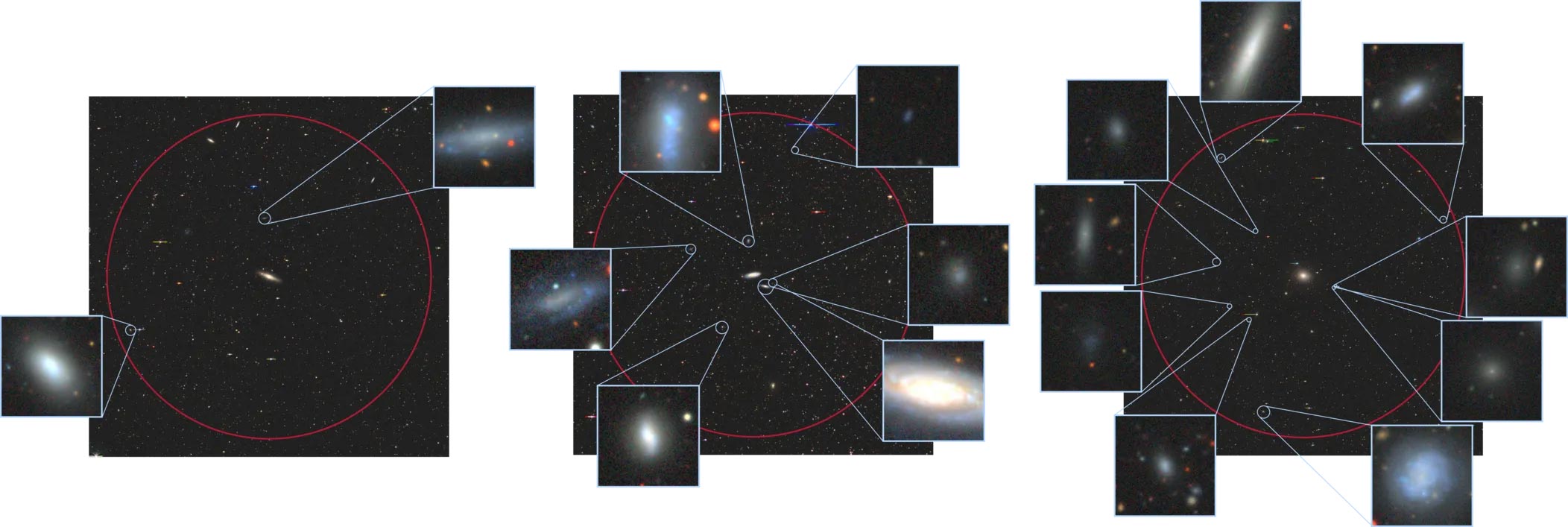
To explore this question, Wechsler co-founded the Satellites Around Galactic Analogs (SAGA) Survey, a project focused on identifying galaxies similar in size and mass to the Milky Way. After more than a decade of observations, the SAGA team analyzed 101 Milky Way-like galaxies as a first step in their ongoing research. Their findings, published in three studies in The Astrophysical Journal, reveal that the Milky Way’s evolutionary history differs in key ways from other galaxies of similar size.
“Our results show that we cannot constrain models of galaxy formation just to the Milky Way,” said Wechsler, who is also a professor of particle physics and astrophysics at the SLAC National Accelerator Laboratory. “We have to look at that full distribution of similar galaxies across the universe.”
In addition to Wechsler, the SAGA project is led by Professor Marla Geha at Yale University and Yao-Yuan Mao, Wechsler’s former doctoral student at Stanford, now an assistant professor at the University of Utah. All three co-authored the newly published studies.
Exploring Dark Matter’s Role
The Milky Way is made of ordinary atomic matter, like hydrogen and iron. But ordinary matter only accounts for about 15% of matter in the universe. The remaining 85% is mysterious, invisible dark matter.
“No one knows what dark matter is made of,” Wechsler said. “It doesn’t interact with ordinary matter or light. There’s probably dark matter running through you right now and you don’t even know it.”
Studies show that galaxies form inside massive regions of dark matter called halos. A dark matter halo may be invisible, but its enormous size creates a gravitational force strong enough to pull in ordinary matter from space and transform it into stars and galaxies.
Insights from Satellite Galaxies
A key objective of the SAGA Survey is to determine how dark matter halos impact galactic evolution. To begin, the SAGA team focused on galactic satellites—small galaxies that orbit much larger host galaxies like the Milky Way. The researchers identified four of the Milky Way’s brightest satellite galaxies, including the two biggest, known as the Large and Small Magellanic Clouds (LMC and SMC). The scientists then conducted a painstaking search for satellites around other host galaxies similar in mass. Using telescopic imaging, they eventually identified 378 satellite galaxies surrounding 101 Milky Way-like hosts.
“There’s a reason no one ever tried this before,” Wechsler said. “It’s a really ambitious project. We had to use clever techniques to sort those 378 orbiting galaxies from thousands of objects in the background. It’s a real needle-in-the-haystack problem.”
Uncovering Anomalies in Galactic Satellites
In one[1] of the three new SAGA studies, researchers found that the number of satellites per host galaxy ranges from zero to 13. The Milky Way’s four observable satellites fit within that range.
The study also revealed that host galaxies with large satellites, similar in size to the Milky Way’s massive LMC and SMC galaxies, tend to have more satellites overall. But the Milky Way actually hosts fewer satellites than similar galaxies, making it an outlier among its peers.
A second study[2] focused on star formation in satellite galaxies—an important metric for understanding how galaxies evolve. The study found that in a typical host galaxy, smaller satellites are still forming stars. But in the Milky Way, star formation only occurs in the massive LMC and SMC satellites. All the smaller satellites have stopped forming stars.

The Dark Matter Puzzle
“Now we have a puzzle,” Wechsler said. “What in the Milky Way caused these small, lower-mass satellites to have their star formation quenched? Perhaps, unlike a typical host galaxy, the Milky Way has a unique combination of older satellites that have ceased star formation and newer, active ones—the LMC and SMC—that only recently fell into the Milky Way’s dark matter halo.”
The study also found that star formation typically stops in satellite galaxies located closer to the host, perhaps because of the gravitational pull of dark matter halos in and around the host galaxy.
“To me, the frontier is figuring out what dark matter is doing on scales smaller than the Milky Way, like with the smaller dark matter halos that surround these little satellites,” Wechsler said.
Advancements in Galaxy Formation Models
The third study,[3] led by Stanford doctoral scholar Yunchong “Richie” Wang, compares the new data to computer simulations and calls for the development of a new model of galaxy formation based in part on the SAGA Survey.
“SAGA provides a benchmark to advance our understanding of the universe through the detailed study of satellite galaxies in systems beyond the Milky Way,” Wechsler said. “Although we finished our initial goal of mapping bright satellites in 101 host galaxies, there’s a lot more work to do.”
References:
- “The SAGA Survey. III. A Census of 101 Satellite Systems around Milky Way–mass Galaxies” by Yao-Yuan Mao, Marla Geha, Risa H. Wechsler, Yasmeen Asali, Yunchong Wang, Erin Kado-Fong, Nitya Kallivayalil, Ethan O. Nadler, Erik J. Tollerud, Benjamin Weiner, Mithi A. C. de los Reyes and John F. Wu, 18 November 2024, The Astrophysical Journal.
DOI: 10.3847/1538-4357/ad64c4 - “The SAGA Survey. IV. The Star Formation Properties of 101 Satellite Systems around Milky Way–mass Galaxies” by Marla Geha, Yao-Yuan Mao, Risa H. Wechsler, Yasmeen Asali, Erin Kado-Fong, Nitya Kallivayalil, Ethan O. Nadler, Erik J. Tollerud, Benjamin Weiner, Mithi A. C. de los Reyes, Yunchong Wang and John F. Wu, 18 November 2024, The Astrophysical Journal.
DOI: 10.3847/1538-4357/ad61e7 - “The SAGA Survey. V. Modeling Satellite Systems around Milky Way–Mass Galaxies with Updated UniverseMachine” by Yunchong Wang, Ethan O. Nadler, Yao-Yuan Mao, Risa H. Wechsler, Tom Abel, Peter Behroozi, Marla Geha, Yasmeen Asali, Mithi A. C. de los Reyes, Erin Kado-Fong, Nitya Kallivayalil, Erik J. Tollerud, Benjamin Weiner and John F. Wu, 18 November 2024, The Astrophysical Journal.
DOI: 10.3847/1538-4357/ad7f4c
Wechsler is also director of the Kavli Institute for Particle Astrophysics and Cosmology jointly operated by Stanford and SLAC.
Funding for the SAGA Survey was provided by the National Science Foundation, the Heising-Simons Foundation, and Stanford.
Never miss a breakthrough: Join the SciTechDaily newsletter.
Follow us on Google and Google News.
10 Comments
thank you
Curious article
Certainly the people who live on a place called “Earth” are freaks, so that comes as no surprise.
Well, the dark matter seems supernatural.
Realize the real lies of reality
Or maybe, everything we’re observing is not only physically distant, speeding up, and manipulated by unseen forces, but aren’t even in the current states we observe them in, something like relative conscious superpositioning, where everything exists in a state of infinite probability that becomes more solidfied into reality with the force of conscious awareness (which is an arguably natural force of the universe, if we can perform tests of which a conscious observer effects the results of the same way every time, should be leading more studies that would differentiate between shaping forces (like consciousness, radiation, physical distribution of innert forces through interaction, and innert forces that active forces shape from the infinite probability matrix into a manifested structured reality)
For all we know, we observe red shift and signs of early development because in this undetermined state of relative superpositioning, the universe is entirely light, but not in the sense of a photon that is consciously shaped from the photon energy field that we know, but the consious light of awareness that was created when the universe became self aware. We have such misunderstandings of everything because of relative context to information and how it can be perceived in a multitude of ways according to the structure of the intelligence observing it.
To claim, without evidence, that the universe has consciousness requires blind faith.
This is for informational purposes only. For medical advice or diagnosis, consult a professional.
It’s true that recent findings from the SAGA Survey suggest that the Milky Way might be an outlier among other galaxies of similar size and mass. This means that our galaxy might not be as typical as we once thought, which has significant implications for our understanding of dark matter and galaxy evolution.
Here are some key findings from the SAGA Survey:
The Milky Way has fewer satellite galaxies than other similar galaxies.
Star formation in the Milky Way’s satellite galaxies is different from that in other galaxies.
The Milky Way’s satellite galaxies are older and less active than those in other galaxies.
These findings suggest that the Milky Way’s evolutionary history is different from that of other galaxies, and that we may need to revise our models of galaxy formation to account for this.
The SAGA Survey is an ongoing project, and we can expect to learn more about the Milky Way and other galaxies in the years to come.
reading works
We are missing something.
Like all previous scientific biases in human history, only a radically creative new way of thinking or a dogma-crushing discovery will force a change in how we interpret observations of the universe.