
Close Menu
    Facebook X (Twitter) Instagram
    SciTechDaily
    • Biology
    • Chemistry
    • Earth
    • Health
    • Physics
    • Science
    • Space
    • Technology
    Facebook X (Twitter) Pinterest YouTube RSS
    SciTechDaily
    Home»Space»Unlocking Space Secrets: How ISS Research Is Transforming Health and Robotics
    Space

    Unlocking Space Secrets: How ISS Research Is Transforming Health and Robotics

    By NASADecember 12, 2024No Comments4 Mins Read
    Facebook Twitter Pinterest Telegram LinkedIn WhatsApp Email Reddit
    Share
    Facebook Twitter LinkedIn Pinterest Telegram Email Reddit
    Astronaut Suni Williams Checks Out the Astrobee Robotic Free-Flyer
    NASA astronaut and Expedition 72 Commander Suni Williams checks out the Astrobee robotic free-flyer in the Kibo laboratory module outfitted with tentacle-like arms containing gecko-like adhesive pads to demonstrate satellite capture techniques. Development of this robotic technology may increase the life span of satellites and enable the removal of space debris. Credit: NASA

    Researchers aboard the International Space Station (ISS) focused on three major areas of advanced research on Wednesday: disease detection, cellular immunity, and free-flying robotics.

    Meanwhile, the Expedition 72 crew prepared for the year’s final spacewalk while awaiting the departure of a U.S. cargo spacecraft.

    Genetic Research and Health Monitoring in Space

    On Earth, scientists are leveraging the ISS’s microgravity environment to improve methods for detecting genetic mutations and viruses linked to diseases like cancer. This research could benefit both astronauts and people on Earth. NASA Flight Engineer Don Pettit worked in the Harmony module’s maintenance area, processing RNA samples for visualization using a handheld fluorescence viewer. The goal is to rapidly identify genetic sequences that impact human health, aiding future missions to the Moon, Mars, and beyond.

    NASA Flight Engineer Nick Hague began his day collecting his blood and saliva samples. He processed the specimens and stowed some of the samples in a science freezer and placed others inside the Kubik research incubator for later analysis. Doctors will study the samples to understand and prevent space-caused cellular stress and tissue damage. Hague also took off the Bio-Monitor headband and vest and downloaded the health data collected over two days from the biomedical wearables.

    Tashkurgan River in Western China From Space
    The Tashkurgan River in western China’s Hindu Kush mountains near the nations of Tajikistan and Afghanistan is pictured from the International Space Station as it orbited 259 miles above Asia. Credit: NASA

    Robotic Operations and Material Science Experiments

    Working in the Kibo laboratory module, NASA Flight Engineer Butch Wilmore outfitted the toaster-sized Astrobee robotic free-flyer with a small docking mechanism for the Clingers technology demonstration. Engineers on the ground monitored the Astrobee as it tested autonomous navigation, docking, and undocking techniques using the Clingers device. Insights may boost space industry standardization of in-space refueling, repair, and manufacturing operations.

    Spacecraft Management and Upcoming Events

    Station Commander Suni Williams from NASA opened up the Materials Science Laboratory (MSL) inside the Columbus laboratory module troubleshooting its components. The MSL enables safe, high-temperature observations of materials such as metals, polymers, semiconductors, and more in weightlessness to discover new applications and create new materials.

    Mission managers waved off the planned return of a Dragon resupply spacecraft on Thursday, December 12, due to forecasted unfavorable weather conditions at the splashdown site off the coast of Florida. NASA and SpaceX now are targeting Saturday, December 14, for the next undocking opportunity of NASA’s SpaceX 31st commercial resupply services spacecraft.
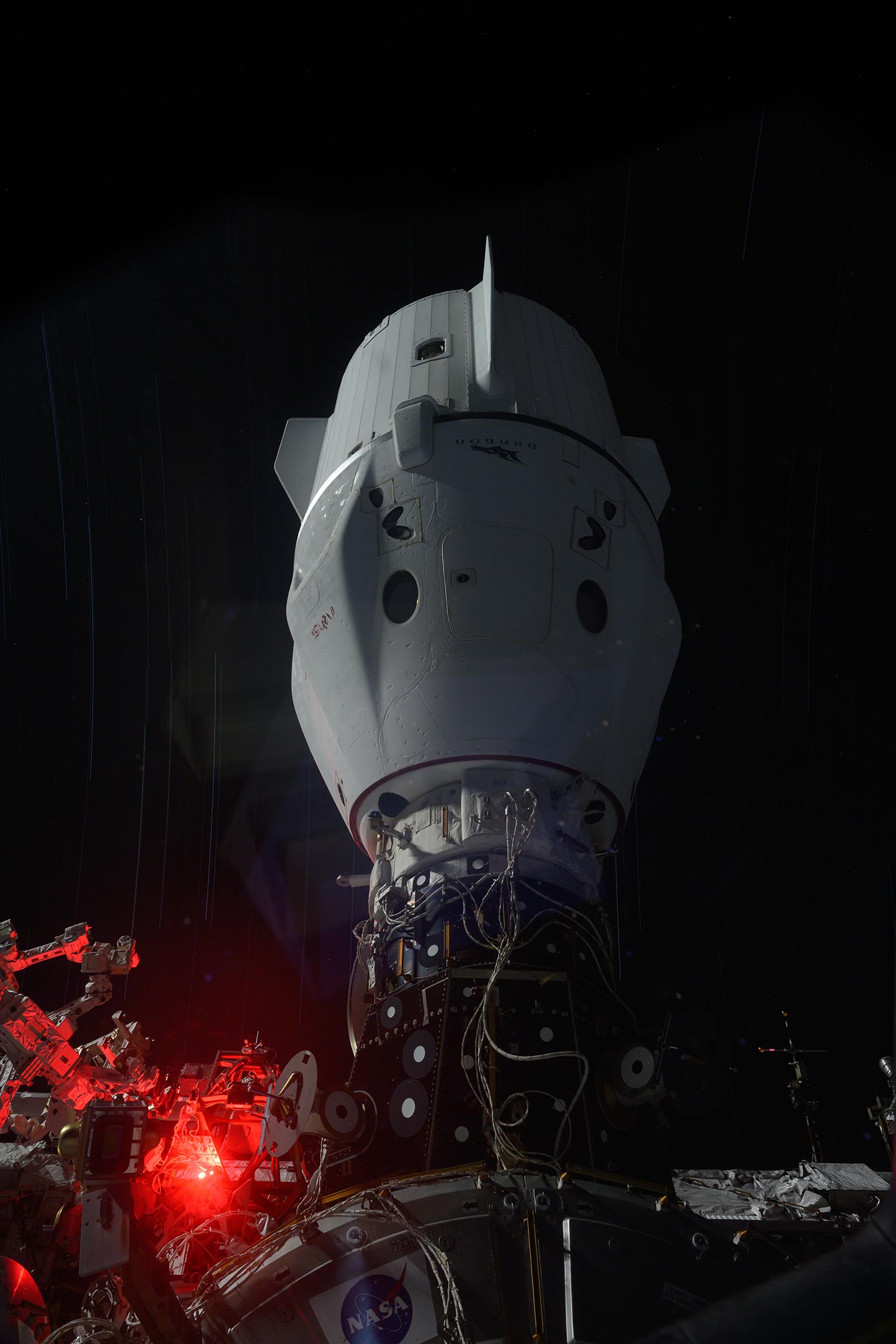
    SpaceX Dragon Endeavour Docked to Harmony Module Wide Vertical
    The SpaceX Dragon Endeavour spacecraft is pictured docked to the International Space Station’s space-facing port on the Harmony module. Endeavour launched four SpaceX Crew-8 members to the orbital outpost including NASA astronauts Matthew Dominick, Mike Barratt, and Jeanette Epps, and Roscosmos cosmonaut Alexander Grebenkin. Credit: NASA

    NASA’s live coverage of Dragon’s undocking and departure begins at 10:50 a.m. EST on NASA+ as the spacecraft autonomously undocks from the Harmony module’s forward port around 11:05 a.m. on Saturday.

    Roscosmos Flight Engineers Alexey Ovchinin and Ivan Vagner continued their spacewalk preparations on Wednesday. The duo checked their suits for leaks, tested communications and medical hardware, and installed spacewalking gear inside the Poisk module. The cosmonauts will exit Poisk into the vacuum of space at 10:10 a.m. EST on Thursday, December 19, and spend about six hours and 40 minutes removing science experiments and relocating robotic hardware.

    Cosmonaut Aleksandr Gorbunov began his day working on video and computer hardware throughout the station’s Roscosmos segment. Afterward, he entered the Nauka science module activating the European robotic arm (ERA) and verifying mission data uploaded to the ERA.

    Never miss a breakthrough: Join the SciTechDaily newsletter.
    Follow us on Google and Google News.

    Astronaut International Space Station NASA SpaceX
    Share. Facebook Twitter Pinterest LinkedIn Email Reddit

    Related Articles

    NASA’s Crew-9 Returns After 286-Day Mission With a Spectacular Splashdown in the Gulf of America

    NASA’s SpaceX Crew-9 Splashes Down Off Coast of Florida

    SpaceX Dragon Undocks With NASA Crew-9 Members for Return to Earth

    Liftoff! NASA’s SpaceX Crew-10 Blasts Off From Kennedy Space Center [Video]

    Rocket Ready: NASA’s SpaceX Crew-10 Set for Liftoff

    NASA’s SpaceX Crew-10 Was Moments From Liftoff – Then a Last-Minute Malfunction Shut It Down

    NASA’s SpaceX Crew-10: Four Astronauts, a 17,500 MPH Rocket, and 200+ Experiments

    No Treadmill, No Problem – NASA’s Space Workout Experiment Could Change Fitness Forever

    NASA and SpaceX’s Unexpected Spacecraft Swap Sends Crew-10 to Space Sooner

    Leave A Reply Cancel Reply

    • Facebook
    • Twitter
    • Pinterest
    • YouTube

    Don't Miss a Discovery

    Subscribe for the Latest in Science & Tech!

    Trending News

    Monster Storms on Jupiter Unleash Lightning Beyond Anything on Earth

    Scientists Create “Liquid Gears” That Spin Without Touching

    The Simple Habit That Could Help Prevent Cancer

    Millions Take These IBS Drugs, But a New Study Finds Serious Risks

    Scientists Unlock Hidden Secrets of 2,300-Year-Old Mummies Using Cutting-Edge CT Scanner

    Bread Might Be Making You Gain Weight Even Without Eating More Calories

    Scientists Discover Massive Magma Reservoir Beneath Tuscany

    Europe’s Most Active Volcano Just Got Stranger – Here’s Why Scientists Are Rethinking It

    Follow SciTechDaily
    • Facebook
    • Twitter
    • YouTube
    • Pinterest
    • Newsletter
    • RSS
    SciTech News
    • Biology News
    • Chemistry News
    • Earth News
    • Health News
    • Physics News
    • Science News
    • Space News
    • Technology News
    Recent Posts
    • Simple Blood Test May Predict Alzheimer’s Years Before Brain Scans Show Signs
    • Scientists Say Adding This Unusual Seafood to Your Diet Could Reverse Signs of Aging
    • U.S. Waste Holds $5.7 Billion Worth of Crop Nutrients
    • Scientists Say a Hidden Structure May Exist Inside Earth’s Core
    • Doctors Surprised by the Power of a Simple Drug Against Colon Cancer
    Copyright © 1998 - 2026 SciTechDaily. All Rights Reserved.
    • Science News
    • About
    • Contact
    • Editorial Board
    • Privacy Policy
    • Terms of Use

    Type above and press Enter to search. Press Esc to cancel.